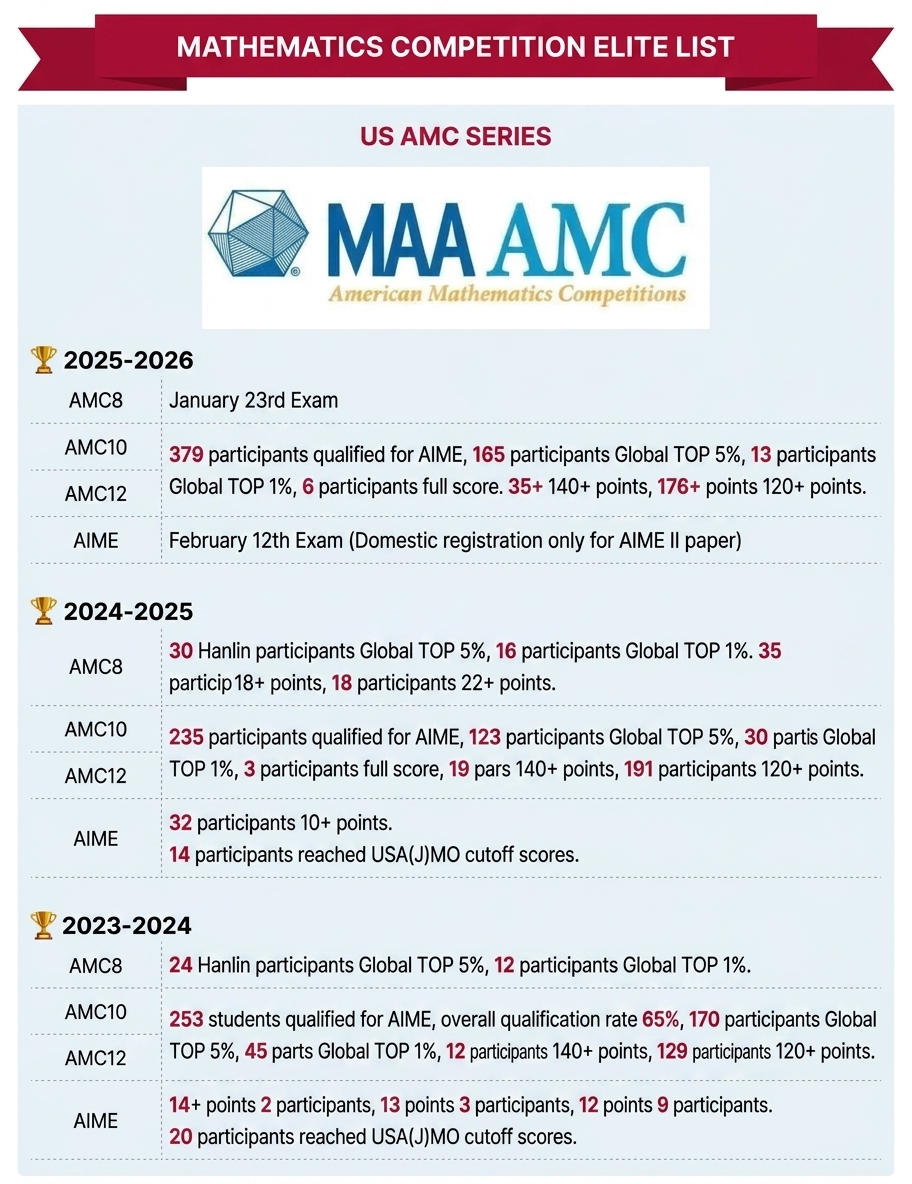
Earning an outstanding score in the AMC8 is a powerful proof of mathematical ability. However, it is only the beginning. For students who aspire to go further on the mathematics competition path, the AMC10 is the next essential milestone and a bridge to top-level competitions such as AIME and USAMO. This article provides a clear roadmap for AMC8 award winners, detailing how to smoothly transition from AMC8 to AMC10 and plan for higher-level competitions.
I. AMC8 vs. AMC10: A Comprehensive Comparison of Core Differences
First, it is crucial to recognize the fundamental differences between the two competitions in terms of positioning, difficulty, and focus of assessment.
| Comparison Dimension | AMC8 | AMC10 |
|---|---|---|
| Positioning & Goal | Stimulates interest in mathematics and tests foundational thinking. A “stepping stone” for middle school transition and early academic ability. | Selects academic potential and challenges higher-order thinking. The “golden ticket” to qualify for AIME and prove mathematical talent, highly regarded by top university admissions officers. |
| Eligibility | Grade 8 or below, and age ≤ 15.5 on the day of the exam. | Grade 10 or below, and age ≤ 17.5 on the day of the exam. |
| Exam Format | 40 minutes, 25 multiple-choice questions. | 75 minutes, 25 multiple-choice questions. |
| Scoring Rules | +1 point for correct answer, 0 points for incorrect or blank. Maximum score: 25 points. | +6 points for correct answer, +1.5 points for blank, 0 points for incorrect. Maximum score: 150 points. |
| Knowledge Scope | Core content from elementary school to 8th grade, including basic algebra, geometry, number theory, and combinatorics. | Expands to include content from middle school through 9th/10th grade, with significantly greater depth and breadth. |
| Thinking Requirements | Focuses on computational accuracy, basic logical reasoning, and direct application of single knowledge points. | Emphasizes integration of knowledge, multi-step logical chains, abstract modeling skills, and problem-solving strategies. |
| Awards & Advancement | Offers Honor Roll awards (e.g., Top 1%, Top 5%). No direct advancement pathway. | The top 2.5%–5% of test-takers qualify for the AIME (American Invitational Mathematics Examination). |
| Typical Score References | Top 1% (DHR): approximately 21–23 points; Top 5% (HR): approximately 17–19 points. | AIME qualification threshold (approx. top 2.5%): approximately 100–110 points; Top 1% (DHR): approximately 130–135 points. |
II. Knowledge Leap: Four Modules You Must Supplement When Transitioning from AMC8 to AMC10
AMC10 is not a simple extension of AMC8, but a comprehensive upgrade of the knowledge system. The table below outlines the content that requires focused study and deepening.
| Knowledge Module | Level in AMC8 | Required Level in AMC10 | Core New/Deepened Knowledge Points |
|---|---|---|---|
| Algebra | Solving linear equations and inequalities, ratio applications, basic sequences. | Complex algebraic operations, function concepts, systems of equations and inequalities. | Polynomial operations and theorems (Vieta’s theorem), properties and graphs of linear/quadratic functions, absolute value equations and inequalities, basic concepts of complex numbers, general term and summation of arithmetic/geometric sequences. |
| Geometry | Basic plane geometry formulas (perimeter, area), Pythagorean theorem, basic similarity. | Complex plane geometry proofs, analytic geometry, comprehensive solid geometry. | Power of a Point theorem, properties of triangle centers (circumcenter, incenter, centroid, orthocenter), Ceva’s theorem and Menelaus’ theorem, equations of lines and circles in the coordinate plane, surface area and volume calculations of solid figures (prisms, pyramids, cylinders, cones). |
| Number Theory | Divisibility, prime factorization, greatest common divisor (GCD) and least common multiple (LCM). | In-depth congruence theory and modular arithmetic applications. | Basic properties of congruence, modular arithmetic, simple applications of Fermat’s Little Theorem, solving linear congruence equations, preliminary concepts of the Chinese Remainder Theorem. |
| Combinatorics & Probability | Basic permutations and combinations (multiplication and addition principles), classical probability. | Advanced counting techniques, conditional probability, and expected value. | Inclusion-exclusion principle, recurrence relations, pigeonhole principle, conditional probability and independent events, calculation of mathematical expectation. |
III. Capability Upgrade: Shifts in Mindset and Preparation Strategy
Beyond knowledge, thinking and strategy must also be upgraded.
| Capability Dimension | AMC8 Preparation Focus | AMC10 Preparation Focus |
|---|---|---|
| Problem-Solving Depth | Single-step or two-step reasoning, direct application of formulas. | Multi-step reasoning with long logical chains, often requiring 3–5 steps, emphasizing “transformation” and “construction” thinking. |
| Integration of Knowledge | Problems typically test a single core knowledge point. | Many problems integrate multiple knowledge points. Cross-module problems combining “algebra + geometry” or “number theory + combinatorics” are common. |
| Time Strategy | 25 questions in 40 minutes. The first 15 questions need to be solved quickly and accurately to leave time for the last 10. | 25 questions in 75 minutes. Time is more abundant, but each question requires deeper thinking. Establish a new rhythm: solve the first 15 steadily (foundation scoring zone), then allocate time wisely to tackle the last 10. |
| Exam Techniques | Relies on basic techniques such as elimination and substitution. | Requires more advanced strategies, such as symmetry analysis, invariants, and extremal principle. Additionally, due to the rule that “blank answers receive 1.5 points”, more scientific skipping strategies are needed. |
IV. Transition Pathways and Timeline Planning
Based on your current level (as measured by your AMC8 score) and your goals, you can choose different transition pacing.
| Current Level (AMC8 Score) | Recommended Transition Pathway | Core Tasks and Timeline | Goal Setting |
|---|---|---|---|
| Below 17 points | Consolidate foundation, warm up simultaneously | Now – June 2026: Systematically review AMC8 mistakes. Solidify all concepts including integers, fractions, ratios, and basic geometry. Ensure zero calculation errors. July – August 2026 (Summer): Begin learning core new AMC10 modules (as in the table above), focusing on understanding concepts and solving intermediate-level problems. September – October 2026: Conduct focused topic training for AMC10 and start working on early years’ past papers. |
Target AMC10 score: 90–100 points (aim for Achievement Award for younger students). Next steps: Based on October mock exam results, decide whether to continue preparing for the following January’s AMC8 (if age permits) to achieve a higher award. |
| 18–21 points (Top 5%) | Steady transition, focused breakthrough | Now – June 2026: While maintaining AMC8 proficiency, begin self-studying or systematically learning new AMC10 algebra and geometry content. July – August 2026 (Summer): Complete the first round of studying all AMC10 knowledge modules and begin focused problem-solving by module. September – October 2026: Move into full-paper simulation and timed practice. Focus on conquering AMC10 intermediate-level questions (questions 11–20). |
Core goal: Qualify for AIME (approximately 100–110 points). Next steps: If the November AMC10 score meets the AIME threshold, immediately begin AIME preparation. |
| 22 points or above (Top 1%) | Accelerate advancement, aim for AIME | Now – June 2026: Quickly review new AMC10 knowledge points, devoting more energy to high-difficulty comprehensive problems. July – August 2026 (Summer): Directly begin focused training on AMC10 challenging problems (questions 21–25) and attempt some problems at the difficulty level of AIME I (first 5 questions). September – October 2026: Conduct intensive mock exams with the goal of consistently scoring above the AIME qualification threshold. Begin preliminary familiarization with AIME problem types and thinking patterns. |
Target: Qualify for AIME with a high score (120+). Next steps: After the November exam, regardless of the outcome, immediately begin full preparation for the AIME in February 2027. |
V. Reaching the Peak: From AMC10 to AIME and Higher-Level Competitions
Successfully qualifying for AIME through the AMC10 opens the door to an entirely new competitive arena.
| Competition Level | AIME (American Invitational Mathematics Examination) | USA(J)MO (United States of America Mathematical Olympiad) |
|---|---|---|
| Positioning | An intermediate-to-advanced competition in the AMC series, a critical step in selecting the US Mathematical Olympiad team. | The highest-level middle school mathematics competition in the United States. Top performers enter the IMO (International Mathematical Olympiad) national training camp. |
| Eligibility | Approximately top 2.5% in AMC10 or top 5% in AMC12. .=Determined by total score based on the formula: AMC score + 20 × AIME score (new rule effective 2026). | |
| Exam Format | 3 hours, 15 short-answer questions, all answers are integers between 0 and 999. Calculators are not permitted. | Two days, 4.5 hours per day, 3 proof-based questions per day. Tests mathematical proof and problem-solving skills in depth. |
| Difficulty & Characteristics | Significantly more difficult than AMC10/12. No multiple-choice options; requires solid ability. Questions 1–5 are comparable to AMC12 challenging problems; questions 6–10 require integrated knowledge; questions 11–15 are extremely challenging. | Pure proof-based questions, requiring rigorous mathematical language and logical derivation. The depth of knowledge and creativity required reaches the Olympiad level. |
| 2026 Key Dates | AIME II: February 12, 2026 (for international candidates). .=Typically held approximately one month after AIME. |
Important Rule Change: Starting in 2026, the weight of the AIME score in the USA(J)MO qualification formula has been doubled, from 10x to 20x. This means that performance on the AIME has become more important than ever for advancing to top-tier competitions.
VI. Summary and Final Recommendations
Assess your situation, choose your path: Based on your AMC8 score and grade, refer to the tables above to select the most suitable transition pace. Avoid blind overreaching or stagnation.
Learn systematically, fill your gaps: Use extended periods of time such as summer break to systematically study new AMC10 knowledge points, especially the algebra functions and geometry proofs sections.
Use past papers as your guide, simulate real exams: Use official AMC10 past papers as your core learning material. Familiarize yourself with the question types, pacing, and difficulty distribution through timed mock exams.
Be goal-oriented, adjust dynamically: Set clear stage-by-stage goals (e.g., an AMC10 score target) and adjust your learning focus based on mock exam results.
Think long-term, plan coherently: View the AMC10 as a necessary step toward the AIME. Once you qualify for AIME, immediately devote yourself to preparation, leveraging the increased weight of AIME scores under the new rules.
Moving from AMC8 to AMC10 is a transformation from an “enthusiast” to an “academic competitor.” This path is filled with challenges, but also rich with opportunities. Clear planning, solid effort, and the right strategies will help you steadily climb the mathematics competition ladder and reach your own peak.
AMC8 Preparation Courses
Our instructors are graduates from top global universities. With precise curriculum planning and comprehensive learning tracking, we ensure your score improvement and award-winning success!
| Class Type | Hours | Class Size | Start Date |
|---|---|---|---|
| Winter Break Class | 30H | 3–8 students | Consult teacher for details |
| Systematic Course | 20H | 1v1 / 3–8 students | Consult teacher for details |
| Problem-Solving Class | 20H | 1v1 / 3–8 students | Consult teacher for details |