Since its inception in 1985, the AMC8 – designed for students in grade 8 and below – has become an important benchmark for measuring the mathematical abilities of young people worldwide. In recent years the AMC8 syllabus has trended toward integration and real-world application. Let us now analyze the exam in full detail to help pave the way for your competition journey! (Note: the scoring rule is unchanged — 1 point per correct answer, 0 for a wrong or blank answer, no penalty.)
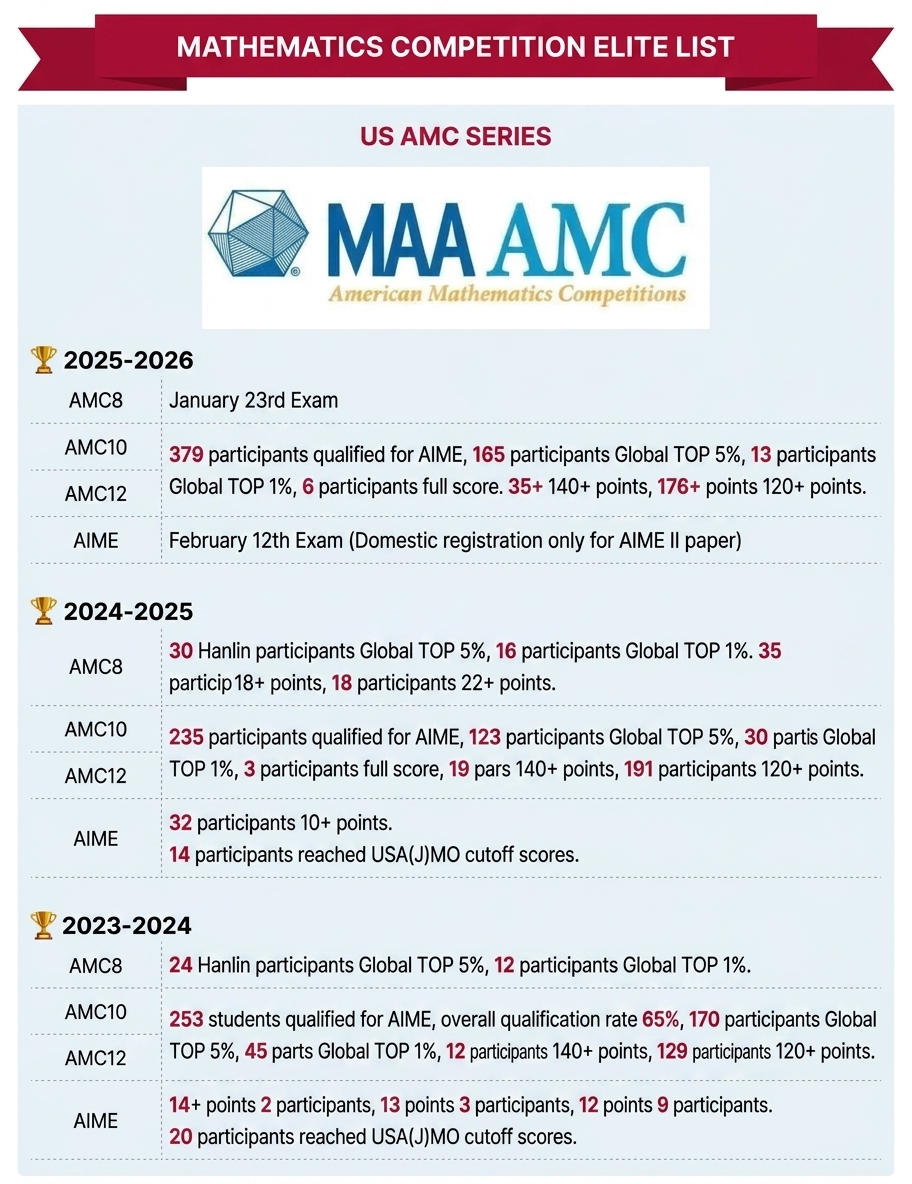
I. Exam Changes
In recent years the AMC8, created by the Mathematical Association of America (MAA), has seen its question style evolve, with adjustments mainly in the syllabus content and problem design. The scoring rule, however, is unchanged.Exam Format
In mainland China the AMC8 is offered in both an on-campus (offline) paper-based format and a home-based (online) format. Candidates may choose to take the exam either online or offline based on their individual circumstances. This change means that candidates need to confirm in advance whether their school is an officially certified in‑person test center. Students from non‑partner schools must register through officially authorized proxy registration agencies.Exam Time
The AMC8 is taken in a single 40-minute window in January. Confirm the exact start time for your session against the official schedule for the current season.Syllabus Content
The AMC8 syllabus has trended toward integration and innovation, with overall question types as follows for each module: Algebra & Probability (40%–45%): Newly added real‑world applications of quadratic function modeling; probability question types integrated with business scenarios. Geometry (25%–30%): Introduction of dynamic analysis of 3D nets; integration of the Pythagorean theorem with building structural stability problems. Number Theory & Combinatorics (20%–25%): Difficulty of prime factorization has increased, requiring quick factorization of four‑digit integers. The AMC8 question design exhibits a distinct “interdisciplinary integration” characteristic. The average text length of problem statements has increased by 45% compared to 2020, incorporating unstructured information such as charts and business data. Problem backgrounds often involve cutting‑edge fields such as smart cities and carbon neutrality, marking a strategic shift from “problem‑solving techniques” to “real‑world modeling ability.”II. Competition Details
Eligibility: Students in grade 8 (second year of junior high) or below, and must be no older than 15.5 years old on the day of the competition. There are no nationality restrictions; eligible students from around the world may participate. However, there are special regulations regarding the registration method. Registration: The AMC8 uses a unified registration system through schools or authorized institutions. Individual direct registration is not permitted. Students from partner schools can register through their school. Non‑partner school students must register through officially authorized proxy agencies, providing materials such as ID number and proof of grade. Registration closes a few weeks before the exam each January. Because proxy registration deadlines are generally earlier than the official cutoff, it is recommended that students planning to participate start preparations as early as possible.The 2026 AMC8 registration channel is now open! We are an officially authorized AMC8 in‑person & online test center. Scan the QR code to receive the registration form and free proxy registration!
Exam Structure: The competition includes 25 multiple‑choice questions, with an exam duration of 40 minutes, averaging only 1.6 minutes per question. The scoring method awards 1 point per correct answer, with a maximum score of 25 points. Unanswered or incorrect questions receive 0 points (no penalty). The difficulty of the questions follows a gradient design:
Basic questions (1–10): Test basic mathematical concepts and computational ability.
Intermediate questions (11–20): Require a certain level of mathematical thinking and problem‑solving techniques.
Challenging questions (21–25): Challenge students’ comprehensive mathematical ability and innovative thinking.
Exam Schedule Overview:
| Item | Date/Time |
|---|---|
| Registration Deadline | About 10 days before the exam each January |
| Official Exam Date | A single 40-minute window in January (the next sitting is in January 2027) |
| Score Release | 2–4 weeks after the exam |
| Certificate Download | 6–8 weeks after the exam |
III. Award Categories
The AMC8 has established a multi‑level awards system to encourage students of different levels to continue exploring the wonders of mathematics. Global Perfect Score Award: Awarded to students who achieve a perfect score of 25 points. This is the highest recognition of mathematical ability. Global Distinguished Honor Roll: Awarded to participants who rank in the top 1% globally, typically requiring 21 or more correct answers. Global Honor Roll: Awarded to participants who rank in the top 5% globally, typically requiring 17 or more correct answers. Global Achievement Roll: Specially awarded to students in grade 6 or below who answer 15 or more questions correctly, encouraging young math enthusiasts. Looking at the historical score cutoffs, the threshold for the top 1% has ranged between 21 and 23 points, reflecting the increasing level of competition year by year.IV. Recommended Preparation Strategy
Foundation Consolidation Phase (From now until 2 weeks before the exam)
Systematically review the four core modules of the syllabus to build a complete knowledge framework. Spend 15–20 minutes each day on speed calculation exercises to strengthen calculation accuracy. Focus on practicing questions 1–15 from past papers to master basic question types and problem‑solving patterns. Maintain a mistake notebook to record and analyze common error types.Skill Enhancement Phase (2–3 weeks before the exam)
Conduct modular review targeted at weak areas, focusing on high‑frequency question types such as similar triangles, remainder problems, and permutations and combinations. Practice solving questions 11–20 using multiple methods to develop flexible thinking. Begin regular timed mock exams to become familiar with exam pace and time allocation strategies.Sprint Phase (1 week before the exam)
Conduct 2–3 full‑length mock exams per week to simulate the real exam environment. Focus on practicing problem‑solving techniques such as elimination, substitution, and special value methods. Review the mistake notebook to avoid repeating errors. Adjust your daily routine before the exam to ensure you are in the best condition.The AMC8 marks a strategic shift from “problem‑solving skills” to “real‑world modeling ability.” We wish all participants the very best and hope you achieve outstanding results!
AMC8 Preparation Courses
Our instructors are graduates from top global universities. With precise curriculum planning and comprehensive learning tracking, we ensure your score improvement and award-winning success!| Class Type | Hours | Class Size | Start Date |
|---|---|---|---|
| Winter Break Class | 30H | 3–8 students | Consult teacher for details |
| Systematic Course | 20H | 1v1 / 3–8 students | Consult teacher for details |
| Problem-Solving Class | 20H | 1v1 / 3–8 students | Consult teacher for details |
Next steps
- Register for the 2026 AMC 8 — through an authorised test centre in China.
- AMC 8 Past Papers (1985–2025) — get the free practice pack and a proven way to use it.