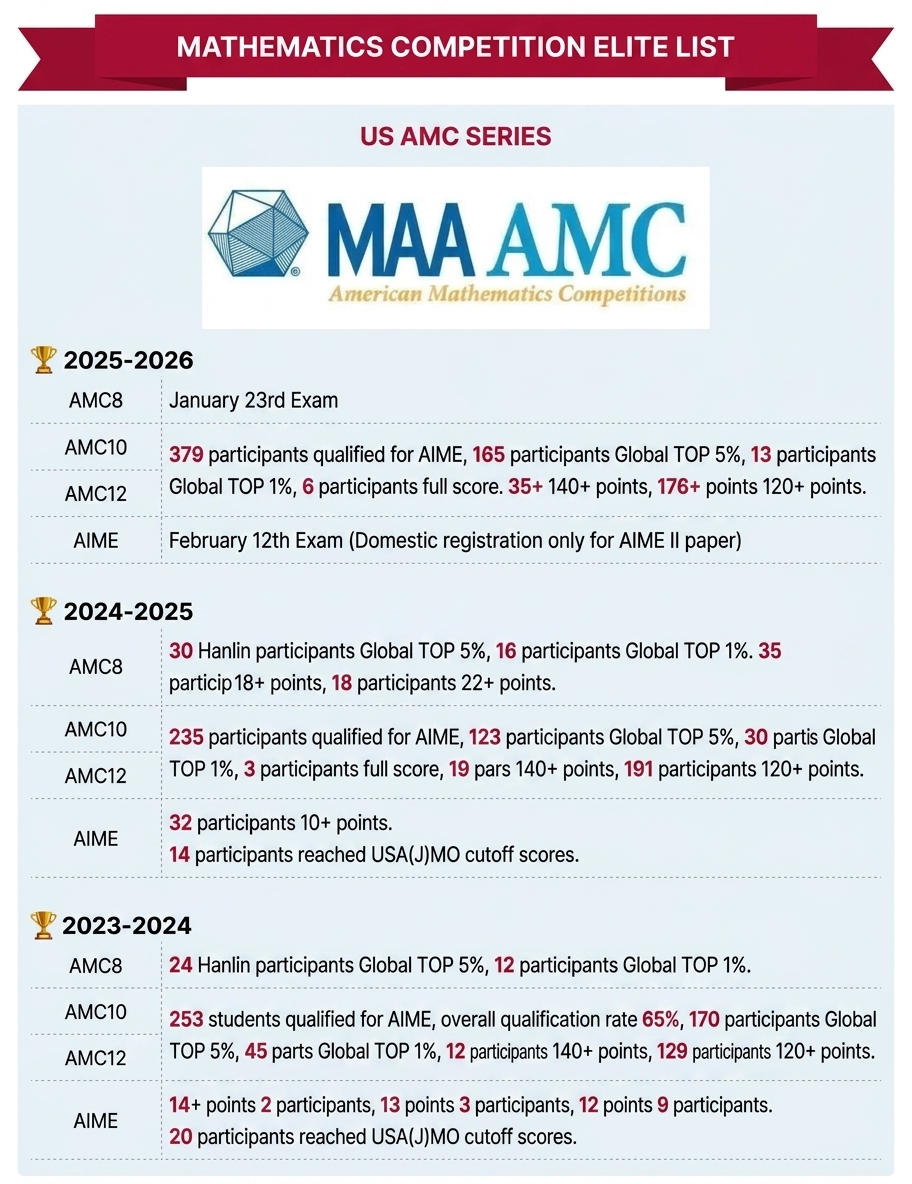
In the AMC8 competition, difficult problems often lie not in computational complexity but in the setting of thinking traps. Even students with strong mathematical abilities often lose points unexpectedly on specific question types. Understanding these error-prone question types and their solution methods not only provides a clear direction for competition preparation but also effectively enhances mathematical thinking skills.
I. Geometry Traps and Solutions
Geometry questions account for about 20%-25% of the AMC8, making it the second largest area of assessment after algebra, and also a major point of lost points.
Analysis of 3D nets has become a frequent high-difficulty topic in recent years. These questions require test-takers to unfold a solid figure into a plane figure, or to imagine the folding process in reverse. Common question types include calculating surface area, volume, or finding the shortest path. To tackle these problems, the “origami method” is one of the most practical techniques: use scratch paper to create a simple model, mark the corresponding vertices, and intuitively understand the correspondence between unfolding and folding.
Calculating the area of lattice point figures is another common pitfall. Test-takers often try to use complex formulas, which not only wastes time but is also error-prone. The “assembly method” works well here: through appropriate cutting and moving, transform irregular figures into combinations of regular shapes.
A trap commonly seen in geometry problems is that “figures are not drawn to scale.” Many test-takers rely on visual estimation, while question setters deliberately provide disproportionate figures to induce incorrect choices. The only way to avoid this trap is to rely entirely on data calculation, not on visual judgment.
II. Thinking Blind Spots in Combinatorics Problems
Combinatorics accounts for about 15%-20% of AMC8 test points. Although there are not many questions, they are relatively difficult and are key differentiators for students aiming for the top 1% awards.
Improper application of the Inclusion-Exclusion Principle is a common mistake. When problems involve the intersection and union of multiple sets, test-takers tend to double-count or miss certain cases. For example, problems asking “at least one” often require the “total minus complement” method rather than direct addition.
The difficulty of permutation and combination problems lies in the completeness of case classification. Test-takers often have logical loopholes when determining classification criteria, resulting in some cases being omitted or double-counted. When tackling such problems, classification must follow a unified standard, and after completion, check whether the categories are mutually exclusive and complete.
Another characteristic of combinatorics problems is that the solution methods are flexible and varied. Once you fall into the trap of reverse thinking, it is very easy to make mistakes. After mastering the basic computational methods, you still need to become familiar with various problem variations through extensive practice.
III. Hidden Difficulties in Number Theory Problems
Number theory problems account for about 10%-15% of the AMC8. Although the proportion is not large, there are many concepts, and students are prone to confusion.
Divisibility judgment is a common point of lost points. When dealing with divisibility judgment involving large numbers, direct calculation is extremely time-consuming. At this point, you should master the rules of divisibility, such as the characteristics of divisibility by 2, 3, 5, 9, etc., which can greatly simplify the problem.
The difficulty of remainder problems lies in discovering cyclic patterns. For example, the problem “What is the remainder when 3¹⁰⁰ is divided by 7?” seems complex, but it can be solved quickly by finding the cycle of remainders. Starting with simple numbers, identifying the pattern, and then applying it to complex problems is an effective strategy.
Problems related to prime factorization have increased in difficulty in recent years, especially when combined with place value principles. Solving such problems requires proficiency in determining prime numbers and knowing how to find the greatest common divisor (GCD) and least common multiple (LCM) through prime factorization.
IV. Misunderstandings and Breakthroughs in Word Problems
Word problems in the AMC8 often have lengthy statements and complex relationships, and test-takers are prone to errors in understanding the problem context.
Concepts related to percentages are common sources of confusion. In particular, misunderstandings of keywords such as “growth rate” vs. “growth amount” and “percentage” vs. “specific value” directly lead to incorrect equation setups. Circling keywords while reading is an effective way to avoid this.
Multi-step real-world problems require converting textual descriptions into mathematical expressions. For example, mixture concentration problems and travel problems require setting up unknown variables to establish equations or systems of equations.
Given the large amount of information in the problem statements, the charting method is highly effective. As you read, represent the data relationships with charts to intuitively understand the problem’s intent and avoid missing information or misinterpretation.
V. Typical Errors in Algebraic Operations
Algebra accounts for the largest proportion of the AMC8, about 40%-50%, so performance on algebra questions significantly affects the overall score.
Simplification of complex algebraic expressions often involves sign errors or missing terms. Especially when skipping steps, negligence in intermediate processes leads to final errors. Writing the calculation process in steps and underlining key results can effectively prevent such mistakes.
Sequences and pattern recognition problems require identifying patterns in numbers or algebraic expressions. A common mistake is hastily generalizing a pattern after observing only the first few terms without verifying subsequent terms. The correct approach is to write out at least the first six terms before analyzing the pattern.
The substitution of special values is a powerful tool for solving algebraic multiple-choice questions. When a problem asks to compare the magnitudes of several unknown quantities, and both the quantities and their relationships are unknown, choosing appropriate special values for substitution can quickly eliminate incorrect options or obtain the correct answer.
VI. Effective Time Management and Answering Strategies
The time pressure of completing 25 questions in 40 minutes is immense, and improper time allocation is a major reason many students fail.
The stratified problem-solving approach is an effective strategy for dealing with time pressure. Divide the questions into three levels:
Basic level (Questions 1-10): Limit to 8 minutes, ensuring 100% accuracy.
Intermediate level (Questions 11-20): Allocate 15 minutes.
Challenge level (Questions 21-25): Reserve 17 minutes, prioritizing problem types you can solve.
When encountering a difficult problem, skip and mark is a key strategy. Spend no more than 1 minute looking for a solution approach. If you have no idea, mark it and move on to avoid losing points on easier questions.
Cross-verification can improve answer accuracy. If time permits, use different methods to verify your answers, such as substitution, special value testing, or checking digit patterns.
For students aiming for the top 5%, ensuring the accuracy of the first 15 questions is crucial. These questions are relatively basic and form the foundation of your score. For those aiming for the top 1%, while consolidating the fundamentals, it is essential to focus on conquering difficult problems in combinatorics and number theory.
Avoiding common mistakes in the AMC8 can improve your score more than solving difficult problems themselves. A solid foundation combined with targeted problem-solving strategies is the key to achieving excellent results.
AMC8 Preparation Courses
Our instructors are graduates from top global universities. With precise curriculum planning and comprehensive learning tracking, we ensure your score improvement and award-winning success!
| Class Type | Hours | Class Size | Start Date |
|---|---|---|---|
| Winter Break Class | 30H | 3–8 students | Consult teacher for details |
| Systematic Course | 20H | 1v1 / 3–8 students | Consult teacher for details |
| Problem-Solving Class | 20H | 1v1 / 3–8 students | Consult teacher for details |