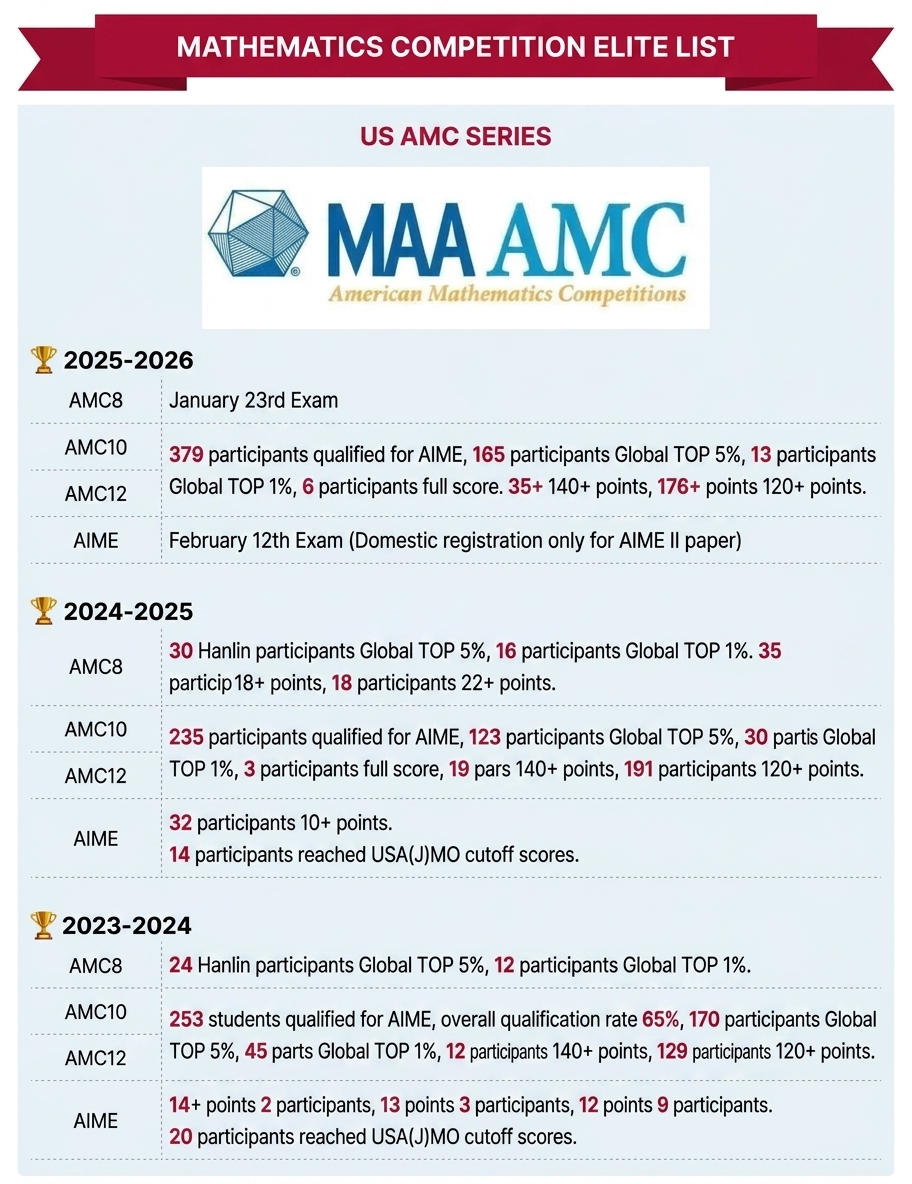
For students and parents planning to participate in math competitions, AMC8 and Math Kangaroo are two frequently mentioned popular options. They have vastly different styles and suit students with different goals and characteristics. This article provides a comprehensive comparison of these two competitions across multiple dimensions, offering clear advice to help you make the most suitable decision.
I. Core Overview and Basic Information Comparison
| Comparison Dimension | AMC8 (American Mathematics Competition 8) | Math Kangaroo |
|---|---|---|
| Organizer & Origin | Hosted by the Mathematical Association of America (MAA), founded in 1985, the entry point of the American mathematics competition system. | Originated in Australia, founded in 1991, now organized by member countries worldwide, one of the largest youth math competitions globally. |
| Core Positioning | Academic and selective; the entry-level event in the American mathematics talent selection system (AMC → AIME → USAMO → IMO). | Fun and accessible; aims to stimulate students’ interest in mathematics and showcase the fun and practical value of math. |
| Exam Date | Once a year in January (next: January 2027 season). | Once a year, typically in March. |
| Eligibility | Grade 8 and below, and age ≤ 15.5 on the day of the exam. | Grades 1–12, divided into 6 levels (Levels 1–6); students may choose a level equal to or higher than their current grade. |
| Exam Format | Both online and offline. 25 multiple-choice questions, 40 minutes. | Primarily online computer-based. Depending on the level, 24 or 30 multiple-choice questions, 75 minutes. |
| Scoring Rules | 1 point for each correct answer, 0 points for incorrect or unanswered; maximum score 25. | Points are awarded for correct answers, 1 point deducted for incorrect answers, no deduction for unanswered questions. Point values increase with question difficulty (3/4/5 points); maximum score 120 or 150. |
II. In-Depth Comparison: Question Types, Content, and Difficulty
This is where the two competitions differ most significantly, directly determining different preparation strategies.
| Comparison Dimension | AMC8 | Math Kangaroo |
|---|---|---|
| Question Types & Content Focus | Knowledge-system oriented, strictly aligned with core middle school math modules. • Algebra & Probability (40%-45%): Quadratic function modeling, real-world probability. • Geometry (25%-30%): Analysis of 3D nets, real-world applications of the Pythagorean theorem. • Number Theory & Combinatorics (20%-25%): Prime factorization, geometric sequence sums, using short division to find GCD/LCM. |
Thinking and fun oriented, emphasizing logic, spatial imagination, and mathematical applications. • Visual/Spatial (30%-42%): Figure movement, 3D views, spatial orientation. • Mathematical Logic (25%-38%): Logical reasoning, conditional analysis, pattern recognition. • Applications & Fun Problems (approx. 45%): Integrating math into everyday scenarios like shopping, games, and mazes. |
| Question Style | Problem statements are longer, incorporating real-world contexts and emphasizing mathematical modeling and problem-solving. The logical chain is long, and the difficulty spikes sharply in the last 5 questions. | Questions are vivid, interesting, illustrated, and close to life. They aim to test observation, creativity, and the ability to apply mathematical knowledge in games. |
| Overall Difficulty | Relatively high, with a clear selective nature. The difficulty gradient is well-designed; the last 5 questions (21–25) aim to distinguish top students and have low accuracy rates. | Wide range, but low starting point. Difficulty increases with question number. The first third of questions are very basic, designed to encourage all participants; the last third are challenging and differentiate agile thinkers. |
| Typical Trends | Greater emphasis on interdisciplinary integration and higher-order logical reasoning. Note: AMC 8 is multiple-choice only and scored 1 point per correct answer (0 for wrong or blank, no penalty) — there is no process or step-based grading. | Enhanced interdisciplinary integration (e.g., introducing environmental science scenarios); more anti-routine designs, fewer patterned question types, and more multi-step reverse inference problems. |
III. Comparison: Value, Awards, and Impact on Further Education
| Comparison Dimension | AMC8 | Math Kangaroo |
|---|---|---|
| Award Structure | Global awards are determined by score cutoffs: • Distinguished Honor Roll (DHR): Top 1% globally • Honor Roll (HR): Top 5% globally • Achievement Roll (AR): High-scoring younger participants (usually around 15 points). |
China region awards are determined by ranking percentages: • Super Gold: Top 3% • Gold: Top 10% • Silver: Top 20% • Bronze: Top 35% • Math Skills Award: Additional top 25% within each region. |
| International Recognition | Extremely high; recognized as an authoritative benchmark for middle school math competitions in North America and globally. A significant advantage when applying to top U.S. high schools and undergraduate STEM programs. | Widespread; due to its large participation numbers (over 90 countries), the certificate is generally recognized internationally and particularly reflects a student’s interest in mathematics and flexible thinking. |
| Impact on Further Education | High scores in AMC8 (especially top 1% or 5%) are strong proof of academic ability when applying to top secondary schools and universities in the U.S., Canada, etc., and serve as a stepping stone to advanced competitions like AIME. | As a broadly accessible competition, its awards effectively demonstrate a student’s interest in math and overall quality, making it especially suitable as a starting point for younger students’ competition journey. It has auxiliary value for applications to schools emphasizing holistic development. |
| Core Value | A hard proof of academic ability, focusing on depth, difficulty, and academic potential. | A demonstration of passion for math and soft thinking skills, focusing on breadth, fun, and applicability. |
IV. How to Choose? Participation Advice Comparison Table
Choosing which competition to participate in depends largely on the student’s age, math level, long-term goals, and personal characteristics.
.=Outstanding math talent, eager to challenge high difficulty
| Your Situation | Top Recommendation | Main Reasons |
|---|---|---|
| Early elementary students (Grades 1-4) | Math Kangaroo | Questions are fun and can greatly protect and develop a child’s interest in math. The level system (Levels 1-2) suits younger beginners, and Chinese reading is available. |
| Planning to apply to top secondary schools or universities in North America, with a solid math foundation | AMC8 | AMC8 scores carry significant weight in the North American academic evaluation system and are key proof of academic competitiveness. |
| Average math foundation, wanting to cultivate interest and build confidence | Math Kangaroo | The competition has a low starting point, with the first third of questions being relatively simple, making it easy to gain a sense of accomplishment. The unique point-deduction mechanism also teaches students to think carefully. |
| Both are viable, with different focuses | AMC8 challenges knowledge depth and difficult problem-solving; Math Kangaroo’s high-point questions (5-point problems) challenge mental agility and creativity. | |
| Limited time and energy, can only prepare for one | Depends on your goal | Short-term goal (enhancing resume): Math Kangaroo has a relatively shorter preparation cycle and a broader award scope (top 35% receive awards). Long-term goal (academic path): Systematic preparation for AMC8 is needed to lay the foundation for subsequent AMC10/12. |
| Want a warm-up for other high-difficulty competitions (e.g., AMC10/12) | Start with Kangaroo, then AMC8 | Use Math Kangaroo to develop competition sense and test-taking mindset, then use AMC8 for in-depth academic training. This is a reasonable step-by-step path. |
Math Kangaroo is more like a “mathematical playground,” welcoming all children to explore the joy of math and encouraging active participants (with a high award ratio). AMC8, on the other hand, is more like a “mathematical gym,” using standardized yet challenging events to measure and select potential “athletes” in mathematics.
AMC8 Preparation Courses
Our instructors are graduates from top global universities. With precise curriculum planning and comprehensive learning tracking, we ensure your score improvement and award-winning success!
| Class Type | Hours | Class Size | Start Date |
|---|---|---|---|
| Winter Break Class | 30H | 3–8 students | Consult teacher for details |
| Systematic Course | 20H | 1v1 / 3–8 students | Consult teacher for details |
| Problem-Solving Class | 20H | 1v1 / 3–8 students | Consult teacher for details |