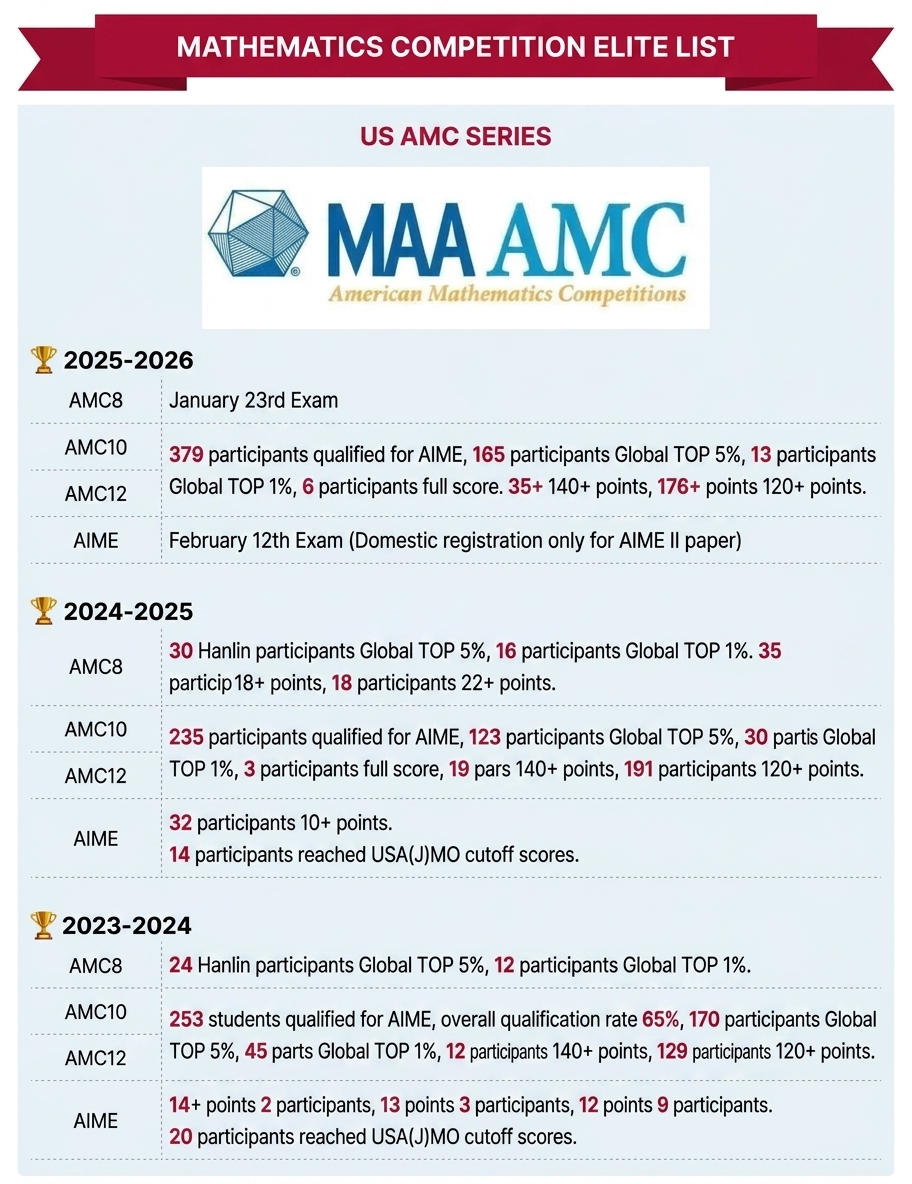
In the AMC8 competition, moving from 10 points to over 20 points is not just a score increase — it represents a comprehensive advancement in mathematical thinking, problem-solving strategies, and test-taking skills. Each score range corresponds to different levels of knowledge mastery and ability bottlenecks, so improvement strategies must be “tailored to the problem.” This article will customize a clear path to score improvement and practical tips for students at different score levels.
I. Understanding AMC8 Score Ranges and Goal Setting
First, understanding the global rankings and award thresholds corresponding to each score range helps set clear goals.
| Score Range (Based on 2025 cutoffs) | Global Ranking / Award | Core Goal & Significance |
|---|---|---|
| Below 10 points | Below global top 50% | Build a solid foundation: Focus on filling knowledge gaps to ensure no points lost on basic questions. |
| 10–15 points | Global top 25%–50% | Aim for the Achievement Roll: Perform steadily and ensure accuracy on intermediate-level questions. |
| 15–18 points | Global top 5%–25% | Aim for the Honor Roll (top 5%): Conquer some difficult problems to achieve the transition from “knowing how to solve” to “solving correctly”. |
| 18–22 points | Global top 1%–5% | Aim for the Distinguished Honor Roll (top 1%): Build on consistent performance to seek breakthroughs on difficult problems. |
| 22 points or above | Global top 1% — elite level | Top-tier competition: Pursue perfection, reduce any minor mistakes, and develop the ability to solve the most complex problems. |
Detailed Diagnosis and Score-Boosting Strategies for Each Score Range
1. Below 10 Points: Foundation Rebuilding Stage
Current Situation Analysis: Obvious gaps in knowledge, prone to calculation errors, unfamiliar with competition question types.
| Dimension | Specific Issues | Improvement Strategies & Action List |
|---|---|---|
| Knowledge Level | Core concepts from elementary and lower middle school (e.g., fraction operations, ratios, basic geometry formulas) are not solid. | 1. Return to the textbooks: Systematically review 5th–7th grade math materials to ensure thorough understanding of all formulas and theorems. 2. Focused topic practice: Concentrate on three major modules: “Arithmetic”, “Basic Algebra”, and “Plane Geometry”. |
| Test-Taking Level | Difficulty reading questions, unable to complete all problems within 40 minutes, possibly losing points even on the first 10 questions. | 1. Untimed practice: Use earlier years’ past papers (2000–2010), focusing on solving each problem correctly and understanding it thoroughly. 2. Timed training: Start with solving the first 10 questions in 20 minutes, gradually increasing speed and accuracy. |
| Psychological Level | Prone to fear of difficulty, lacking confidence. | Set small goals (e.g., “get two more questions right on the next mock exam”) and gain positive feedback from progress. |
2. 10–15 Points: Steady Performance Stage
Current Situation Analysis: Basic questions are mostly mastered, but intermediate-level questions (11–20) lose many points, and difficult problems are almost impossible to start.
| Dimension | Specific Issues | Improvement Strategies & Action List |
|---|---|---|
| Key Points Lost | Unclear problem interpretation on intermediate word problems, lengthy and error-prone solution steps, relatively weak in geometry and combinatorics modules. | 1. Targeted intermediate problem practice: Focus on questions 11–20 from 2011–2020 past papers, summarizing question patterns (e.g., distance-rate-time, work, ratio word problems). 2. Optimize solution process: Train yourself to solve problems using standardized steps (set unknowns, draw diagrams, create lists) to avoid mistakes from skipping steps. |
| Ability Gaps | Insufficient knowledge transfer ability, unable to integrate multiple knowledge points. | 1. Cross-module learning: Practice problems that combine algebra with geometry (e.g., coordinate geometry) and arithmetic with number theory. 2. Build a “method library”: Summarize standard solution methods for common question types, such as “use the cross method for mixture problems” and “draw line diagrams for distance problems”. |
| Goal Management | Content with getting basic questions right, avoids difficult problems. | Clarify the next stage goal (15 points). After each mock exam, force yourself to study the solution approach for at least two difficult problems. |
3. 15–18 Points: Tackling Difficult Problems Stage
Current Situation Analysis: Basic and intermediate problems are relatively stable, but the last 5 problems (21–25) have low accuracy, and time allocation may be unreasonable.
| Dimension | Specific Issues | Improvement Strategies & Action List |
|---|---|---|
| Core Challenge | Number theory, combinatorics, and complex geometry problems become major obstacles, with limited solution approaches. | 1. Focused difficult problem practice: In-depth study of number theory (divisibility, prime numbers), combinatorics (counting, probability), and geometry (models, auxiliary lines). 2. Study solution thought processes: For difficult problems you cannot solve, focus on learning the problem-solving approach and constructive thinking, not just the calculation steps. |
| Test-Taking Strategy | Spending too much time on difficult problems, leading to time pressure on earlier problems, or losing points on easy questions due to anxiety. | 1. Create a time allocation plan: For example, 1–10 (10 min), 11–20 (15 min), 21–25 (15 min), leaving time for review. 2. Learn to skip strategically: If you have no idea after 2 minutes on a problem, decisively mark it and skip it, returning after completing the entire paper. |
| Precision Improvement | Still losing points on easy questions due to carelessness or calculation errors — a pity. | 1. Establish a review routine: During mock exams, force yourself to leave 3–5 minutes to specifically review the calculations and problem interpretation of the first 15 questions. 2. Create a carelessness checklist: Record your common types of careless mistakes (e.g., sign errors, unit conversions) and remind yourself repeatedly before the exam. |
4. 18–22 Points+: Pursuing Excellence Stage
Current Situation Analysis: Possesses the ability to compete for the top 1%, but scores may fluctuate, potentially missing top awards due to a particular difficult problem or exam-day condition.
| Dimension | Specific Issues | Improvement Strategies & Action List |
|---|---|---|
| Breakthrough Bottleneck | Insufficient preparation for extremely difficult “inspiration problems” or “new question types”, problem-solving methods not yet optimized. | 1. Expand thinking boundaries: Study a wider range of mathematical thinking problems, even try some easier AMC10 problems to broaden your horizons. 2. Pursue multiple solution methods: For difficult problems you solved correctly, try to find simpler, more elegant solutions to exercise thinking flexibility. |
| Cultivating Stability | How to maintain nearly 100% accuracy on the first 20 problems under high pressure. | 1. High-fidelity mock exams: Fully simulate the exam environment (including noise, time pressure) to train your mindset. 2. Zero-error notebook: Build an ultimate error log to ensure you never make the same mistake on any question type or knowledge point again. |
| On-the-Day Strategy | How to allocate the precious 40 minutes to find the best balance between “solving correctly” and “solving completely”. | 1. Solidify personalized strategy: Determine the optimal order of answering questions (e.g., do all questions you’re confident about first) through multiple mock exams. 2. Guessing techniques: For problems you have no idea about, learn to use elimination, extreme value testing, estimation and other strategies to increase the probability of a correct guess. |
Golden Rules That Apply to All Score Ranges
Past papers are the best resource: No matter which stage you are at, past papers are the best training material. Use the last 5 years’ past papers for mock exams, and earlier years for topic-specific practice.
Reviewing is more important than problem-solving: The time spent analyzing mistakes and summarizing patterns should be at least equal to the time spent solving problems. Problem-solving without review is ineffective.
Modular learning: Don’t blindly complete full sets of past papers. Regularly diagnose your weak modules (e.g., geometry, number theory) and do 1–2 weeks of intensive reinforcement.
Mindset management: Treat every mock exam as an opportunity to discover problems, not as a measure of self-worth. With patience and consistent effort, score improvement will come naturally.
Summary: The journey from 10 points to 20+ is a step-by-step process: from “filling gaps” to “steady performance”, then to “tackling difficulties”, and finally to “pursuing excellence”. By clearly identifying your current stage, adopting targeted strategies, and persistently executing them, every student can achieve their own breakthrough on the AMC8 track.
AMC8 Preparation Courses
Our instructors are graduates from top global universities. With precise curriculum planning and comprehensive learning tracking, we ensure your score improvement and award-winning success!
| Class Type | Hours | Class Size | Start Date |
|---|---|---|---|
| Winter Break Class | 30H | 3–8 students | Consult teacher for details |
| Systematic Course | 20H | 1v1 / 3–8 students | Consult teacher for details |
| Problem-Solving Class | 20H | 1v1 / 3–8 students | Consult teacher for details |