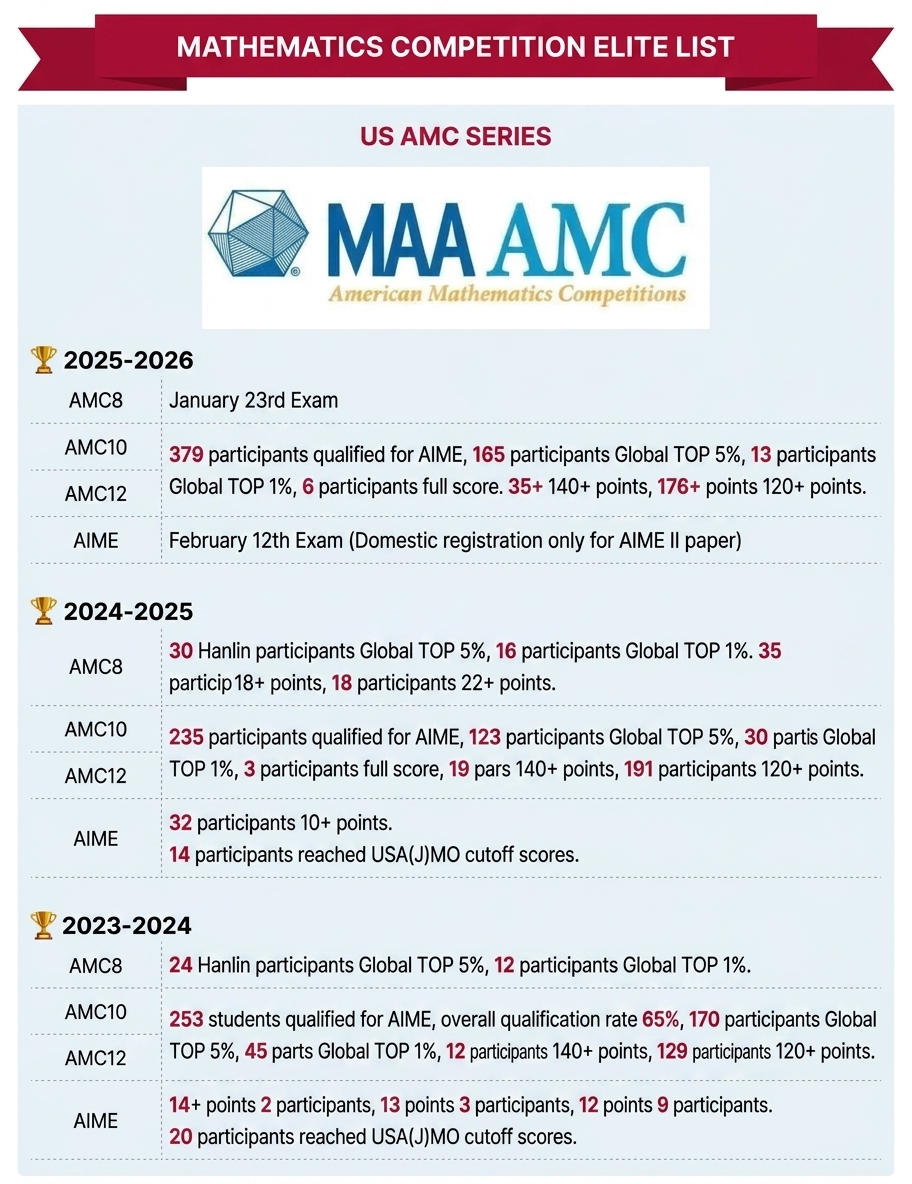
As one of the world’s most influential middle school math competitions, the AMC8 is known for its well-balanced design that challenges both foundational and advanced skills. Analysis of past exams shows that while the distribution of topics remains largely stable, the weight of geometry problems has increased significantly in recent years, with number theory and combinatorics problems gradually becoming more difficult.[reference:0] This article systematically breaks down the core topics, common pitfalls, and trends for 2027 to help you build an effective preparation strategy.
01 Core Topics and Question Characteristics
The AMC8 covers four major content areas: algebra, geometry, number theory, and combinatorics. Understanding the distribution and question characteristics in each area is essential for efficient preparation.
1. Algebra: Largest Volume, Application‑Focused
Algebra accounts for the largest number of questions, typically 35%–45% of the exam (about 8–11 problems). This section tests fractions, percentages, ratios, word problems, equations (linear equations in one and two variables), and sequences (such as arithmetic sequences).[reference:1] In recent years, algebra problems have placed greater emphasis on real‑world applications, with longer problem statements that demand strong mathematical modeling skills.[reference:2]
2. Geometry: Rising Weight, Increasing Difficulty
Geometry is the second‑largest area, with 6–8 questions, or 20%–30% of the exam. Core topics include triangle properties, the Pythagorean theorem, quadrilateral properties and area calculations, and circle properties and calculations.[reference:3] Notably, the proportion of geometry problems has increased, and 3D geometry problems have become much more frequent—for example, analyzing nets of a cube (e.g., the shortest path for an ant crawling on the surface of a cube) often serve as distinguishing questions.[reference:4]
3. Number Theory and Combinatorics: Difficulty Peaks, Thinking Challenges
Number theory and combinatorics are the most difficult parts of the AMC8. Number theory includes about 3–5 questions, focusing on primes, composites, prime factorization, divisibility properties, parity analysis, etc. Combinatorics also includes about 3–5 questions, concentrating on counting principles, permutations, combinations, and probability calculations.[reference:5] These two areas often appear in the latter half of the exam, and among the last five questions, 2–3 usually come from number theory and combinatorics. Mastery of these topics is key to competing for the top 1% globally.[reference:6]
AMC8 Core Topics and Difficulty Characteristics
| Module | Question Proportion | High‑Frequency Topics | Difficulty Characteristics |
|---|---|---|---|
| Algebra | 35%–45% | Fractions/percentages/ratio word problems, equations, sequences | Easier at the beginning, harder later; increased reading load for word problems |
| Geometry | 20%–30% | Triangle and quadrilateral properties, circle calculations, 3D geometry | Rising proportion; more 3D geometry problems |
| Number Theory | 15%–20% | Prime factorization, divisibility properties, remainder problems | Problems are “brain‑burning”; high demand for logical reasoning |
| Combinatorics | 12%–20% | Counting principles, permutations and combinations, probability calculations | Main source of final “boss” problems; emphasizes construction and case analysis |
02 Common Mistakes and Counter‑Strategies
In the AMC8, many students lose points not because they don’t know the concepts, but because they fall into traps set by the problem writers. Being aware of these common pitfalls can significantly improve your score.
1. Unit Conversion and Calculation Precision
Mismatched units are a frequent trap, such as mixing centimeters and meters in the same problem. You must convert to a common unit before calculating, and take care to compute fractions, decimals, and percentages accurately. Counter‑strategy: Convert units to a common base before calculating, and re‑check your arithmetic before selecting an answer.
2. Overcounting or Undercounting in Combinatorics
In permutation/combination problems, unclear classification or step‑by‑step criteria can easily lead to overcounting or undercounting. For example, when calculating “at least one” problems, the common method is “universe minus complement,” but the boundary of the complement is often mis‑handled.[reference:9] Counter‑strategy: Use systematic enumeration, such as tree diagrams, to ensure no duplication or omission.[reference:10]
3. Misreading and Hidden Wording
Although the AMC8 provides bilingual (Chinese‑English) test papers, the Chinese translation may be somewhat rigid, and problems may contain hidden conditions (e.g., keywords like “integer” or “positive integer”). The problem statements often include subtle constraints that need careful mining.[reference:11] Counter‑strategy: Circle key words, paying special attention to range restrictions.[reference:12]
4. Poor Time Management
Completing 25 questions in 40 minutes means an average of less than 1.6 minutes per question. Spending too much time on earlier questions directly reduces the time available for the high‑value later ones.[reference:13] Counter‑strategy: Control the first 15 questions within 15 minutes, leaving ample time for the last 10.[reference:14]
AMC8 Common Mistakes and Counter‑Strategies
| Mistake Type | Specific Behavior | Counter‑Strategy |
|---|---|---|
| Calculation Errors | Inconsistent units, rounding mistakes, careless arithmetic | Convert units before calculating, maintain neat writing, double‑check work |
| Logical Gaps | Overcounting/undercounting in combinatorics, incomplete case analysis | Establish classification criteria, verify with enumeration, use complement‑set thinking |
| Misinterpretation | Ignoring hidden conditions, misreading keywords, overlooking value ranges | Circle keywords, pay attention to details, compare the English and Chinese versions |
| Time Mismanagement | Slow start, spending too long on difficult problems, disrupted rhythm | Plan your time allocation, decisively skip stuck problems, never leave an answer blank (no penalty for wrong answers) |
03 2027 Trends and Preparation Advice
Based on the question‑setting patterns of recent AMC8 exams and analysis of the 2026 test, we can predict the trends for 2027 and develop an effective preparation plan accordingly.
2027 Trends
Overall difficulty will rise steadily: The exam will continue to be selective, with greater emphasis on integrated knowledge application and logical reasoning. Purely formula‑plugging problems will decrease.[reference:15]
Cross‑module integration: Pure single‑knowledge‑point problems will become rarer; instead, you will see more problems that combine algebra with geometry, or number theory with combinatorics. You must be able to flexibly connect knowledge from different modules.[reference:16]
Geometry and combinatorics will continue to increase in weight: Geometry, especially 3D geometry and complex figure analysis, may maintain a high proportion. Combinatorics problems may focus more on logical construction and integration with real‑world contexts.[reference:17]
Emphasis on mathematical thinking and strategy: The last five “boss” problems will particularly test creative thinking and problem‑solving strategies, such as constructing figures, testing extreme values, and clever enumeration—unconventional methods that efficiently solve problems.[reference:18]
Scientific Preparation Plan
In response to the characteristics of the 2027 AMC8, we recommend the following preparation strategies:
Phased, systematic preparation
Foundation building phase: Systematically study all topics, especially the weaker areas in school (e.g., number theory and combinatorics), ensuring a solid grasp of fundamental concepts and formulas.[reference:19]
Topic‑specific intensive phase: Deepen your training module by module, learn classic solution methods and quick approaches for various problem types, and build a library of solution methods and thinking models.[reference:20]
Practice test sprint phase: Take timed mock exams that strictly simulate the real test environment (40 minutes), and conduct in‑depth reviews of mistakes to analyze error causes.[reference:21]
Value past papers and mistake logs
Past papers are the best preparation material. By working through them, you become familiar with the problem style and difficulty gradient. Keep a mistake log and review it regularly to avoid repeating the same errors.[reference:22]
Master necessary test‑taking techniques
When facing difficult problems, make good use of techniques such as substitution, special‑value testing, and elimination. Remember that there is no penalty for wrong answers on the AMC8, so never leave a question blank; make an educated guess when uncertain.[reference:23]
AMC8 Three‑Phase Preparation Plan
| Phase | Timeline | Core Tasks | Target Outcomes |
|---|---|---|---|
| Foundation Building | 5–6 months before the exam | Systematically study all topics, strengthen number theory and combinatorics, solidify calculation foundations | Establish a complete knowledge system, stabilize scores on the first 10 questions |
| Topic‑Specific Intensive | 2–4 months before the exam | Module‑by‑module training, learn rapid problem‑solving techniques, build thinking models | Break through intermediate/high‑difficulty problems (questions 11–20), master multiple solution methods |
| Practice Test Sprint | 1–2 months before the exam | Full‑length mock exams, mistake review, time‑allocation optimization, mindset adjustment | Establish a stable answering rhythm, develop targeted strategies for questions 21–25 |
The true value of the AMC8 lies not only in the award itself but also in the systematic training of mathematical thinking during the preparation process. The 2027 AMC8 is expected to continue its selective nature, placing greater emphasis on flexible knowledge application and depth of thinking.[reference:24]
AMC8 Preparation Courses
Our instructors are graduates from top global universities. With precise curriculum planning and comprehensive learning tracking, we ensure your score improvement and award-winning success!
| Class Type | Hours | Class Size | Start Date |
|---|---|---|---|
| Winter Break Class | 30H | 3–8 students | Consult teacher for details |
| Systematic Course | 20H | 1v1 / 3–8 students | Consult teacher for details |
| Problem-Solving Class | 20H | 1v1 / 3–8 students | Consult teacher for details |