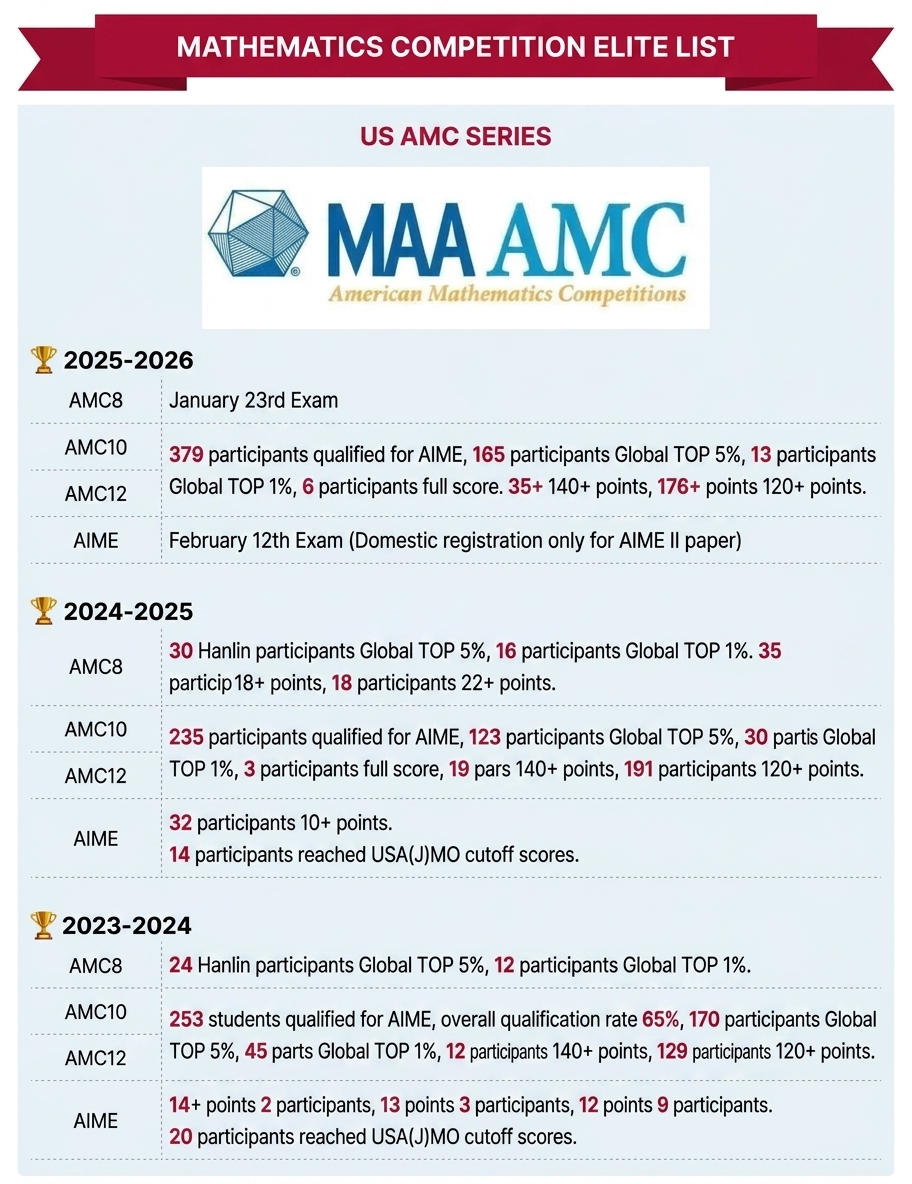
The AMC 8 math competition is held once a year in January. As a globally authoritative competition organized by the Mathematical Association of America (MAA), its stable test format and consistent question-setting logic continue to guide the direction of math education for young students. For participants, understanding the question type distribution and rules is the cornerstone of effective preparation.
01 Basic Rules of the Competition
The AMC8 is open to students in grade 8 (second year of junior high) or below, and participants must be no older than 15.5 years old on the day of the competition. The exam is conducted as a paper-based test, consisting of 25 multiple-choice questions. The exam duration is 40 minutes, with a total possible score of 25 points. One point is awarded for each correct answer, with no deduction for incorrect or omitted answers, encouraging students to attempt all problems. The test is provided in both Chinese and English, providing an equitable answering environment for participants from different language backgrounds.
AMC8 Competition Basic Information
| Item | Specific Information |
|---|---|
| Eligibility | Grade 8 (second year of junior high) or below, and not exceeding 15.5 years of age on the day of the competition |
| Exam Date | Once a year in January (next: January 2027 season; exact date varies by test center) |
| Exam Format | 25 multiple-choice questions |
| Exam Duration | 40 minutes |
| Scoring Rules | 1 point for each correct answer, no deduction for incorrect or unanswered questions; total possible score of 25 points |
| Exam Language | Bilingual (Chinese and English) |
02 The Five Question Types and Their Distribution
Although the AMC8 is often categorized into four main knowledge modules—Algebra, Geometry, Number Theory, and Combinatorics—based on the specific content and skills assessed, the questions can be further refined into five types. The table below clearly shows the distribution of each category and the key content tested.
Distribution and Key Content of the Five AMC8 Question Types
| Question Type | Proportion | Core Content Tested |
|---|---|---|
| Algebra Applications | Approx. 20%-25% | Linear equations, quadratic functions, inequalities, sequences. Emphasis on modeling to solve real-world problems. |
| Probability and Statistics | Approx. 15%-20% .=Contextual probability calculations, data analysis. Emphasizes integration with real-world scenarios, such as data analysis models for supermarket promotions. | |
| Geometry and Space | 25%-30% .=Properties of triangles, quadrilaterals, and circles; the Pythagorean theorem; analysis of 3D nets and calculation of irregular shapes. | |
| Number Theory | Approx. 10%-15% .=Prime numbers, composite numbers, multiples, divisors, prime factorization. Question difficulty has increased, requiring quick calculation of greatest common divisors (GCD) and least common multiples (LCM). | |
| Combinatorics | Approx. 10%-15% .=Permutations and combinations, logical reasoning, counting principles, pattern recognition. Includes topics such as the sum of geometric sequences, testing rigorous logical thinking. |
From the table, it is evident that the question-setting leans toward applicability and interdisciplinary integration. Algebra and probability & statistics together account for 40%–45% of the test, meaning nearly half of the problems require test-takers to apply mathematical tools to solve real-world problems.
The geometry module is not limited to simple calculations of plane figures; it also draws on spatial reasoning and applies classic results such as the Pythagorean theorem to real-world contexts.
03 Syllabus Focus and Preparation Insights
The AMC8 places real emphasis on interdisciplinary application and higher-order logical reasoning in its question design. The difficulty of the problems follows a stepped distribution: Questions 1–10 are basic, questions 11–20 are intermediate, and questions 21–25 are difficult. This design allows students of all levels to be challenged while effectively distinguishing top performers.
Based on these changes, preparation strategies should be adjusted accordingly:
Strengthen short‑time problem‑solving skills: With 25 problems to solve in 40 minutes (an average of just 1.6 minutes per question), it is essential to engage in timed simulation training on a regular basis.
Value application of knowledge: Think frequently about how mathematical concepts apply to real‑life contexts, such as environmental protection, economic models, etc.
Solidify the foundations of number theory and combinatorics: These two areas are the exclusive challenges of the competition. Systematic study is required to master problem‑solving approaches and methods.
For those who have already taken this year’s competition, the above analysis of question types can serve as a reference for post‑exam reflection. Understanding the trends in question setting is more important than merely pursuing a high score. The “Distinguished Honor Roll” (top 1% globally) typically requires about 23 correct answers, the “Honor Roll” (top 5%) requires about 19 points, and the “Achievement Roll” for students in grade 6 or below is set at a threshold of 15 points.
AMC8 Preparation Courses
Our instructors are graduates from top global universities. With precise curriculum planning and comprehensive learning tracking, we ensure your score improvement and award-winning success!
| Class Type | Hours | Class Size | Start Date |
|---|---|---|---|
| Winter Break Class | 30H | 3–8 students | Consult teacher for details |
| Systematic Course | 20H | 1v1 / 3–8 students | Consult teacher for details |
| Problem-Solving Class | 20H | 1v1 / 3–8 students | Consult teacher for details |