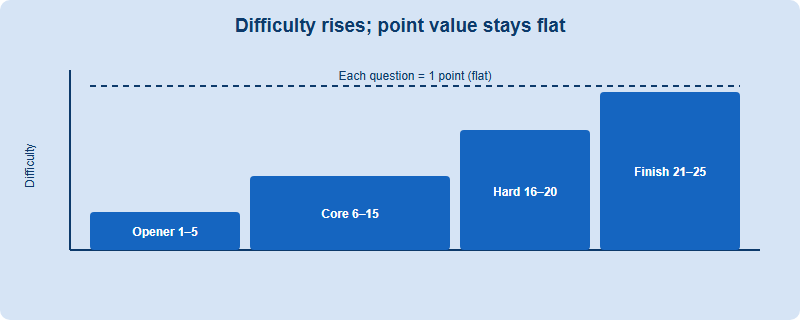
The AMC 8 is 25 questions in 40 minutes, and its questions rise in difficulty roughly from front to back — but every question is worth exactly one point (per maa.org). Instead of grinding front to back, you can map the paper into difficulty blocks — the opener, the core, the hard band, and the finishers — and set a realistic per-block target. This turns a vague “do better” into a precise plan for where your next point lives.
Why a difficulty-ramp map beats a score-range plan
Most improvement advice is organised by score range: what a 10-scorer does, what a 15-scorer does. That is useful, but it hides where on the paper the points are being won or lost. A difficulty-ramp map is organised by question position instead. It answers a sharper question: given how the AMC 8 gets progressively harder, which block should you be defending, which should you be attacking, and which should you be strategically guessing?
The single most important fact behind the map is one we return to often: on the AMC 8 the raw score does not weight questions by difficulty. Question 2 and question 24 are each worth one point. Difficulty ramps up; point value stays flat. That asymmetry means the highest-return strategy is almost never “spend more time on the hard questions.” It is “lock down every point in the easy and mid blocks first, then spend remaining time — and guesses — on the hard band.” The block map operationalises exactly that.
A caveat before the numbers: the AMC 8’s questions generally get harder toward the end, but the ordering is a broad tendency, not a strict guarantee, and any given year’s paper has its own quirks — an “easy” question can hide a trap, and a later one can be approachable. Treat the blocks as a planning tool, not a promise about any single problem. And confirm the current format, question count, and timing on maa.org before your sitting.
The four blocks of the AMC 8
Here is the paper divided into four working blocks, each with a role, a rough time budget, and a mindset. The time budgets sum to 40 minutes with a small reserve for the endgame; adjust them to your own speed after a few practice papers.
| Block | Questions | Role | Rough time budget | Mindset |
|---|---|---|---|---|
| The Opener | 1–5 | Bank the certain points | ~6–8 min | Fast and accurate; never careless |
| The Core | 6–15 | Where most of your score is decided | ~16–18 min | Steady; park don’t grind |
| The Hard Band | 16–20 | Attempt the reachable ones | ~8–10 min | Selective; pick your battles |
| The Finishers | 21–25 | Stretch targets + smart guesses | Remaining + endgame | Try one or two; guess the rest |
Setting your own per-block target
The point of the map is to convert your current level into a specific target for each block, so you always know where the next point should come from. Start from an honest baseline — your recent practice-paper scores — then set targets that defend what you already reach and add one reachable block. Below are three illustrative profiles. They are planning templates, not predictions or promises; your real targets come from your own timed papers.
| If your recent score is roughly… | Opener 1–5 | Core 6–15 | Hard 16–20 | Finishers 21–25 | Where your next point lives |
|---|---|---|---|---|---|
| Around 8–11 | Aim 5/5 | Aim 5–7 / 10 | Attempt 1–2 | Guess all | Stop losing Opener/early-Core points to carelessness |
| Around 12–16 | 5/5 | Aim 8–9 / 10 | Attempt 3–4 | Try 1, guess rest | Convert the back half of the Core reliably |
| Around 17–20 | 5/5 | 10/10 | Aim 4–5 | Aim 2–3 | Break into the Hard Band and finishers |
Read the rightmost column carefully, because it is the strategic heart of the map. For a student around 8–11, the fastest gains are not on questions 21–25 — they are in stopping the leak of points that were already within reach in the Opener and early Core. For a student around 17–20, the ceiling has moved: the Opener and Core are assumed solved, so the growth edge is genuinely in the Hard Band and Finishers. Same paper, completely different “next point,” because your block map is different.
Pacing the ramp: two passes plus an endgame
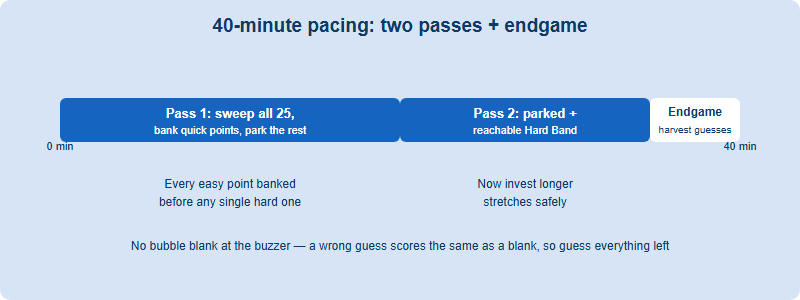
A block map only pays off if your pacing lets you reach the blocks where your points live. The reliable structure is two passes and an endgame, which prevents the classic failure of running out of time before touching approachable later questions.
- Pass 1 — sweep for certain points. Go through all 25 in order. Solve and bubble anything you can do quickly (most of the Opener and much of the Core). The moment a question would cost more than about a minute, park it: mark its number, skip its answer row, and keep moving. The goal of pass 1 is to have banked every easy point on the whole paper before spending time on any single hard one.
- Pass 2 — work the parked and the reachable Hard Band. Return to parked Core questions and the approachable questions in 16–20. Now you can invest longer stretches, because the cheap points are already secured. Attempt one or two Finishers only if a genuine idea appears.
- Endgame — harvest, don’t solve. In the last few minutes, resolve every unanswered row with a considered guess after eliminating obviously wrong choices. Because there is no penalty for guessing, no bubble should be blank at the buzzer.
The discipline that makes this work is parking rather than grinding. A student who refuses to leave question 9 until it is solved may never reach an easy question 14. Parking is not giving up; it is deferring, so difficulty order does not dictate the order in which you collect points. You return to the hard ones — you simply do not let them hold your easy points hostage.
Turning the map into practice
A map is only as good as the practice that calibrates it. Use timed past papers to find your real block boundaries — the point on the ramp where your accuracy starts to fall — then train the block just above it. A structured routine:
- Score by block, not just total. After each timed paper, record how many you got right in 1–5, 6–15, 16–20, and 21–25 separately. Patterns emerge fast: many students discover they are quietly dropping one or two Opener/Core points to carelessness, which is the cheapest fix on the whole paper.
- Train the boundary block. If your accuracy holds through the Core but collapses at 16–20, drill mid-hard problems specifically, rather than spreading effort evenly. The map focuses your study where a point is genuinely gettable next.
- Rehearse the endgame. Practise the last-five-minutes harvest so it is automatic on test day — walk unanswered rows, eliminate, guess, check bubble alignment.
This block-and-pacing framework is a first-party planning lens we use with China-based international-school students; it is not an official MAA method, and it does not replace genuine topic mastery. It simply makes sure the mastery you do have is converted into the maximum number of points the flat scoring allows. Reconfirm the AMC 8’s current question count, timing, and format on maa.org, since the MAA sets and occasionally updates them.
Frequently asked questions
Are later AMC 8 questions worth more points?
No. Every AMC 8 question is worth one point regardless of difficulty (per maa.org). Later questions are harder but not more valuable, which is why securing the easy blocks first is the highest-return strategy.
Do the questions always go from easy to hard?
Roughly, yes — difficulty tends to rise across the paper — but it is a broad tendency, not a strict rule. Any single question can buck the trend, so treat the block map as a planning tool.
Which block should I focus my study on?
The block just above where your accuracy currently drops. Score practice papers by block to find that boundary, then drill it — that is where your next point is realistically gettable.
How long should I spend on questions 1–5?
Fast but careful — roughly 6–8 minutes as a template, adjusted to your speed. Losing an Opener point to carelessness is the most expensive mistake on the AMC 8.
Pair this with our companion pieces on the no-penalty scoring math and calculator-free arithmetic technique on the AMC 8 resource hub, and verify current rules on the official AMC pages at maa.org.
This is an independent guide operated by Hanlin Education for China-based international-school students. It is not affiliated with, endorsed by, or sponsored by the Mathematical Association of America (MAA). The AMC 8’s format, question count, scoring, and any difficulty patterns are determined by the MAA — always confirm current details on maa.org and your registration page. Any error will be corrected within 7 working days.