Partly — and that word matters. If you attend an international school in China running IB MYP, IGCSE, or a bilingual programme, your math class covers most of the arithmetic, algebra, and geometry tools the AMC 8 uses. What it usually does not cover is how the AMC 8 asks about them, plus two whole strands — number theory and counting — that barely appear in school schemes of work. This article maps the gaps strand by strand and shows how to close them without sacrificing school grades.
First, what the AMC 8 actually demands
The AMC 8 is the entry tier of the American Mathematics Competitions, run by the Mathematical Association of America (MAA). It is a 25-question, 40-minute multiple-choice paper for students in grade 8 and below, taken with no calculator. Since the shift away from at-home online sittings, it is administered in person during a January window — China-based families register through authorized test centers, a process we walk through in detail in our 2026–27 in-person AMC 8 registration guide. Exact dates and rules for each cycle should always be confirmed on maa.org.
Notice what that format implies. Forty minutes for 25 questions is roughly 96 seconds per problem — far less thinking time per item than a typical school test, and with no calculator to lean on. School assessments usually test one topic at a time, right after you learned it, with scaffolded sub-parts (“(a) find x, (b) hence show…”). The AMC 8 mixes every strand into one sitting, gives no scaffolding, and writes answer choices specifically designed to catch predictable errors. That difference in format is the first gap, before we even talk about content.
The gap map: five strands, honestly rated
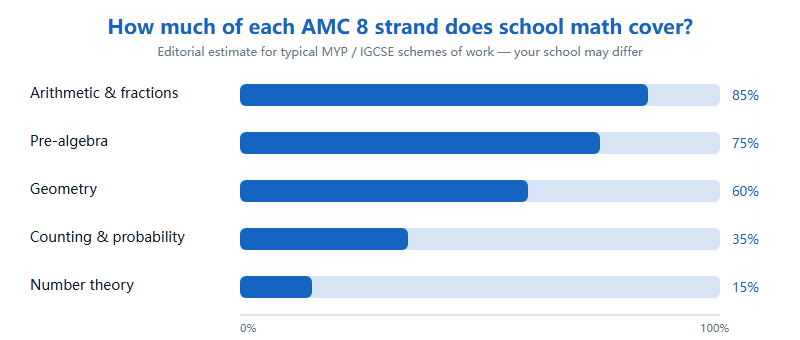
Based on our editorial team’s experience coaching China-based international-school students across MYP, IGCSE, and bilingual national-curriculum tracks, here is how typical school coverage lines up against what AMC 8 problems draw on. Every school implements its curriculum differently, so treat this as a starting map, not a verdict on your school.
| Strand | Typical MYP / IGCSE coverage by grade 7–8 | What AMC 8 problems demand | Gap size |
|---|---|---|---|
| Arithmetic, fractions, percentages, ratios | Strong — core of every scheme of work | Fast, calculator-free manipulation under time pressure | Small (speed, not content) |
| Pre-algebra and simple equations | Strong — linear equations, substitution, patterns | Setting up equations from unfamiliar word problems | Small–medium (translation skill) |
| Geometry | Moderate — area, perimeter, angles, some solids | Composite figures, clever dissections, spatial reasoning | Medium |
| Counting and probability | Light — often one short unit, late in the year | Systematic casework, arrangements, complementary counting | Large |
| Number theory (divisibility, primes, remainders) | Minimal — rarely taught as its own topic | Prime factorization habits, remainder logic, digit problems | Largest |
Why an A* in school math doesn’t automatically transfer
Parents are often puzzled when a student with top school grades scores modestly on a first AMC 8 practice paper. Four structural reasons explain it, and none of them mean the student is “bad at competition math”:
- Topic mixing. School tests announce their topic. The AMC 8 jumps from a ratio problem to a geometry dissection to a remainder puzzle with no warning, so retrieval — deciding which tool to use — becomes the real skill.
- No scaffolding. IGCSE-style structured questions guide you through steps. AMC 8 problems hand you the final question only; you must invent the intermediate steps yourself.
- Distractor answers. The five choices typically include the results of the most common mistakes (forgetting a case, off-by-one errors, misreading “at least” as “exactly”). Partial understanding gets punished more visibly than at school.
- Untaught strands. A student can genuinely have never seen complementary counting or prime factorization tricks, because their scheme of work never scheduled them. That is a curriculum gap, not an ability gap.
The encouraging flip side: because two of the five strands are nearly untaught, targeted work on just those strands produces unusually fast score movement compared with grinding strands school already covers.
Closing each gap: what to add, strand by strand
Arithmetic and pre-algebra (small gap). Don’t re-learn content — convert it to speed. Ten minutes of daily calculator-free drill (fraction operations, percentage conversions, squares to 25) is enough. Your school homework maintains the rest.
Geometry (medium gap). School geometry teaches formulas; AMC 8 geometry tests seeing. Practice composite-area problems where you must add a helping line or subtract a region. One focused session per week from past problems builds the “dissection eye” that classrooms rarely train.
Counting and probability (large gap). Treat this as a new subject, not revision. Start with systematic listing, then the multiplication principle, then casework and complementary counting. The discipline of writing cases out fully — before learning shortcut formulas — is what separates students who get counting questions right from students who “sort of know” permutations.
Number theory (largest gap). Also a new subject for most international-school students. Core habits: factorize numbers by reflex, know divisibility rules cold, and get comfortable with remainder reasoning (“what is the remainder when … is divided by …?”). These problems look intimidating precisely because school never named the topic; the underlying techniques are learnable in weeks.
Fitting it around a school year that ends in June
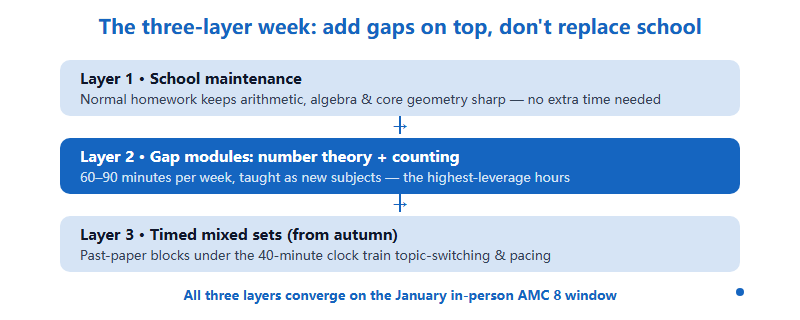
International-school calendars in China typically run August to June, which fits the January AMC 8 window surprisingly well. A realistic rhythm: use the spring and summer terms of the year before to introduce number theory and counting gently (no time pressure); use September to November to deepen those modules and start weekly timed sets; use December and early January for full past papers and error review. Because the exam sits mid-year, it doesn’t collide with IGCSE mocks or MYP eAssessment season, which land later in spring.
One logistics note that catches families out: since the AMC 8 is now an in-person exam, you need a confirmed seat at an authorized center before the January window — registration closes well ahead of exam day, and centers have finite capacity. Our step-by-step guide to finding a center and registering from China covers the timeline; the authoritative calendar is always maa.org.
Finally, a word of reassurance for MYP families specifically: MYP’s emphasis on investigation and explaining reasoning is genuinely useful for competition math — students used to justifying their thinking adapt quickly to multi-step problems. The gap is content scheduling, not pedagogy. Add the two missing strands, respect the clock, and school math and AMC 8 prep reinforce each other rather than compete.
FAQ
Is the AMC 8 harder than IGCSE math?
Different, not simply harder. The content sits at or below IGCSE level, but questions are unscaffolded, mixed across topics, timed at under two minutes each, and include strands schools rarely teach.
Which gap should we fix first?
Number theory and counting. They appear regularly on the AMC 8, are almost absent from MYP and IGCSE schemes, and respond fastest to focused study — the best score-per-hour investment.
Can school homework count as AMC 8 prep?
Partially. It maintains arithmetic, algebra, and core geometry. It does not train speed, topic-switching, or the two untaught strands, so add 60–90 targeted minutes weekly on top.
Does a bilingual national-curriculum track change this map?
Slightly — such tracks are often stronger on arithmetic speed and drill, but the number theory and counting gaps remain, and the English problem wording adds a separate reading layer to train.
This article is an independent guide operated by Hanlin Education for China-based international-school students. We are not affiliated with, endorsed by, or sponsored by the Mathematical Association of America (MAA). Competition dates, rules, and registration details change; always confirm current information on maa.org. If you spot an error, we will correct it within 7 working days.