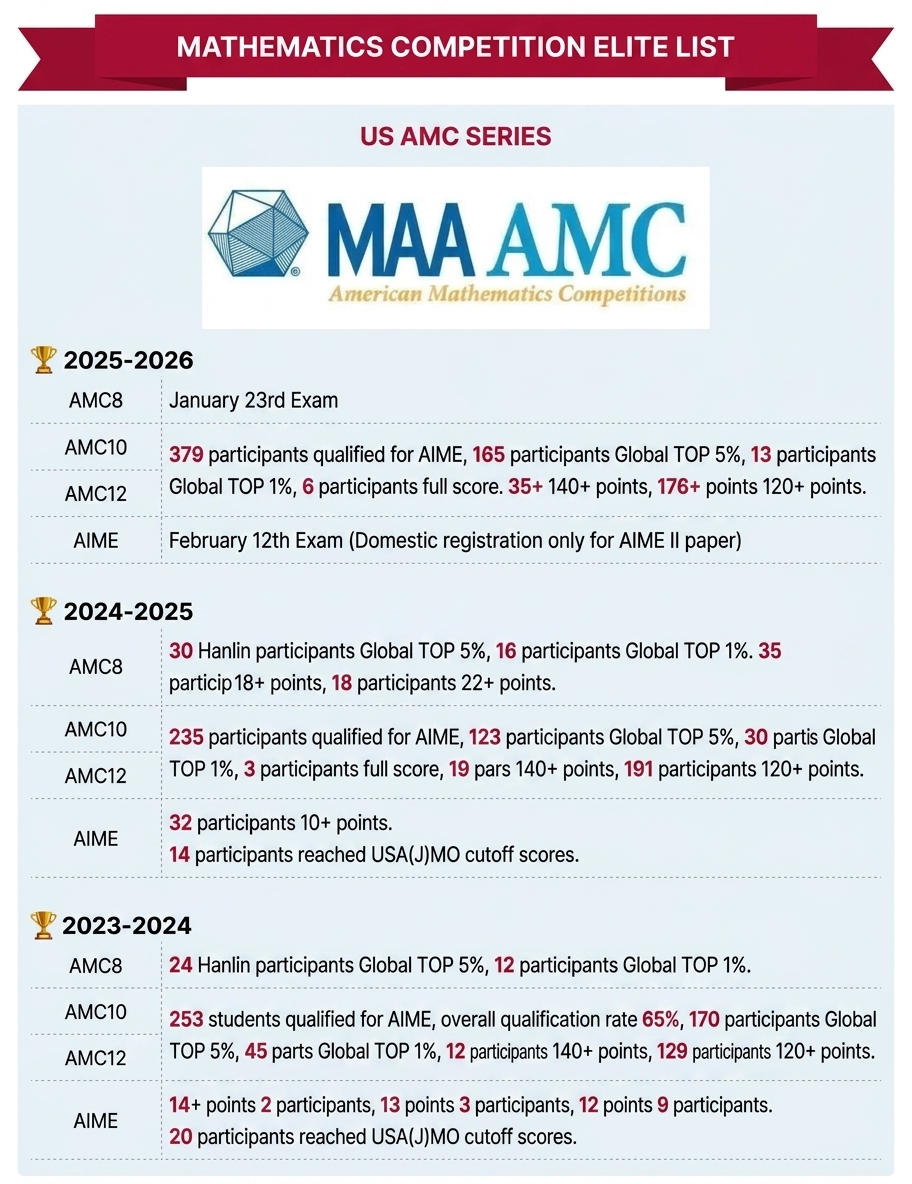
In the brilliant constellation of math competitions, the AMC8 shines like a captivating star, attracting countless math enthusiasts from around the world. Founded in 1985, this international math competition is designed for students in the 8th grade and below and has become an important benchmark for measuring students' mathematical abilities. Whether aiming for prestigious schools or enhancing your thinking skills, the AMC8 can open a door to the world of mathematics for you.

I. Competition Schedule
The key dates for the 2026 AMC8 season have been set. Proper planning is the first step to success.
2026 AMC8 Important Timeline
Time management is crucial: you have 40 minutes to solve 25 multiple-choice questions, averaging less than 2 minutes per question. This intensity tests not only your knowledge but also your time allocation skills.
II. Registration Channels
The online exams that were temporarily allowed due to the pandemic have been fully discontinued. All 2026 events will be conducted offline. There are two main registration channels: school group registration and the ASDAN official channel. Students from non-partner schools must register through officially authorized agencies. The registration fee is 120 RMB. Seats are limited, so it is recommended to complete registration as early as possible to avoid system congestion near the deadline.
Special Note: Participants must meet two requirements: they must be in 8th grade or below and not exceed 14.5 years of age on the day of the competition.
III. Syllabus Overview
The 2026 AMC8 syllabus has undergone significant changes, placing greater emphasis on the application of mathematics in real life. The competition covers four major modules, each with a different focus.
Knowledge Area Distribution Table
The scoring standards have also become more stringent: the weight of process points has increased to 30%, requiring the citation of theorem bases, and calculation results must retain three significant figures. These changes mark a strategic shift in the AMC8 from "problem-solving skills" to "real-world modeling abilities."
IV. Value of the Competition
The value of the AMC8 is reflected in multiple dimensions. For academic advancement, it has become an implicit threshold for prestigious schools such as Shanghai's "San Gong" schools and Beijing's "Liu Xiao Qiang" schools. In the field of international education, top international schools like YK Pao School and Star River School use it as a reference for class placement. From a personal development perspective, the logical thinking and problem-solving skills cultivated by the AMC8 are precisely the key competencies most needed in the age of artificial intelligence.
Trend of Score Cutoffs Over the Years
Data shows that the threshold for the top 1% has been rising year by year, indicating increasingly fierce competition. However, the standard for the Global Honor Roll (students in grade 6 and below scoring ≥15 points) has remained stable, providing opportunities for younger students.
V. Preparation Strategies
Success does not happen by chance; it stems from carefully designed plans and persistent execution.
Three-Phase Preparation Path:
Foundation Building Phase (from now to mid-December): Systematically build a knowledge framework, focusing on breaking through the four major modules.
Intensive Training Phase (mid-December to early January): Use past papers to drive skill improvement, implementing a categorized practice strategy.
Simulation Sprint Phase (early January to before the exam): Fully simulate the exam environment to cultivate time management and test-taking mentality.
Golden Rules of Time Management:
Basic Questions (Questions 1-10): Limit to 8 minutes, ensuring 100% accuracy.
Intermediate Questions (Questions 11-20): Allocate 15 minutes, making good use of techniques such as substituting special values.
Challenging Questions (Questions 21-25): Reserve 17 minutes, prioritizing the types of problems you can tackle.
Remember: "Seek stability in basic questions, accuracy in intermediate questions, and breakthroughs in challenging questions."
Warning on High-Frequency Mistakes: Unit conversion errors are a common point of losing marks, such as writing kilometers as meters. Be wary of missing process points; failing to label theorem numbers may result in a 30% deduction. Insufficient calculation accuracy can also affect your score; probability results must retain three significant figures. Keeping a notebook of mistakes and reviewing them regularly is an effective way to avoid repeating errors.
VI. On-the-Spot Tips
The exam room is a battlefield where strategy determines success or failure. Facing the test paper, you might adopt the "Three-Round Answering Method":
First Round: Quickly answer the questions you are confident about.
Second Round: Tackle the questions that are somewhat challenging.
Third Round: Focus on the most difficult problems and conduct a review.
When encountering a difficult problem, decisively skipping it is key to ensuring you get all the points from the questions you can solve.
There are also tips for using scratch paper: write in sections, clearly label question numbers, and keep your steps neat. These details not only improve checking efficiency but can also demonstrate your problem-solving process when needed, helping you earn process points.
Finally, remember that maintaining a balanced mindset is the guarantee of a normal performance. The AMC8 is just a starting point on the path of mathematical exploration, not the end. Regardless of the outcome, the thinking training and skill enhancement during the preparation process are more valuable treasures than the score itself.
The call for the 2026 AMC8 has sounded, and the mysteries of the mathematical world await young explorers to unlock them. Make a reasonable plan, maintain a steady pace, and this mathematical feast will surely bring you unexpected gains.
Students preparing for the competition can download the 2000-2025 AMC8 bilingual past papers + answer analyses + formula collection + vocabulary list + preparation books + handouts for free.
AMC8 Preparation Courses
Our instructors are graduates from top global universities. With precise curriculum planning and comprehensive learning tracking, we ensure your score improvement and award-winning success!
| Class Type | Hours | Class Size | Start Date |
|---|---|---|---|
| Winter Break Class | 30H | 3–8 students | Consult teacher for details |
| Systematic Course | 20H | 1v1 / 3–8 students | Consult teacher for details |
| Problem-Solving Class | 20H | 1v1 / 3–8 students | Consult teacher for details |