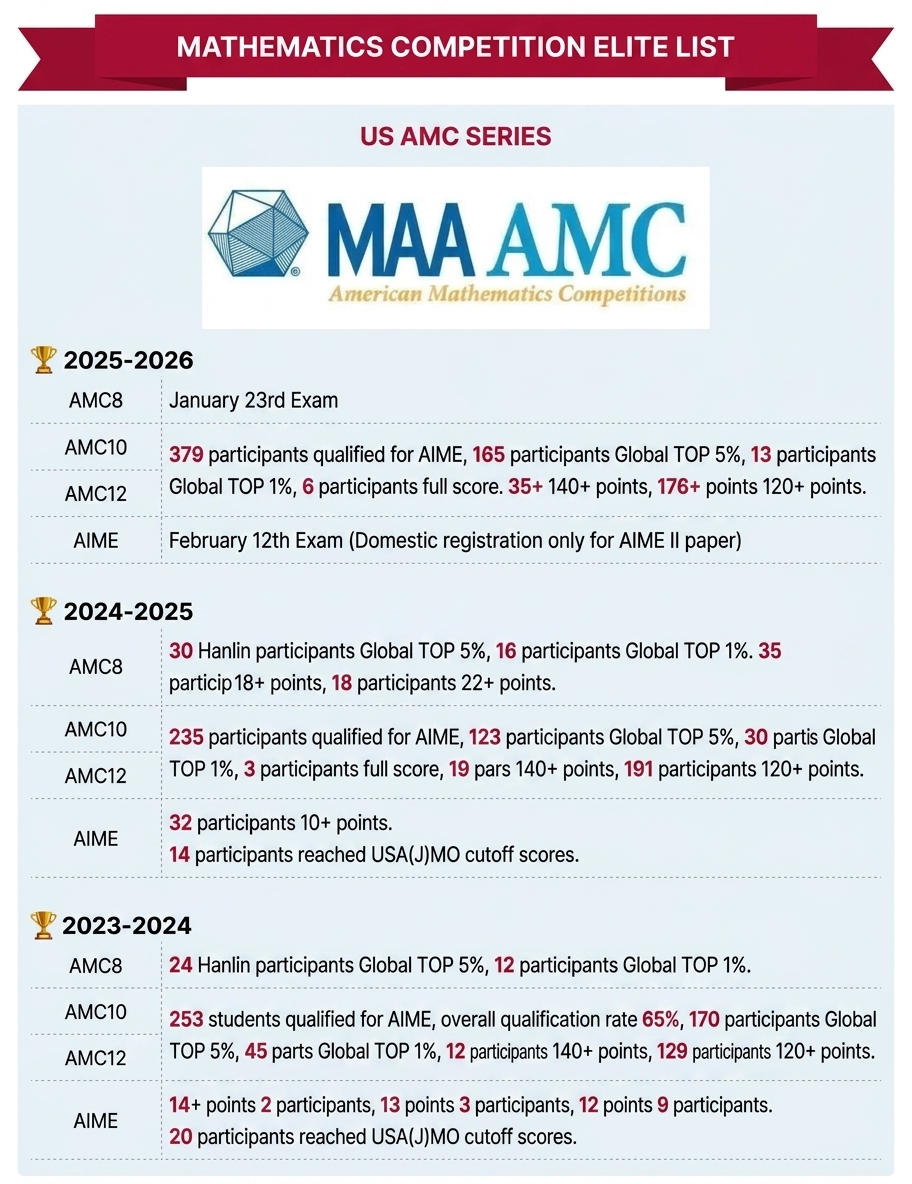
The AMC 8 is held once a year in January, in a single 40-minute window; your test center will confirm the exact start time. The China region offers both online (home-based) and in-person (on-campus) testing modes, allowing candidates to choose the most suitable option. It’s important to note that AMC8 does not accept individual direct registration; participation must be arranged through schools or official designated channels.The syllabus places real emphasis on logical thinking and modeling skills. The geometry module includes analysis of 3D nets, and the algebra section features real-world application problems such as promotion and pricing models and function-based applications.
II. AMC8 Key Timeline
The key milestones for the AMC8 each year are as follows:
Event
Date
Registration Deadline
Shortly before the contest each year
Official Exam Date
Once a year in January, a single 40-minute window (next: January 2027 season)
Score Release
2–4 weeks after the exam
Certificate Download
6–8 weeks after the exam
Candidates should note that registration typically closes about 10 days before the exam. It is recommended to complete registration as early as possible to avoid system congestion near the deadline.
III. Eligibility
AMC8 is open to students in grade 8 or below, and participants must be no older than 15.5 years old on the day of the exam. Based on domestic registration trends, the majority of participants are in grades 4–7—students at this level already have a solid math foundation and sufficient time to master competition-specific knowledge points. Grades 5 and 6 are considered the “golden window” for taking the AMC8, as students have acquired ample math knowledge, competition is relatively less intense, and awards at this stage offer the greatest benefit for academic advancement.
IV. Registration Guide
Since 2021, individual registration has been discontinued in the China region. Candidates must register through the following channels:School Group Registration: If the student’s school is an ASDAN partner test center, registration can be arranged through the school’s academic affairs office or the teacher responsible for competitions.Self-Registration via ASDAN Mini-Program: If the school is a partner school but does not organize group registration, students can complete the registration process independently through the “ASDAN International STEM Assessment” WeChat mini-program.Proxy Registration through Authorized Agencies: For students whose schools are not partner test centers, registration must be done through an authorized agency. In this case, the deadline may be earlier than the official cutoff date, so advance preparation is necessary.
AMC8 registration for the January 2027 season is available! We are an officially authorized AMC8 in-person & online test center. Scan the QR code to receive the registration form and free proxy registration!
V. Exam Format and Structure
The AMC8 uses a format of 25 multiple-choice questions to be completed in 40 minutes. The total score is 25 points, with 1 point awarded for each correct answer; unanswered or incorrect answers receive 0 points (no penalty). The test is bilingual (Chinese-English), accommodating students from different language backgrounds.The exam content covers four major math areas, with the following approximate module distribution:
Module
Percentage
Algebra & Probability
40%–45%
Geometry
25%–30%
Number Theory & Combinatorics
20%–25%
The difficulty of the questions follows a clear gradient:Questions 1–10: Basic levelQuestions 11–20: Intermediate difficultyQuestions 21–25: High difficulty
VI. Effective Preparation Strategies
Preparing for the AMC8 can be divided into three phases, each with a distinct focus:Phase 1: Foundation Building (1–2 months before the exam): Systematically review the syllabus, build a solid framework for the four modules (algebra, geometry, number theory, combinatorics), and engage in daily timed practice to improve problem-solving speed and accuracy.Phase 2: Skill Enhancement (1 month before the exam): Target weak areas through modular review, focusing on high-frequency topics such as similar triangles, remainder problems, and permutations and combinations. Maintain an error log to record the causes of mistakes and avoid repeating them.Phase 3: Sprint (2–3 weeks before the exam): Take 2–3 full-length mock exams per week, strictly adhering to time limits. Develop a time allocation strategy: aim to complete questions 1–10 in 8 minutes, questions 11–20 in 15 minutes, and reserve 12 minutes for questions 21–25.
VII. Scoring and Awards
The AMC8 scoring system is simple and straightforward: a total of 25 points, with 1 point awarded for each correct answer and 0 points for an unanswered or incorrect answer. There is no penalty for wrong answers and no process or step-based grading — only the multiple-choice answer you select is scored. Because there is no penalty, you should answer every question, guessing if necessary.Awards are divided into four levels:Perfect Score Award: Achieving a perfect score of 25 pointsDistinguished Honor Roll (DHR): Top 1% globallyHonor Roll (HR): Top 5% globallyAchievement Roll (AR): Students in grade 6 or below who score 15 points or moreIn recent years, award score cutoffs have been steadily rising. In 2025, the cutoff for the top 1% reached 23 points, and for the top 5%, 19 points. For students aiming for prestigious schools such as Shanghai’s “San Gong” or Beijing’s “Liu Xiao Qiang,” a score above 18 points is a key threshold.
VIII. Value and Significance of the Competition
The AMC8 is not only a globally recognized proof of mathematical ability but also an important springboard for students’ future academic development. For students planning to study abroad, outstanding AMC scores are a powerful advantage in applications to top overseas private schools and universities. The logical thinking, problem-solving, and stress management skills cultivated through the competition have a profound impact on students’ overall academic growth. Moreover, AMC8 serves as the starting point for higher-level math competitions, laying the foundation for AMC10/12 and AIME.The AMC8 rewards real-world modeling ability alongside solid problem-solving techniques, reflecting how mathematics applies to practical, real-life situations.Students preparing for the competition can download free resources, including 2000–2025 AMC8 bilingual past papers, answer analyses, formula collections, vocabulary lists, preparation books, and handouts.
AMC8 Preparation Courses
Our instructors are graduates from top global universities. With precise curriculum planning and comprehensive learning tracking, we ensure your score improvement and award-winning success!