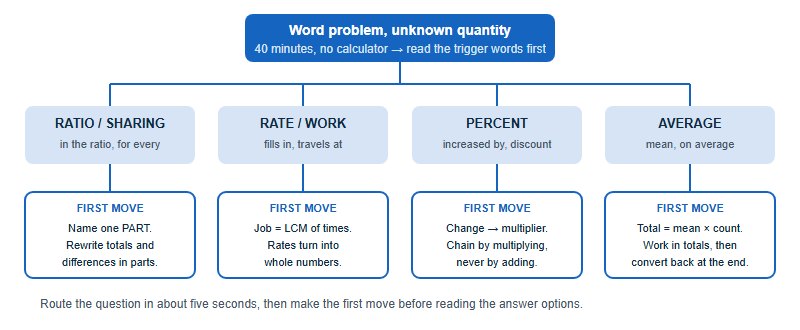
Most AMC 8 questions that look like algebra are solved faster without it. With 25 questions in 40 minutes and no calculator, building and solving an equation is often the slow route. Four setups — ratio as parts, rate as a unit, percent as a multiplier, average as a total — cover most of them, and three specific signals tell you when an equation really is worth writing.
The AMC 8 algebra illusion
Students arriving from a school syllabus have usually been rewarded for one thing: defining a variable, forming an equation, solving it, and showing the working. That is good mathematics and it is the right habit for a school assessment marked by method. It is a poor fit for a 25-question, 40-minute multiple-choice paper with no calculator, sat in person in a single sitting — see the 2026-27 in-person AMC 8 guide for the format and how the January sitting is administered.
The reason is arithmetic, not ideology. An equation route on a ratio problem typically produces a fraction like 5r/3 that you then have to clear by hand. A parts route on the same problem produces small whole numbers. Both are correct; only one of them is a good idea when you have roughly ninety seconds and a pencil.
There is a second, quieter reason. In the error logs our coaches review with students, the most common loss on this family of questions is almost never a failed equation. It is a correct equation, solved for the wrong quantity — the student finds the number of red counters when the question asked for the total, and one of the five options is waiting for exactly that (pattern observed by Hanlin coaches; individual experience varies). The four setups below reduce that risk because they keep the target quantity visible the whole way through.
| Setup | Trigger language | First move | The trap it avoids |
|---|---|---|---|
| Parts (ratio, sharing) | “in the ratio”, “shared between”, “for every 3 … there are 5” | Name one part. Rewrite every total and difference in parts. | Fractional coefficients; answering for one share instead of the total. |
| Unit (rate, work, speed) | “fills in 6 minutes”, “travels at”, “working together” | Set the job equal to the LCM of the times, so rates become whole numbers. | Adding or averaging rates; fraction arithmetic under time pressure. |
| Multiplier (percent) | “increased by 20%”, “a 25% discount”, “% more than” | Convert each change to a multiplier and chain them by multiplying. | Adding percentages; confusing “% more than X” with “% less than Y”. |
| Total (average, mean) | “the mean is”, “on average”, “combined average” | Recover the total before doing anything else: total = mean × count. | Averaging the averages when the group sizes differ. |
Setup 1 — Ratio: think in parts, not fractions
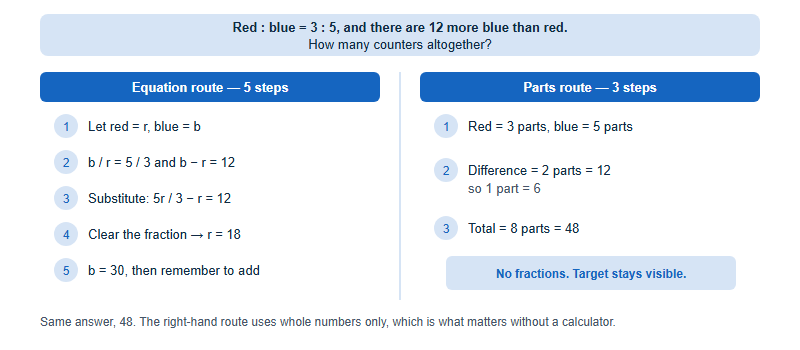
Worked example (written for this article, not taken from a past paper): a box holds red and blue counters in the ratio 3 : 5, and there are 12 more blue than red. How many counters are there altogether?
The equation route defines two variables, forms b/r = 5/3 and b − r = 12, substitutes to get 5r/3 − r = 12, clears the fraction, finds r = 18, then b = 30, then remembers to add them. Five steps and one fraction.
The parts route reads the ratio as a physical description. Red is 3 parts, blue is 5 parts, so the difference is 2 parts. Two parts equal 12, so one part is 6. The total is 8 parts, which is 48. Three steps, no fractions, and the total was in view the whole time.
The habit to build: every phrase in a ratio question should be translated into parts before any number is used. “12 more blue than red” is 2 parts = 12. “There are 64 altogether” is 8 parts = 64. “Blue is twice red plus 4” is a warning sign that this is no longer a pure ratio question and you may be in equation territory — more on that below.
Setup 2 — Rate and work: fix the unit before you touch the numbers
Rate questions punish fraction arithmetic, and there is a standard way to remove almost all of it: choose the size of the job yourself, and choose it to be the lowest common multiple of the times given.
Example: one tap fills a tank in 6 minutes, a second fills it in 12 minutes. How long together? Instead of adding 1/6 and 1/12, declare the tank to be 12 units. Now tap one delivers 2 units a minute, tap two delivers 1 unit a minute, together 3 units a minute, and 12 ÷ 3 = 4 minutes. Every number in that chain is a whole number.
Speed questions are the same family with a different trap. A cyclist rides 60 km out at 30 km/h and returns at 60 km/h. What is the average speed for the whole trip? The trap answer is 45, the mean of the two speeds, and it will be among the options. Average speed is always total distance divided by total time: 120 km over (2 + 1) = 3 hours, so 40 km/h. The rule to memorise is short and absolute: rates are never averaged, only totals are divided.
- Combined work → job = LCM of the individual times, then add the per-minute rates.
- Average speed → total distance ÷ total time, computed separately.
- Someone joins or leaves partway → count the units of work already done, then restart the clock on the remaining units.
Setup 3 — Percent: everything is a multiplier
Convert every percentage change into a multiplier immediately, before doing anything else. Up 20% is ×1.2. Down 20% is ×0.8. A 25% discount is ×0.75. Once the changes are multipliers, sequences of changes are handled by multiplication, and the classic traps stop working.
A price rises 20% and then falls 20%. The instinct says it is back where it started. The multipliers say 1.2 × 0.8 = 0.96, so it ended 4% below the original. The order does not matter, because multiplication commutes — a useful thing to notice, because questions sometimes reverse the order to see whether you believe it does.
The harder trap is directional language. If x is 25% more than y, then x = 1.25y, so y = x ÷ 1.25 = 0.8x, which makes y 20% less than x — not 25%. The percentage always refers to whatever comes after “than”. Whenever a question says “more than” or “less than”, underline the noun that follows it; that noun is the 100%.
Setup 4 — Average: recover the total first, always
A mean is a compressed total, and almost every AMC 8 mean question becomes easy the moment you decompress it.
Example: the mean of five numbers is 12. One number is removed and the mean of the remaining four is 13. Which number was removed? Total before is 5 × 12 = 60. Total after is 4 × 13 = 52. The removed number is 8. There is no algebra at all once the totals exist.
The trap is combining groups of different sizes. A class of 20 averages 70 and a class of 30 averages 80; the combined average is not 75. Totals: 1400 and 2400, so 3800 over 50 students, giving 76. It sits above 75 because the larger group is the higher-scoring one — and noticing that direction before you compute gives you a free check on your answer.
When you genuinely should write an equation
This is not an argument against algebra. It is an argument for spending it where it pays. Three signals say the equation is the efficient route:
- Two independent unknowns tied by two conditions that both mix them. Ticket-and-coin problems — “42 items, some at 3 yuan and some at 5, total 158 yuan” — are genuine simultaneous systems. No amount of clever reading collapses them into parts.
- The unknown appears on both sides in a way that is not simple scaling. “After giving away a third and then 4 more, she has 10 left” is cleaner as an equation, or as a backwards walk from the end. Either is fine; parts reasoning is not.
- The answer options are not usable as inputs. Testing options only helps when the five values are clean and the relationship is monotonic. When the options are ugly or widely spread, solving directly is faster.
The mirror image of signal three is worth stating on its own, because it is the single most under-used tool on the paper: when the five options are clean integers and the quantity moves in one direction, test the middle option first. One test tells you whether to go up or down; a second usually finishes the job. Two arithmetic checks often beat four lines of manipulation, and they carry far less risk of a sign slip.
A 20-minute weekly drill
This is deliberately short, because the skill being trained is routing, not solving. Run it once a week alongside your normal work, ideally on the same weekday so it survives a shifting January exam date — the AMC 8 is administered inside a competition week rather than on a fixed day, which is covered in the 2026-27 registration and logistics guide.
- Minutes 0–5 — routing only. Take twelve word problems from past papers. Do not solve any of them. Write only the setup name against each: parts, unit, multiplier, total, or equation. Check against the solutions afterwards. Mis-routing is the error you are hunting.
- Minutes 5–15 — solve six. Pick six of the twelve, one from each category plus two repeats of whichever you routed wrongly. Time yourself at 90 seconds each and stop when the timer goes, whether or not you are finished.
- Minutes 15–20 — log the misses. For each miss, write one line: was it the route, the arithmetic, or the target quantity? Over a term this log stops being a list of problems and becomes a list of two or three repeating habits, which is what you can actually fix.
Students often report the same thing after four or five weeks of this: the questions did not get easier, but the first ten seconds got quieter. That is the whole point. On a 40-minute paper, the time you save is mostly time you never spent going down the wrong road.
Questions students ask
Is it wrong to use algebra on the AMC 8?
Not at all. It is simply slower on ratio, rate, percent and average questions. Save it for genuine two-unknown systems, where it is the efficient route.
How much algebra does the AMC 8 actually assume?
The paper is for students in grade 8 and under and is sat without a calculator. Treat formal algebra as one tool among several rather than the default; confirm current syllabus guidance on maa.org.
When should I test the answer choices instead of solving?
When the five options are clean integers and the quantity changes in one direction. Start with the middle option: one test tells you which way to move.
Why do I get the right equation but the wrong answer?
Usually you solved for a part and the question asked for the total. Circle the target quantity in the question before you start, and check it again before you bubble.
This is an independent guide operated by Hanlin Education for China-based international-school students. It is not affiliated with, endorsed by, or sponsored by the Mathematical Association of America (MAA). All example problems on this page were written for this article and are not reproduced from any past paper. Competition format, eligibility and syllabus guidance are set by the MAA and can change — always confirm current details on maa.org. If you spot an error on this page, tell us and we will correct it within 7 working days.