If your child is in grade 8 this year, the January 2027 AMC 8 is their last one: MAA eligibility is grade 8 and under, so there is no next attempt. That changes the planning question from “how do we improve by next year” to “how do we finish well”. It also creates an odd calendar — the step-up exam, the AMC 10, arrives in November, roughly ten weeks before the final AMC 8.
Why grade 8 is a different planning problem
For a grade 6 or grade 7 student, an AMC 8 sitting is a rung. A weak score is diagnostic information with a whole year of runway behind it, and the sensible response is to log the gaps and come back. That logic is what most preparation advice is built on, and for younger students it is right.
In grade 8 the same advice quietly stops applying. There is no coming back. Three consequences follow, and each one changes a decision families usually make on autopilot:
- Diagnostics have to happen earlier. A first full mock in December is fine when there is another year; in a final season it leaves nothing to act on. The diagnostic work belongs in August and September.
- Breadth beats depth in the last stretch. With one attempt left, an unshored topic domain is a permanent hole rather than a project for next spring. Shoring four shallow weaknesses usually returns more than perfecting one strength.
- The step-up decision comes due before the final sitting. This is the counterintuitive one, and it is a calendar fact rather than a matter of judgement. Details below.
None of this argues for treating January as high-stakes. The AMC 8 is a middle-school mathematics competition, not an admissions gate, and no single score determines anything. It argues only for sequencing the year deliberately, because there is no second pass.
One season, two calendars — and the harder exam comes first
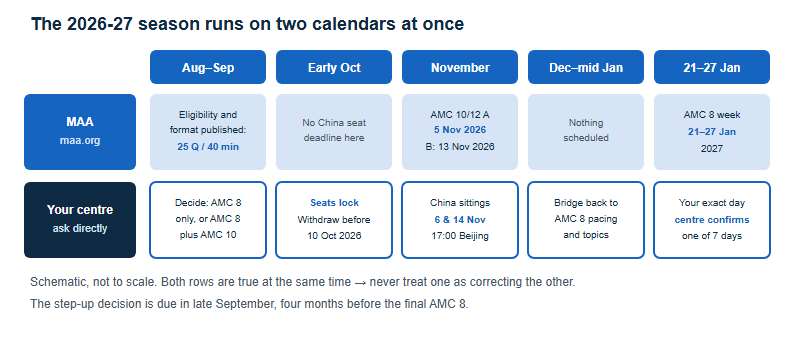
Here is the shape of 2026-27 as the MAA has published it on maa.org: AMC 10 A and AMC 12 A on 5 November 2026, AMC 10 B and AMC 12 B on 13 November 2026, and the AMC 8 across a competition week, 21 to 27 January 2027. Read that ordering again. For a grade 8 student, the exam one grade level up happens in the autumn; the exam they are ageing out of happens in the winter.
Overlaid on that is a second calendar that the MAA does not publish and cannot: the one your test centre runs. For the November competitions, our China-region authorised centres are scheduling their own sittings on 6 November and 14 November 2026, 17:00–18:15 Beijing time, on a bilingual paper at 120 RMB per sitting (operator briefing, 6 August 2026). A date published in United States terms and a local administration slot in Beijing time are two different facts about two different things — neither one corrects the other, and quoting one against the other only creates confusion. For January, the MAA gives the week; your centre gives the day. If you have not yet chosen a centre, the 2026-27 in-person AMC 8 guide covers how China-based families find one and register.
The decision deadline is the part families miss. For those November sittings, our briefing has seats locking in early October, with withdrawal possible before 10 October 2026 and not afterwards. So the question “should my grade 8 child also sit an AMC 10 this year?” has to be answered in late September — roughly four months before their final AMC 8, and before the season has produced much evidence either way. Those cut-offs belong to the November cycle; the AMC 8 equivalents come separately from your centre and should not be assumed to match.
The Achievement Roll: what an early AMC 10 actually offers a grade 8 student
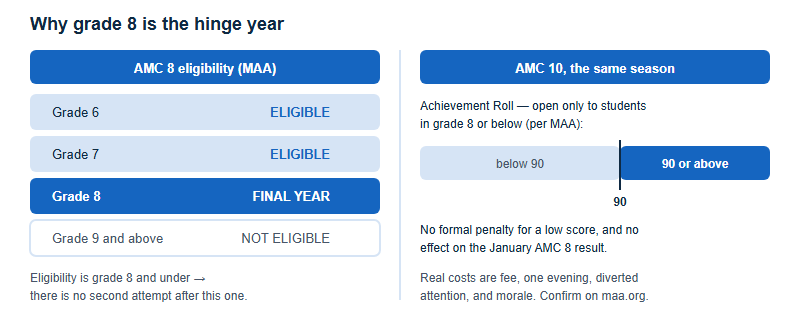
The MAA recognises students in grade 8 or below who score 90 or above on the AMC 10 — the Achievement Roll (confirm the current criteria on maa.org). That is worth understanding precisely, because it is usually described loosely in one direction or the other.
What it means in practice is that the recognition structure of an early AMC 10 attempt is one-sided. There is something specific to be earned that older students cannot earn, and a low score carries no formal penalty and no bearing on their AMC 8 result ten weeks later. In that narrow sense the phrase “upside without downside” is fair.
But it is worth being honest about the costs that are real, because they are not zero: an entry fee, an evening in early November, several weeks of preparation attention diverted from AMC 8 material, and — the one families underestimate — the morale effect on a thirteen-year-old who sits a much harder paper and finds most of it out of reach. That last cost is manageable, but only if it is framed before the exam rather than explained afterwards. The framing that works is simply the truth: the AMC 10 is written for students up to grade 10, the two papers are scored on different schemes, and a grade 8 student attempting it is deliberately sitting above their level.
Splitting five months without damaging either exam
If you do decide on both, the sequencing problem is real: roughly ten to twelve weeks separate the November sitting from the January window, and the two papers reward different behaviour. The mistake to avoid is treating November as the main event and January as a mopping-up exercise. It is the other way round — January is the exam your child is actually eligible to be measured on.
| Stage | Focus | What to protect |
|---|---|---|
| Aug – mid Sep | Full AMC 8 diagnostic under real conditions, then repair by topic domain | Do this before the step-up decision, so the decision has evidence behind it |
| Mid Sep – early Oct | Decide: AMC 8 only, or AMC 8 plus AMC 10. Register accordingly | Seats lock in early October; withdrawal cut-off 10 Oct 2026 for the November cycle |
| Oct – early Nov | If sitting AMC 10: harder material, longer questions, different scoring | Keep one AMC 8 timed paper a fortnight running underneath — do not stop entirely |
| Mid Nov – mid Dec | Bridge back: AMC 8 pacing, 25 questions in 40 minutes, no calculator | Speed on questions 1–15, which AMC 10 work quietly de-trains |
| Mid Dec – 20 Jan | Taper. Weekly full paper, error log, no new topics | Accuracy on the early block; sleep and routine through winter break |
| 21–27 Jan 2027 | Final AMC 8, on the day your centre has set | Be competition-ready on every day of the week, not one guessed day |
Two details in that table deserve emphasis. First, the fortnightly AMC 8 paper during the AMC 10 build is not optional padding; it is what prevents a student returning in mid-November having lost the habit of moving quickly through easy questions. Working on harder material for six weeks makes students more thorough, and thoroughness on question 3 of a 40-minute paper is a cost, not a virtue.
Second, the final row is a genuine constraint rather than a slogan. The MAA publishes the AMC 8 as a week and the administering centre picks the day inside it, so a plan built around one assumed date can be wrong by up to six days. Build a flat final fortnight instead of a spike, and confirm your day in writing — the registration and logistics guide covers what to ask your centre and when.
What a final AMC 8 score is — and what it is not
Because there is no next attempt, families sometimes load the January result with meaning it cannot carry. A few boundaries, stated plainly:
- It is not an admissions decision. No competition score admits or rejects anyone, and any claim otherwise should be treated with suspicion. A result is one line of evidence about mathematical interest and training, read alongside everything else.
- It is not a ceiling. The AMC pathway continues at AMC 10 and beyond for years afterwards; the exam ends, the mathematics does not. A grade 8 student who finishes with a middling AMC 8 and then spends grade 9 working properly is in a stronger position than one who peaked in January.
- It is a clean baseline. This is its most practical use. A final AMC 8 taken under real conditions gives an honest starting point for AMC 10 planning — which domains held up under time pressure and which did not.
- It is the end of one habit, not the end of a habit. The weekly timed paper, the error log, the discipline of leaving a hard question alone: all of that transfers directly. Keep the routine and change the paper.
The last-year checklist
- Sit a full timed AMC 8 paper before mid-September, under real conditions: 25 questions, 40 minutes, no calculator, no interruptions.
- Map the misses by topic domain, not by question number. Four shallow gaps beat one deep one at this stage.
- Make the AMC 10 decision by late September, in time for the early-October seat lock and the 10 October 2026 withdrawal cut-off our briefing gives for the November cycle — confirm both with your own centre.
- Register for the January AMC 8 and ask your centre, in writing, which day inside 21–27 January 2027 they will run, and at what local time.
- Keep one AMC 8 timed paper every fortnight through any AMC 10 build. Do not go dark on it.
- Stop introducing new material after the first week of January. Extra days are for rest and rehearsal.
- After the result arrives, write the AMC 10 plan the same week, while the diagnosis is still fresh.
Questions families ask
Can a grade 9 student sit the AMC 8?
No. MAA eligibility is grade 8 and under, so grade 8 is the final year. Confirm current eligibility rules on maa.org.
Should a grade 8 student sit the AMC 10 in November as well?
It is optional. The MAA recognises grade 8 and below scoring 90 or above on the AMC 10, and a low score carries no formal penalty — but the fee, time and attention costs are real.
Why does the AMC 10 come before the final AMC 8?
Calendar, not design. The MAA lists AMC 10/12 on 5 and 13 November 2026 and the AMC 8 for the week of 21–27 January 2027.
When must we decide about November?
By late September. For the November cycle our China-region centres lock seats in early October, with withdrawal possible before 10 October 2026 and not after.
This is an independent guide operated by Hanlin Education for China-based international-school students. It is not affiliated with, endorsed by, or sponsored by the Mathematical Association of America (MAA). Competition dates, eligibility, award criteria and registration rules are set by the MAA and by individual authorised test centres and can change — always confirm current details on maa.org and directly with your centre. Nothing here is a prediction of any competition result or admissions outcome. If you spot an error on this page, tell us and we will correct it within 7 working days.