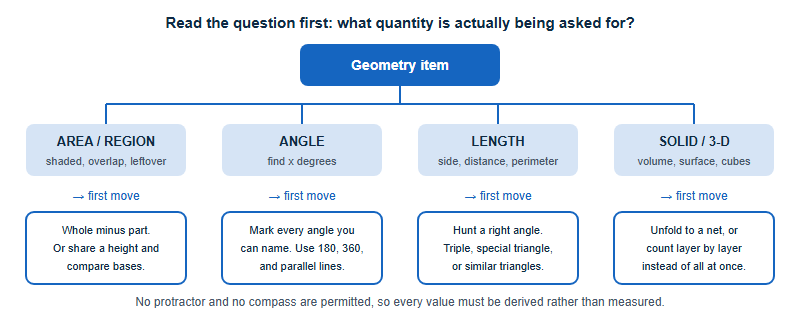
AMC 8 geometry is not a long syllabus. It is a short formula set plus about a dozen configurations that recur every year in new clothing. This page is built as a card you come back to: the formulas, the twelve configurations with the cue that identifies each one and the first move it demands, three fully worked keys, and the exact values you must hold symbolically because there is no calculator.
The bag rules are geometry instructions in disguise
Start with what the MAA permits in the room, because it silently determines how every geometry question must be solved. The 2026 AMC 8 Teacher’s Manual lists the permitted items as writing utensils, blank scratch paper — explicitly not graph paper — rulers and erasers. The prohibited list includes calculators, smartwatches, phones, computing devices, compasses, protractors and graph paper.
Read that list as an examiner’s statement of method. A ruler is allowed, but a compass and a protractor are not, and graph paper is not. So no angle on the page can be measured, no circle can be constructed, and no figure can be plotted onto a grid you did not draw yourself. Every geometric quantity has to be derived from given information. Students who habitually check an answer by eyeballing the diagram are relying on a tool they will not have, and the habit fails precisely on the questions designed to punish it — the ones where the drawing is not to scale.
The working rule for the whole of this card, therefore: treat the diagram as a labelled map of relationships, never as a measurement. If your reason for an answer is “it looks about right”, you have not answered. Twenty-five questions in forty minutes leaves roughly ninety seconds each, and the fastest reliable route through a geometry item is recognition — naming the configuration, then executing its known first move. (For the full permitted-items list and the rest of the exam-day rules, see our guide to the in-person January sitting, and confirm the current list on maa.org.)
The formula set that actually earns points
This is the whole list worth committing to memory for this exam. Anything beyond it is either derivable from these or belongs to a later rung of the ladder.
| Object | Formula | Where it hides on the AMC 8 |
|---|---|---|
| Rectangle / square | Area = lw; Perimeter = 2(l+w) | The “whole” in almost every subtraction problem |
| Triangle | Area = ½·base·height | Height is often outside the triangle — extend the base |
| Parallelogram | Area = base·height | Height is the perpendicular, never the slanted side |
| Trapezoid | Area = ½(a+b)·height | Cut-corner and roof-shaped regions |
| Circle | Area = πr²; Circumference = 2πr | Watch for diameter given instead of radius |
| Sector / arc | Fraction of the circle = angle ÷ 360 | Quarter and semicircle regions inside squares |
| Right triangle | a² + b² = c² | Diagonals, ladders, distances, cube space-diagonals |
| Polygon angles | Interior sum = (n−2)·180; exterior sum = 360 | Regular polygon and tiling questions |
| Prism / cylinder | Volume = base area × height | One formula covers both; find the base area first |
| Cube of side s | Volume s³; surface area 6s² | Painted-cube and unit-cube counting problems |
The card: 12 configurations, their cue, and the first move
This is the part to print. Recognition is the skill being tested; the algebra afterwards is usually short. When practising, force yourself to write the configuration number in the margin before you write any arithmetic — the goal is that naming happens in under ten seconds.
| # | Configuration | Recognition cue | First move |
|---|---|---|---|
| 1 | Composite region | A shaded shape with a curved or notched boundary | Write it as whole − part, and name both |
| 2 | Rearrangement / symmetry | The shaded and unshaded parts look interchangeable | Ask whether shaded is exactly half, or slide a piece |
| 3 | Shared height | Two triangles with bases on the same straight line and a common apex | Area ratio = base ratio; skip finding the height |
| 4 | Similar triangles | Parallel marks, or a small triangle nested in a big one | Match corresponding sides, then one proportion |
| 5 | Pythagorean triple | Two of 3-4-5, 5-12-13, 8-15-17, 7-24-25 or a multiple | Read off the third side; do not square anything |
| 6 | Special right triangle | 45° or 30°/60° marked, or a square’s diagonal | Apply 1 : 1 : √2, or 1 : √3 : 2 |
| 7 | Parallel lines cut by a transversal | Arrowheads on two lines | Chase equal angles across the transversal, then use 180° |
| 8 | Angle sums | An unknown angle with several known ones around it | Choose the right total: 180 in a triangle, 360 around a point |
| 9 | Sector of a circle | A pie slice, quarter, or semicircle | Take the angle over 360 and multiply the whole circle |
| 10 | Circle and square together | Circle inscribed in square, or square inscribed in circle | Circle in square: side = diameter. Square in circle: diagonal = diameter |
| 11 | Coordinate figure | Vertices given as ordered pairs | Bounding box minus the corner right triangles |
| 12 | Cubes and nets | A stack of unit cubes, or a flattened solid | Count by layer or by face; never count the whole picture at once |
Three worked keys, with the decision point marked
The three problems below were written for this page in the style of the exam — they are not past paper questions. In each key, the line marked DECISION is the only place real thinking happens; everything after it is arithmetic. When you review your own work, that is the line to check.
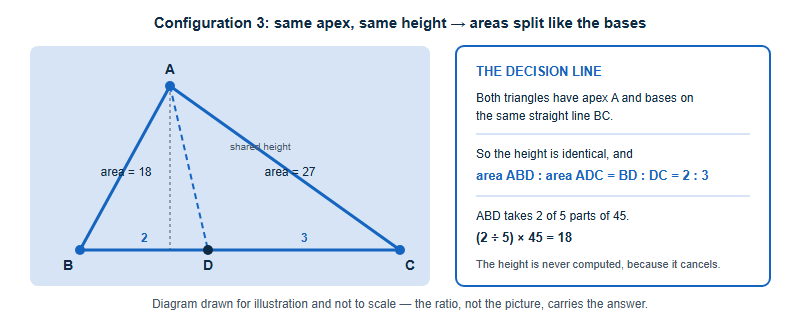
Key A — configuration 3, shared height. In triangle ABC, point D lies on side BC so that BD : DC = 2 : 3. The area of triangle ABC is 45. Find the area of triangle ABD.
- DECISION: triangles ABD and ADC share the apex A, and their bases lie on the same line, so they have the same height. Ratio of areas therefore equals ratio of bases.
- ABD takes 2 parts out of 2 + 3 = 5 parts of the whole.
- Area = (2/5) × 45 = 18. The height was never needed and was never given.
Key B — configurations 1 and 9, composite region with a sector. A square has side 10. A quarter circle of radius 10 is drawn with its centre at one corner of the square. Find the area inside the square but outside the quarter circle.
- DECISION: the shaded shape has a curved edge, so it is not a named shape — write it as whole minus part. Whole = the square. Part = the quarter circle.
- Square = 10 × 10 = 100. Quarter circle = (90/360) × π × 10² = 25π.
- Answer = 100 − 25π. Leave it symbolic: with no calculator, the answer choices on this kind of item are written in terms of π, and converting to 21.46 costs time and invites a rounding trap.
Key C — configuration 11, coordinate figure. A triangle has vertices at (0, 0), (6, 2) and (2, 5). Find its area.
- DECISION: no side is horizontal or vertical, so there is no obvious base and height. Use the bounding box instead of hunting for one.
- Bounding box: 0 ≤ x ≤ 6 and 0 ≤ y ≤ 5, so the box has area 30.
- Three corner right triangles are cut off: legs 6 and 2 gives 6; legs 4 and 3 gives 6; legs 2 and 5 gives 5.
- Area = 30 − 6 − 6 − 5 = 13.
No calculator: what to hold exact, and what to memorise
The calculator ban shapes geometry answers more than it shapes arithmetic. Two rules cover almost everything.
Rule one: do not decimalise π or a surd unless the question forces you to. If a region works out to 100 − 25π, that is the answer, and turning it into 21.46 is strictly extra work plus a rounding risk. Only convert when you are comparing two quantities and cannot see which is larger — and then convert as late as possible.
Rule two: recognition beats computation. The table below is what a fast student has memorised. None of it is deep, and all of it removes multiplication from the clock.
| Hold in memory | Values | Why it saves time |
|---|---|---|
| Squares to 20 | 121, 144, 169, 196, 225, 256, 289, 324, 361, 400 | Recognise 169 as 13² instead of testing factors |
| Pythagorean triples | 3-4-5, 5-12-13, 8-15-17, 7-24-25, plus all multiples | 6-8-10 and 9-12-15 appear constantly as scaled 3-4-5 |
| Special ratios | 45-45-90 is 1 : 1 : √2; 30-60-90 is 1 : √3 : 2 | Converts a square’s diagonal to a side in one step |
| Rough sizes | √2 ≈ 1.41, √3 ≈ 1.73, π ≈ 3.14 | Only for ordering answer choices, never for the final form |
| Sector fractions | 90° = ¼, 60° = 1/6, 45° = 1/8, 120° = 1/3 | Skips the angle-over-360 step entirely |
How to drill the card in three weeks
A reference card is worthless if it is only read. The drill that converts it into recall is short and boring, which is why most students skip it.
- Week 1 — naming only. Take geometry items from past papers and write nothing but the configuration number in the margin. No solving. Twenty items in fifteen minutes. You are training recognition speed, and separating it from arithmetic is the point.
- Week 2 — first move only. Same items, now write the configuration number and the single first move, then stop. If you cannot state the first move in one line, the configuration was misnamed — go back and re-name it.
- Week 3 — full solutions, timed at ninety seconds. Anything that overruns gets logged by configuration number, not by topic. A log that says “three misses, all configuration 4” tells you what to fix. A log that says “geometry, weak” tells you nothing.
Fit that three-week block against a fixed exam date rather than a vague one. The MAA publishes the 2027 AMC 8 as a competition week, 21 to 27 January 2027, and the specific day inside that week is chosen by the centre administering your paper — so pin the date down before you build a schedule around it. Our guide to the in-person January sitting and finding an authorised centre covers how to get that date, and the current rules and dates should always be confirmed on maa.org.
One last note on what this card deliberately leaves out. There is no trigonometry here, no circle theorems about inscribed angles, no coordinate distance formula drilled as a formula. Those belong to the next rung. On the AMC 8, a student who can name twelve configurations on sight and execute the first move cleanly, with no calculator and no protractor, is doing the thing the exam was built to reward — and is doing it inside ninety seconds a question. For a mapping of how the wider topic list is distributed, and where geometry sits relative to the other domains, the syllabus and difficulty-ramp material on this site fills in the surrounding picture.
Q: Can I use a ruler on the AMC 8?
Yes. The MAA lists rulers as permitted, with writing utensils, blank scratch paper and erasers. Compasses and protractors are prohibited.
Q: Is graph paper allowed for coordinate questions?
No. Graph paper is on the prohibited list; only blank scratch paper is permitted. Draw your own axes when you need them.
Q: Should I convert answers containing π into decimals?
Usually not. Keep π and surds symbolic unless you must compare sizes. Converting costs time and adds rounding error.
Q: How much AMC 8 geometry is really just area subtraction?
A large share of shaded-region items reduce to whole minus part. Name both shapes before computing anything.
This is an independent guide operated by Hanlin Education for China-based international-school students. We are not affiliated with, endorsed by, or sponsored by the Mathematical Association of America (MAA). Permitted materials, competition dates and rules change between cycles — confirm all current details on maa.org and with your test centre before acting. Any error brought to our attention is corrected within 7 working days.