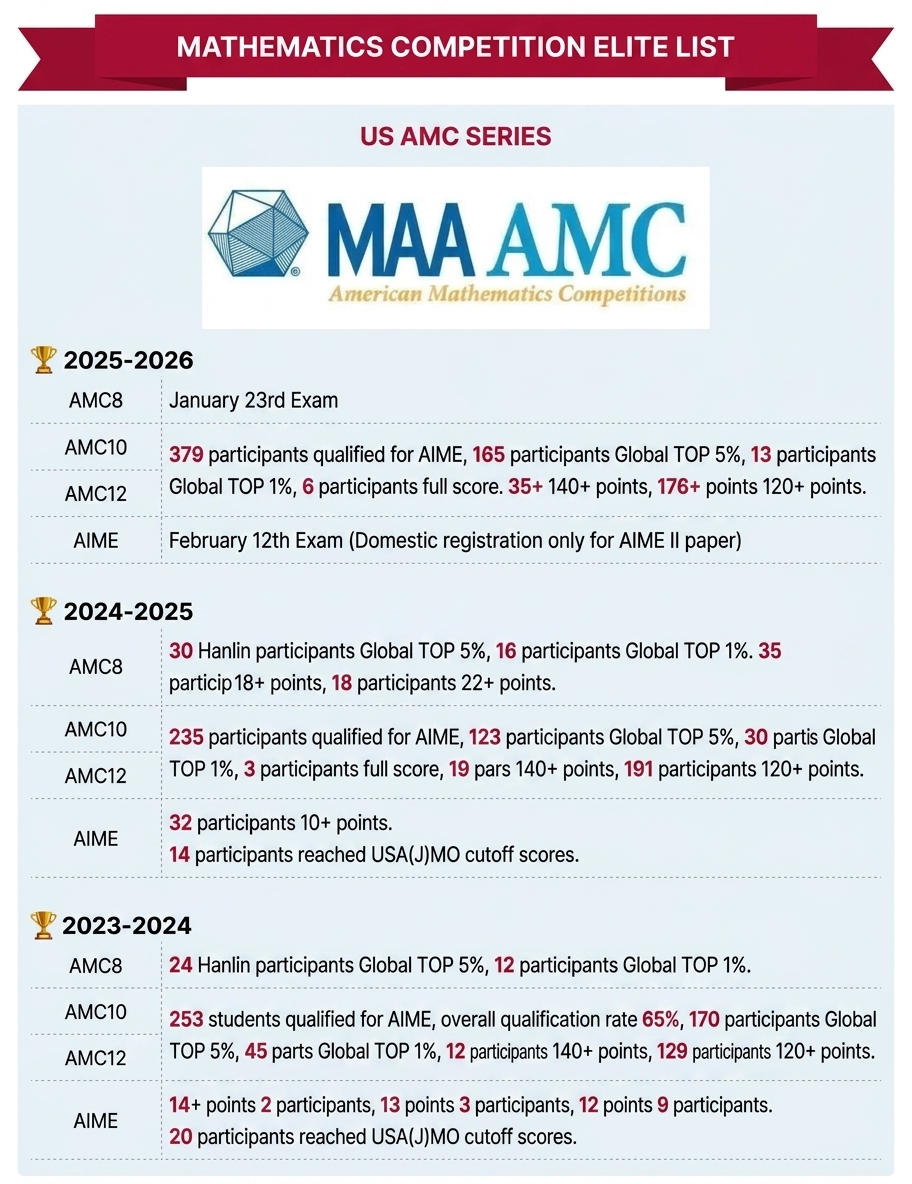
The AMC 8 math competition is held once a year, each January (the next sitting is the January 2027 season), in a single 40-minute window. Participants must be in 8th grade or below and not exceed 15.5 years of age on the day of the exam. This 40-minute challenge consists of 25 multiple-choice questions, with a maximum score of 25 points — 1 point for each correct answer, and no deduction for incorrect or unanswered questions.
For hundreds of thousands of primary and secondary school students worldwide, AMC8 is not only a touchstone of mathematical ability but also a valuable platform for cultivating logical thinking and problem-solving skills. This article provides a comprehensive analysis of the AMC 8 and effective preparation strategies to help you stand out in this intellectual competition!
I. Registration Methods
Individual registration is not supported for the AMC8. Registration is mainly conducted through the following three channels:
| Registration Method | Target Audience | Specific Steps |
|---|---|---|
| School Group Registration | The student’s school is an official AMC partner test center | Registration is organized centrally by school teachers |
| ASDAN Platform Self-Registration | The student’s school is an ASDAN partner school | Register through the “ASDAN International STEM Assessment” WeChat mini-program |
| Agency Proxy Registration | Students whose schools are not test centers | Proxy registration through officially authorized third-party educational institutions |
II. Syllabus Analysis
The AMC 8 syllabus shows an overall trend toward higher knowledge integration and stronger ties to real-world scenarios. The table below details the approximate weight distribution and characteristics for each module:
| Knowledge Module | Weight | Core Changes & New Topics |
|---|---|---|
| Algebra & Probability | 40%–45% | Strengthened integration of probability and statistics with real-world scenarios (e.g., supermarket promotion models); quadratic function modeling (e.g., carbon emission optimization). |
| Geometry | 25%–30% | New: dynamic analysis of 3D nets; integration of the Pythagorean theorem with building structural stability problems; enhanced calculation of irregular shapes. |
| Number Theory & Combinatorics | 20%–25% | Increased difficulty in prime factorization and integer properties; new addition of innovative topics such as sum of geometric sequences. |
As can be seen from the table, algebra and probability remain the focus of assessment, but the comprehensiveness and applicability of geometry and number theory/combinatorics problems have significantly increased. Problem statements increasingly incorporate unstructured information such as charts and business data. Problem backgrounds often involve cutting-edge fields such as smart cities and carbon neutrality, marking a strategic shift from “problem-solving skills” to “real-world modeling ability.”
A reminder on scoring: the AMC 8 is entirely multiple-choice. You earn 1 point for each correct answer and 0 points for a wrong or blank answer, with no penalty for wrong answers and no grading of written steps. Only your final selected answers are scored, so it is always worth attempting every question.
III. Competition Difficulty Analysis
The 25 questions of the AMC8 follow a clear gradient distribution. Understanding this pattern helps in developing effective answering strategies:
| Question Range | Difficulty Level | Characteristics | Preparation Suggestions |
|---|---|---|---|
| Questions 1–5 | Basic | Tests grades 3-4 school knowledge, straightforward | Complete quickly and accurately to buy time for later questions |
| Questions 6–10 | Easy to Medium | Requires some logical thinking, includes text traps | Read carefully, avoid losing points due to carelessness |
| Questions 11–15 | Medium | Involves extension of junior high school knowledge, such as sequences, permutations and combinations | Master knowledge points and apply them flexibly |
| Questions 16–20 | High Difficulty .=Advanced content beyond the regular curriculum, reaching the level of basic Olympiad math | Comprehensive application ability and problem-solving techniques are key | |
| Questions 21–25 | Very High Difficulty .=Determines the top 1% ranking, in-depth Olympiad math problems .=Requires integration of multiple knowledge points and strong calculation skills |
The difficulty of the AMC8 is reflected not only in the depth of knowledge but also in time pressure. Completing 25 questions in 40 minutes gives an average of only 1.6 minutes per question, which is a great test of students’ quick thinking and decision-making abilities. Many students find that time pressure is one of the biggest challenges of the contest.
IV. Preparation Strategies
Foundation Consolidation Phase (From now until 2 weeks before the exam)
Systematically review the four core modules of the syllabus to build a complete knowledge framework.
Spend 15–20 minutes each day on speed calculation exercises to strengthen calculation accuracy.
Focus on practicing questions 1–15 from past papers to master basic question types and problem-solving patterns.
The key at this stage is to identify and fill gaps, keep a mistake notebook, and record common error types.
Skill Enhancement Phase (2–3 weeks before the exam)
Conduct modular review targeted at weak areas, focusing on high-frequency question types such as similar triangles, remainder problems, permutations, and combinations.
Practice solving questions 11–20 using multiple methods to develop flexible thinking.
Begin regular timed mock exams to become familiar with exam pace and time allocation strategies: aim to complete questions 1–10 in 8 minutes, questions 11–20 in 15 minutes, and leave 12 minutes for questions 21–25.
Sprint Phase (1 week before the exam)
Conduct 2–3 full-length mock exams per week to simulate the real exam environment.
Focus on practicing problem-solving techniques such as elimination, substitution, and special value methods.
Review the mistake notebook to avoid repeating errors.
Adjust your daily routine before the exam to ensure you are in the best condition.
It is worth noting that the AMC 8 is showing a trend toward younger participants, with a growing number of strong students in the lower grades taking part. This means competition is becoming more intense, but it also shows that more young students can demonstrate their mathematical talent on this platform through systematic preparation.
V. Common Mistake Points
Many promising candidates lose points due to non-knowledge factors. Here are the most common “traps”:
Careless reading: AMC8 problem statements often include wording traps, such as “maximum” instead of “value”, or the negative “cannot” instead of “can”. The coping strategy is to circle keywords, marking important conditions while reading.
Skipping working on scratch paper: Although only your final answer is scored, rushing without writing down intermediate steps on scratch paper often leads to careless errors. Keep your working neat so you can check it and avoid mistakes on questions you actually know how to solve.
Poor time allocation: Spending too much time on difficult problems while leaving simple ones unfinished is the most common mistake. If you get stuck on a problem, mark it and skip it, then come back to it after completing all the questions.
Unit errors: Watch out for problems that mix units (for example, centimeters and meters). Convert to a common unit before calculating, and quickly check that your answer matches the units the question asks for before selecting it.
Psychological factors: Nervousness can lead to rigid thinking or simple calculation errors. Develop your test-taking mindset through multiple mock exams, treating the real exam as just another practice session.
VI. Award Categories
AMC8 awards are divided into individual and team categories. Individual awards include:
Perfect Scores: Achieving a perfect score of 25 points.
Distinguished Honor Roll (DHR): Top 1% globally, typically requiring 21–23 points.
Honor Roll (HR): Top 5% globally, typically requiring 17–19 points.
Achievement Roll (AR): Students in 6th grade or below who score 15 points or more.
Score cutoffs for the past five years:
| Year | Top 1% Score Cutoff | Top 5% Score Cutoff |
|---|---|---|
| 2025 | 23 points | 19 points |
| 2024 | 22 points | 18 points |
| 2023 | 21 points | 17 points |
| 2022 | 22 points | 19 points |
| 2020 | 21 points | 18 points |
From the data, it can be seen that the top 1% score cutoff fluctuates between 21 and 23 points, and the competition intensity is increasing year by year. For students in grades 6–8, a target can be set at the top 5% (17+ points) or top 1% (22+ points); for students in grades 3–5, a first-time target can be set at the Achievement Roll of around 15 points.
VII. Practical Application of the Syllabus
New test points in algebra and probability, such as the “supermarket promotion model,” require students to abstract probabilistic relationships from complex scenarios. For example, a problem may describe the relationship between the probability of winning a prize in a supermarket promotion and inventory levels, requiring students to establish a dynamic calculation model. When preparing, you should practice more with such real-world scenario math problems to develop modeling thinking.
The newly added “dynamic analysis of 3D nets” in geometry requires students to have strong spatial visualization skills. Practice more with unfolding and folding 3D shapes to understand the transformation between 2D and 3D. The “integration of the Pythagorean theorem with building structural stability” reflects the application of mathematics in real life; you need to learn to transform abstract theorems into tools for solving practical problems.
The difficulty of number theory and combinatorics has increased significantly. “Using short division to find LCM/GCD” requires fast calculation ability, while “sum of geometric sequences with modular arithmetic” requires understanding the combined application of sequences and modular arithmetic. Targeted practice in this area can improve problem-solving speed and accuracy.
AMC8 not only tests mathematical knowledge but also cultivates logical thinking, innovation, and adaptability — qualities that are increasingly important in the era of artificial intelligence. Through systematic preparation, what you gain will be not only awards but also improved problem-solving skills and mathematical thinking. Now, pick up your preparation plan and begin this challenging and enjoyable math journey! Remember, persistent effort and the right methods are more important than talent. Every moment of problem-solving is a testament to the growth of your thinking.
AMC8 Preparation Courses
Our instructors are graduates from top global universities. With precise curriculum planning and comprehensive learning tracking, we ensure your score improvement and award-winning success!
| Class Type | Hours | Class Size | Start Date |
|---|---|---|---|
| Winter Break Class | 30H | 3–8 students | Consult teacher for details |
| Systematic Course | 20H | 1v1 / 3–8 students | Consult teacher for details |
| Problem-Solving Class | 20H | 1v1 / 3–8 students | Consult teacher for details |