If your child spent two or three years in olympiad-style maths training before moving to an international school, most of that work transfers to the AMC 8 — arithmetic fluency, standard word-problem models, and a genuine tolerance for hard problems. What does not transfer is exam behaviour. A 25-question, 40-minute multiple-choice paper with no calculator rewards several habits that olympiad training actively discourages.
What transfers — and it is worth more than families think
Parents in this position often ask the wrong question. They ask whether the olympiad content was “the right content” for the AMC 8. Mostly it was, and that is not where the risk sits.
Four things carry over almost intact:
- Arithmetic without a calculator. The AMC 8 does not permit calculators. A student who has spent years computing by hand has a real, compounding advantage over classmates who have leaned on a device since Year 6 — not because the questions are computational, but because none of their working capacity is being spent on the arithmetic underneath the reasoning.
- Word-problem archetypes. Rate and distance, work rates, ratio and proportion, mixtures, ages. Olympiad-style training drills these to the point of automaticity, and versions of them appear on the AMC 8 constantly. The trained student recognises the shape of the problem before finishing the stem, which is worth twenty or thirty seconds every time it happens.
- Number sense. Comfort with factors, multiples, digit structure and divisibility is exactly the toolkit the AMC 8’s number-theory questions want, and it is the area where students without that background are slowest to catch up.
- Tolerance for difficulty. This is the underrated one. A great many capable students give up on a problem that has not yielded within twenty seconds, because nothing in their schooling has asked them not to. A student who has been trained to sit with a problem has a temperament advantage that no six-week course can manufacture.
Taken together that is a strong starting position. The problem is that it is a starting position in mathematics, and the AMC 8 is partly a test of something else.
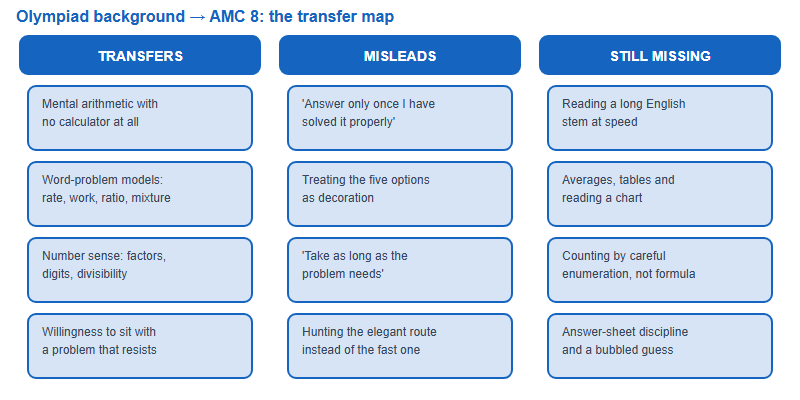
What misleads: four trained habits that quietly cost points
None of the habits below are bad habits. Each one was rational in the setting it was learned in, which is exactly why they survive the move and why nobody thinks to challenge them.
| Trained habit | Why it made sense before | What it costs on the AMC 8 | The replacement |
|---|---|---|---|
| Only answer once you have solved it properly | Full-solution formats reward completeness and penalise a bare number | AMC 8 scoring gives one point per correct answer with no penalty for a wrong one, so an empty box is a discarded point | Bubble something for every question, without exception, before the bell |
| Ignore the answer options | In many training formats there are no options to use | Five given choices are usable information — they bound the answer, expose the intended units, and sometimes let you test rather than derive | Read the options immediately after the stem, before choosing a method |
| Take as long as the problem needs | Long sittings with a small number of deep problems | 25 questions in 40 minutes is about 96 seconds each, and every question is worth the same one point | A hard cap per question, then move on and return with what is left |
| Look for the elegant route | Elegance is genuinely rewarded, and it is good mathematics | A beautiful three-minute route scores exactly what an ugly forty-second route scores | Take the fastest reliable path to the answer; save the elegant one for after the exam |
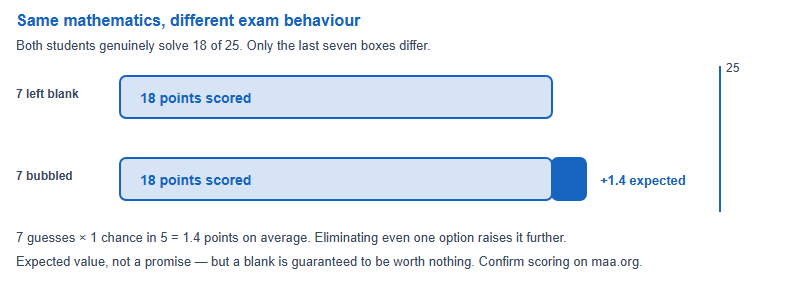
The first row is the biggest single point-loser we see in this group, and it is worth making concrete. Suppose a student solves 18 questions with confidence and, being unwilling to write an answer they have not justified, leaves the remaining 7 blank. They score 18. A student who solves the same 18 and bubbles a considered guess on the other 7 — five options, no penalty — expects roughly 1.4 additional points, and any elimination at all pushes that higher.
The 96-second problem: retraining a student built for long-form thinking
Divide 40 minutes across 25 questions and you get 96 seconds each. That average is misleading in a useful way: the early questions should take a great deal less, which is what makes the later ones affordable. A student who spends 90 seconds each on the first eight questions has already spent 12 of their 40 minutes on the cheapest points on the paper.
For a student trained in a long-form setting, this is the hardest adjustment on the list, and the reason is psychological rather than mathematical. Three minutes into a hard problem, abandoning it feels like wasting the three minutes. It is not — the three minutes are gone either way, and the only live question is what the next two minutes buy. Naming this out loud with a student, once, tends to do more than any amount of pacing advice.
The drill we use is a two-pass run:
- Pass one. Work forward through the paper. Any question that has not broken open within about 90 seconds gets a mark in the margin, an immediate bubbled guess, and no further thought. The guess is bubbled now, not later, because “later” is the thing that disappears when the bell goes.
- Pass two. Return to the marked questions with whatever time is left, in order of how close they felt. Change the bubble only if the working actually lands.
Run this three or four times under real conditions and the sunk-cost reflex weakens noticeably. Run it never, and a student can walk out of a January sitting having genuinely known the mathematics for five questions they never reached.
What is genuinely missing from an olympiad background
Three gaps show up often enough to be worth checking deliberately, because none of them are visible in a student’s topic knowledge.
Reading an English stem at speed. The mathematics may be familiar while the sentence carrying it is not. Questions built around an everyday scenario — a schedule, a shop, a game with rules described in prose — put a reading load in front of the mathematics, and 96 seconds includes the reading. This is a vocabulary and comprehension job, not a maths job, and it responds quickly to deliberate work.
Data, averages and charts. Olympiad-style training tends to weight number theory, geometry and combinatorics heavily, and to touch statistics lightly. Mean, median, mode, reading a bar chart or a table, and simple questions about how an average moves when one value changes are all fair game on the AMC 8 and are frequently the easiest points on the paper for a well-prepared student — and quietly missing from a strong one’s toolkit.
Counting by enumeration. A student drilled on formulas will reach for a formula. Many AMC 8 counting questions are faster and safer with an ordered list or by counting the complement, and the instinct to list carefully rather than to recall a formula has to be built.
There is also a purely practical layer that has nothing to do with mathematics: the AMC 8 is sat in person during a January window, on paper or digitally depending on the test centre, under supervision, and eligibility is set by the MAA at grade 8 and below with an age condition attached — confirm the current eligibility wording, dates and arrangements on maa.org and against our in-person registration and test-centre guide. Families arriving from a different competition culture often assume the entry route works the way their previous one did, and that assumption is worth checking early rather than in December.
A six-week conversion block for a student who already knows the maths
This block assumes the mathematics is broadly in place and the job is conversion. Do not run it alongside heavy new content work; the point is to change behaviour, and behaviour changes badly when the student is also being asked to learn.
| Week | Target | What you actually do | Evidence it worked |
|---|---|---|---|
| 1 | Format immersion | One paper untimed; read the five options before choosing a method on every question | The student can say what the options told them on at least five questions |
| 2 | Bubbling and guess discipline | Timed set with a rule: nothing may be left blank at the bell, ever | Zero blanks, with guesses recorded so you can see how they landed |
| 3 | Pacing | Two-pass drill with a 90-second cap, run on a full paper | All 25 questions are reached, with time returned to the marked ones |
| 4 | Data and averages | Targeted set: mean and median, tables, charts, “how does the average change” | These stop being the questions that produce a pause |
| 5 | Counting by enumeration | Counting and probability set solved by ordered lists and complements, not formulas | The student lists without embarrassment and stops mid-list at a visible endpoint |
| 6 | Integration | One strict mock: 25 questions, 40 minutes, no calculator, no interruptions | All four replacement habits hold up under real time pressure at once |
Week 6 is the test of the whole block, and the thing to watch is not the score. Watch whether the habits survive together. It is common for a student to hold pacing and lose bubbling, or to hold bubbling and revert to hunting for the elegant route on question 19. Habits that work in isolation and collapse in combination need another cycle, not more mathematics — and a student in this position who runs that second cycle usually arrives at the in-person January sitting with a real advantage, because the mathematics underneath was strong the whole time.
Frequently Asked Questions
Is olympiad training useful preparation for the AMC 8?
Yes for the mathematics — arithmetic, word-problem models and number sense transfer well. The gap is exam behaviour on a timed multiple-choice paper.
Should my child guess if they have not solved the question?
Yes. AMC 8 awards one point per correct answer with no penalty for a wrong one, so a blank is a discarded point. Confirm scoring on maa.org.
My child is strong but never finishes. What do I fix first?
Pacing, not content. Run the two-pass drill with a hard per-question cap before adding any new topics.
Which topics does an olympiad-trained student most often miss?
Statistics and data reading — averages, tables and charts — plus counting done by careful enumeration rather than by formula.
This is an independent guide operated by Hanlin Education for China-based international-school students. It is not affiliated with, endorsed by, or sponsored by the Mathematical Association of America (MAA). Worked illustrations above are our own constructions. Competition details change — always confirm current dates, eligibility, format and scoring information on maa.org. Any error will be corrected within 7 working days.