As one of the most influential youth math competitions globally, the AMC 8 attracts over 300,000 students annually. Its syllabus has trended toward integration and real-world application in recent years. This article provides a comprehensive analysis of the latest developments to help you gain an edge in this intellectual contest.
I. Competition Schedule & Rule Updates
The AMC8 is held once a year in January, in a single 40-minute window; the next sitting takes place in January 2027. In mainland China both an on-campus (offline) and a home-based (online) sitting are offered, and candidates may choose either. Registration each year opens in the autumn and closes a few weeks before the exam. Candidates should note the following key points:
Age Limit: Students who are under 15.5 years old on the day of the exam are eligible to participate. The trend is towards younger participants; in Shanghai, a third-grade student has already successfully reached the top 1% globally.
Question Type Innovation: Among the 25 multiple-choice questions, geometry will account for 30%, with potential new question types combining 3D net diagrams and coordinate systems.
Score Certification: A new feature allows for the instant download of electronic score reports. Scores can be checked via the official system two weeks after the exam.
II. Award Competition: Score Line Predictions & Value Analysis
The award structure continues the pyramid model, but competition intensity is rising:
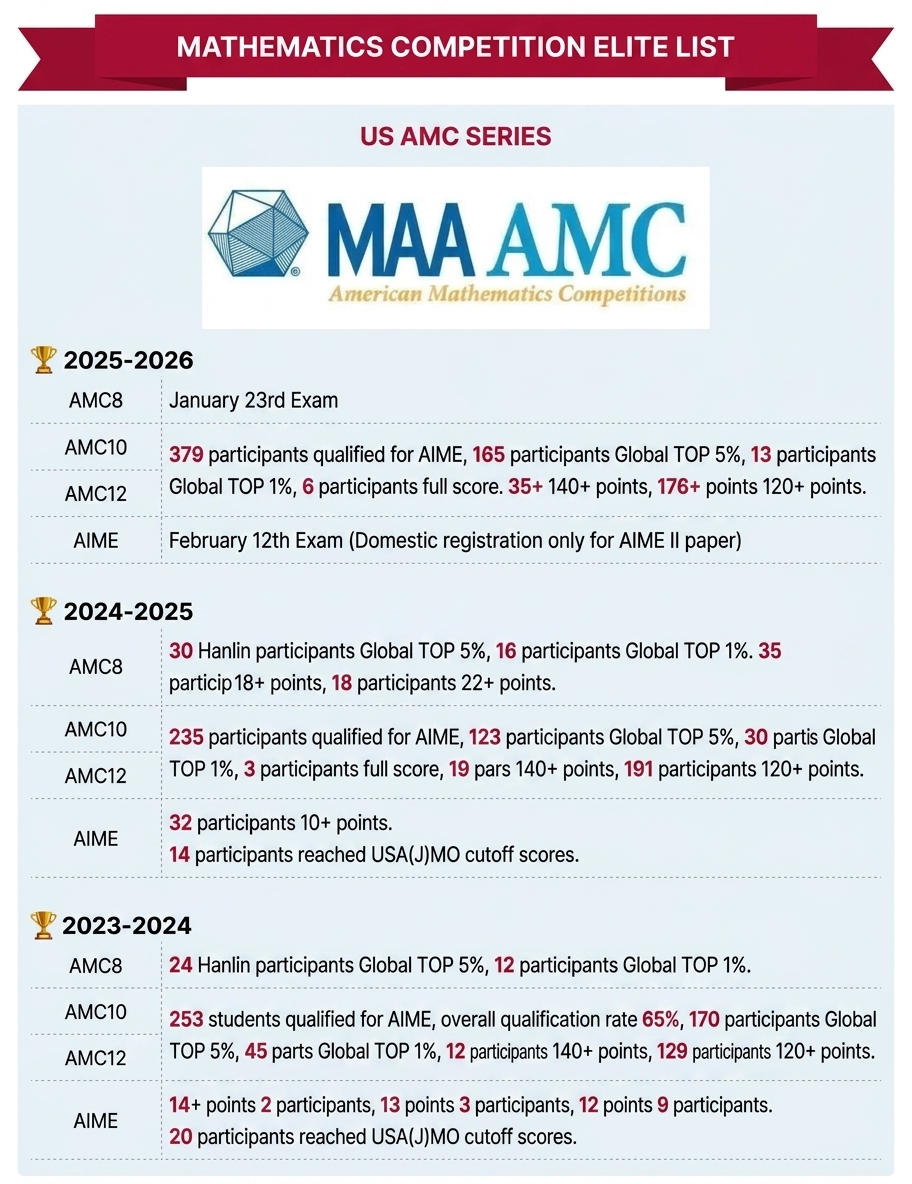
Distinguished Honor Roll (Top 1%): Estimated cutoff score of 21-23 points (out of 25). In key cities like Shanghai, a score of 23 or higher may be required.
Honor Roll (Top 5%): Estimated cutoff score of 17-19 points, serving as a benchmark for admission to international schools.
Achievement Roll (Low Age Breakthrough): Students in grade 6 or below can earn this honor by scoring 15 points. Prestigious schools like Beijing Zhongguancun No. 3 Primary School use this as a selection criterion for their experimental classes.
The competition’s value continues to rise. AMC8 scores have become an “invisible stepping stone” to top secondary schools worldwide. Shanghai’s “San Gong” schools explicitly include top 1% scores as bonus points in interviews. Some international schools directly use AMC8 past paper questions as part of their entrance exams.
III. Comprehensive Topic Analysis: Strategies for the Four Main Modules
Algebra Module (35%-40%): Focus on mastering multivariate equations and sequences. For profit growth rate calculations, master mixed operations of fractions and percentages. “Last-digit elimination” is recommended to improve calculation speed.
Geometry Module (25%-30%): New 3D net diagram question types require understanding the 11 net patterns of a cube. The classic Pythagorean theorem is often tested in combination with circle areas. The “cut-and-paste” method is recommended for solving irregular shapes.
Number Theory Module (15%): Prime factorization and congruence theorems are essential. Proficiency in the Chinese Remainder Theorem is needed for problem-solving. Typical examples include finding combinations of the least common multiple and greatest common divisor of three numbers.
Combinatorics Module (15%-20%): The proportion of permutation and combination questions is increasing. Beware of the pitfalls between “with replacement” and “without replacement” probability. Tree diagrams are recommended for visualizing complex scenarios.
IV. Preparation Roadmap: Three Phases to Accelerate Ahead
Phase 1: Foundation Building (June-August)
Spend 30 minutes daily consolidating core knowledge points from grades 5-6.
Thoroughly study the first 15 questions from past papers (2015-2020) and build an error log.
Focus on breaking through fraction calculations and basic geometry formula applications.
Phase 2: Capability Leap (September-November)
Dedicate 4-6 hours weekly to specialized training, systematically tackling medium-to-high difficulty question types.
Complete questions 16-20 under timed conditions, mastering practical skills like “option substitution.”
Develop geometric model thinking, such as deriving similar triangle proportions.
Phase 3: Peak Sprint (December until exam)
Take full-length mock exams daily (using newer past papers from 2021-2025).
Build a “3-minute problem-solving mindset”: aim to complete the first 10 questions within 12 minutes.
Specialize in tackling final challenging questions, mastering reverse thinking and extreme value verification methods.
V. Parent Support Guide: Three Key Support Strategies
Resource Toolkit: Build an electronic question bank containing past papers from 2000-2025, complemented by a high-frequency formula handbook for micro-learning sessions. A 5-minute speed calculation challenge during daily breakfast is also recommended.
Psychological Nurturing: Adopt a “growth mindset training” approach: turn mistakes into “opportunities to fill gaps in your knowledge map.” Host weekly family problem-solving sessions to explore interesting math puzzles together.
Academic Progression Planning: Awarded students can challenge the AMC10 the following year, forming a progressive chain in their competition portfolio. The Distinguished Honor Roll certificate serves as a core competitive advantage in international school applications.
VI. Exam Survival Rules: Avoiding Common Mistakes
Time Management: Set a segmented timer: limit each set of 5 questions to 8 minutes.
Reading Comprehension Traps: Beware of misreading “at least” as “at most.” For probability questions, confirm the equal likelihood assumption.
Calculation Verification: For geometry, use estimation to check for reasonableness. For algebra, verify by substituting answer options back into the question.
Conclusion: Finding Your Own Coordinates in the Galaxy of Mathematics
The AMC8 is not just a competition; it is a key that opens the door to rational thinking. By mastering scientific methods and accurately breaking through bottlenecks, every participant can gain growth from this global feast of wisdom. As a past perfect scorer once said, “The AMC8 teaches us to see another possibility of the world through the lens of mathematics.” Set off now, the future awaits!
AMC8 Preparation Courses
Our instructors are graduates from top global universities. With precise curriculum planning and comprehensive learning tracking, we ensure your score improvement and award-winning success!
| Class Type | Hours | Class Size | Start Date |
|---|---|---|---|
| Winter Break Class | 30H | 3–8 students | Consult teacher for details |
| Systematic Course | 20H | 1v1 / 3–8 students | Consult teacher for details |
| Problem-Solving Class | 20H | 1v1 / 3–8 students | Consult teacher for details |