The AMC 8 draws on middle-school mathematics across five broad domains: number theory, algebra and patterns, geometry and measurement, counting and probability, and logic-driven word problems. The MAA does not publish fixed weightings, so every domain can appear — and the questions get harder as you go. This map shows what each domain contains, where students quietly leak points, and how to plan coverage. Confirm the current scope on maa.org.
The Shape of the Exam: 25 Questions, 40 Minutes, No Calculator
Before the topics, the frame. The AMC 8 is a 25-question, 40-minute, no-calculator contest for students in grade 8 and under, sat in person in a January window (confirm the exact date on maa.org). Two structural facts should shape how you study the syllabus:
- No calculator. Every computation is by hand or in your head. Mental arithmetic, estimation, and clean number sense are not optional extras — they are the delivery mechanism for every topic below.
- Rising difficulty. The paper generally ramps from accessible early questions to demanding later ones. A domain can appear as a gentle Q4 or a brutal Q23, so “knowing a topic” means being able to handle it at more than one depth.
Because the MAA publishes no rigid topic breakdown, the sensible strategy is breadth with depth: cover all five domains, then push each to a harder tier. For the registration and authorized-center steps behind that January sitting, see our 2026–27 in-person AMC 8 guide.
Keep both facts in view together. A no-calculator paper with a rising difficulty ramp means the cost of slow, error-prone arithmetic compounds precisely when the questions get harder and time gets shorter. Building number fluency early is therefore not a separate “speed” project bolted on at the end — it is the foundation that lets every domain below actually pay off on the day.
The Five Domains, Mapped
Here is the landscape. Treat these as families of ideas that recur year after year, not as an official checklist — the MAA sets the scope and can emphasise domains differently in any given paper.
| Domain | Representative topics | Where it typically appears |
|---|---|---|
| Number theory | Factors, multiples, primes, divisibility, remainders, GCD / LCM, place value | Early to late; late versions get subtle |
| Algebra & patterns | Expressions, linear equations, ratios and proportion, sequences, rates | Throughout the paper |
| Geometry & measurement | Area, perimeter, angles, triangles, circles, coordinate geometry, 3-D shapes | Mid to late; diagrams reward care |
| Counting & probability | Systematic counting, arrangements, combinations, basic probability | Often the hardest late questions |
| Logic & word problems | Multi-step reasoning, work and rate puzzles, translating words to maths | Anywhere; deceptively wordy |
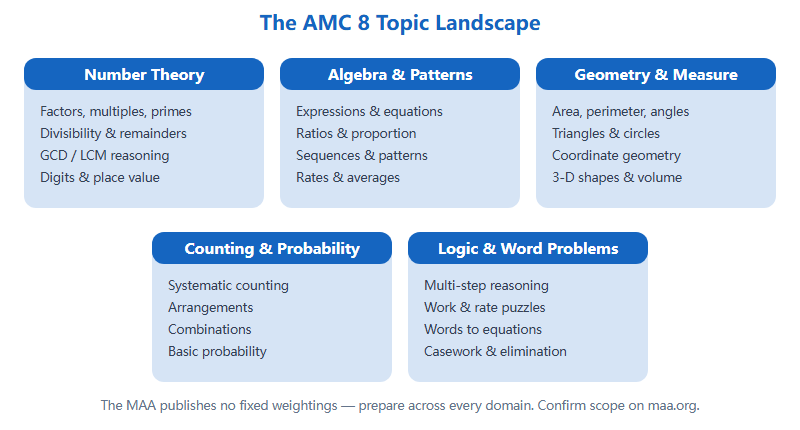
It also helps to see the domains as connected rather than siloed. Many of the harder AMC 8 questions live at the seams — a counting problem dressed in geometry, a number-theory idea hidden inside a word problem, an algebra set-up that only resolves once you spot a pattern. A student who has drilled each domain in isolation but never met them combined can still stall on a question that uses two ideas at once. Practising mixed problems, not just topic-by-topic worksheets, is what makes the map usable under real exam pressure.
Where Points Quietly Disappear
Coaching China-based international-school students, we see lost points cluster in predictable places — and they are rarely about “not knowing the topic.” They are about depth, precision, and reading.
- Counting & probability. This domain punishes hand-waving. Students who can define a set-up but not count it systematically lose the hardest late questions. The fix is casework discipline: list, organise, and check for double-counting rather than guessing a formula.
- Number theory at the harder tier. Early number-theory questions feel friendly, so students under-train the topic — then a subtle remainder or divisibility question late in the paper catches them. Depth, not familiarity, is the gap.
- Geometry diagrams. On a no-calculator exam, a mis-copied length or a rushed angle wrecks an otherwise correct method. Careful diagram reading and labelling recovers more points here than any new theorem.
- Word problems. The maths is often easy once translated; the loss happens in translation. Slowing down to convert words into a clean equation is the single highest-return habit for logic questions.
The pattern is consistent: strong students lose points at the depth boundary and the precision boundary, not the knowledge boundary. That is good news — those are trainable habits, not missing content.
There is also a quieter category of loss on a no-calculator paper: arithmetic slips. A correct method undone by a mis-multiplication or a dropped negative sign scores exactly zero, just like a blank. Because the AMC 8 gives no partial credit, the value of clean, checkable arithmetic is higher than students expect. In practice, the students who improve fastest are often not the ones learning new theory but the ones who tighten execution — writing steps down legibly, re-reading the question’s exact wording, and sanity-checking each answer against a rough estimate before committing.
Reading the Difficulty Ramp
Because difficulty generally rises across the 25 questions, coverage alone is not a plan — you also need a pacing model. A useful mental picture is four zones, each demanding a different behaviour.
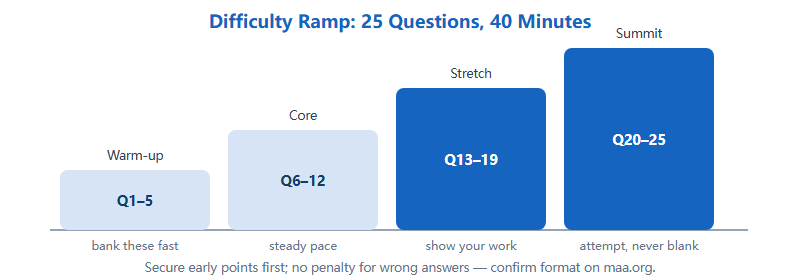
The behavioural takeaway matches the scoring rule. Because there is no penalty for a wrong answer, the summit questions should still receive an educated guess even when time runs short — but only after the warm-up and core zones are fully banked. Students who over-invest in one hard geometry problem and never reach three solvable questions later in the paper are trading points away. Pace to the ramp, not to the order you happen to enjoy.
A practical way to internalise the ramp is to change how you use practice papers. Instead of always starting at Q1 and stopping when time runs out, occasionally practise the zones separately: one session that drills only the warm-up and core zones for speed and accuracy, and a different session that sits with two or three summit-level questions without a clock, to build the technique those questions demand. Blending both — speed on the early zones, depth on the late ones — mirrors what the real 40 minutes will ask of you.
Turning the Map into a Study Plan
A syllabus map is only useful if it changes what you practise. For international-school students balancing AMC 8 prep against a full school timetable, three principles keep the plan honest:
- Cover breadth first, then chase depth. Make sure no domain is a blind spot before pouring hours into your favourite one. A single untouched domain can cost several questions.
- Practise each domain at two tiers. For every topic, train an “early-question” version and a “late-question” version. The gap between them is where most improvement lives.
- Rehearse the no-calculator reality. Build mental-arithmetic and estimation into ordinary practice so the calculator ban never becomes a surprise on the day.
Done this way, the map stops being a list of topics and becomes a diagnostic: after each practice paper, you can see which domain and which depth tier leaked points, and aim the next block of study precisely. When it is time to confirm the January sitting and the authorized-center route, our 2026–27 in-person AMC 8 guide covers the logistics.
A simple weekly rhythm turns those principles into practice. Many students settle into short, frequent sessions rather than rare marathons: a couple of focused topic blocks across the week, one timed mixed set that forces domain-switching, and a review session spent not on getting more questions right but on understanding why the missed ones went wrong. The review is where the learning compounds. A missed question that is simply re-attempted teaches little; a missed question that is diagnosed — wrong domain instinct, arithmetic slip, misread wording, or a genuine gap — tells you precisely what to fix. Over a term, that diagnostic loop matters more than the raw number of problems attempted.
Frequently Asked Questions
What topics does the AMC 8 cover?
Middle-school mathematics: number theory, algebra and patterns, geometry and measurement, counting and probability, and logic-based word problems. Confirm the current scope on maa.org.
Does the MAA publish fixed topic weightings for the AMC 8?
No fixed public weighting exists, and emphasis varies year to year. Plan across all domains and confirm the current syllabus scope on maa.org.
Are calculators allowed on the AMC 8?
No. The AMC 8 is a no-calculator exam, so mental-math fluency and estimation matter. Confirm the current rules on maa.org.
How hard are the later AMC 8 questions?
Difficulty generally rises across the 25 questions, with the last several the most demanding. Confirm the format on maa.org.
This is an independent guide operated by Hanlin Education for China-based international-school students. It is not affiliated with, endorsed by, or sponsored by the Mathematical Association of America (MAA). Competition details change — always confirm current dates, format, and syllabus scope on maa.org. Any error will be corrected within 7 working days.