Move from the AMC 8 to the AMC 10 when a student consistently handles most of the AMC 8 and reaches the eligible grade band — not simply when they turn a certain age. The AMC 10 is a separate, harder contest with its own format and eligibility, and it is the rung that can lead toward the AIME. This guide covers the timing signals, the real gaps to bridge, and how to plan the transition. Confirm all AMC 10 details on maa.org.
Where the AMC 8 Sits on the Ladder
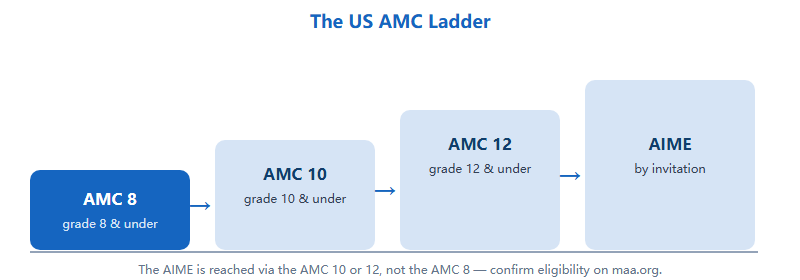
The AMC 8 is the entry tier of the US AMC series run by the Mathematical Association of America. It is a 25-question, 40-minute, no-calculator paper for students in grade 8 and under, sat in person in a January window (confirm the exact date on maa.org). Above it sit the AMC 10 and AMC 12, and beyond those, by invitation, the AIME.
One fact reshapes how families should think about the whole journey: the AMC 8 does not itself lead to the AIME. AIME qualification comes through strong performance on the AMC 10 or AMC 12, not the AMC 8. That makes the AMC 8 a superb training ground and confidence-builder — but the step onto the AMC 10 is the one that opens the higher pathway. For the registration and authorized-center steps for the AMC 8 sitting itself, see our 2026–27 in-person AMC 8 guide.
Make Sure You’re on the Right “AMC”
A word of caution that matters especially for families in China, where several competitions share the letters “AMC.” The pathway in this article is the US AMC run by the MAA. It is a different competition from the Australian Mathematics Competition (AMC) run by the Australian Maths Trust (AMT), and different again from the AMO (American Mathematics Olympiad) run by SIMCC. Same three letters, different organisers, different papers, different progression. If your goal is the AMC 10 → AMC 12 → AIME route described here, confirm you are registering for the MAA’s US AMC on maa.org before you plan anything else.
When to Level Up: The Real Signals
Among the international-school families we work with, the timing question — “should my Grade 8 child move to the AMC 10?” — arrives every autumn. The unhelpful answer is “when they’re ready.” The useful answer is to check three concrete signals together, not any one alone.
- Consistent strength on the AMC 8. Not a single lucky paper, but a stable pattern of handling most of the AMC 8 — including some of the harder late questions — across several practice papers. If the entry tier no longer stretches the student, that is the clearest cue.
- The eligible grade band. The AMC 10 is open to students in grade 10 and under; the AMC 12 to grade 12 and under. A student must be within the band to sit each contest — confirm the current eligibility rules on maa.org before assuming a jump is available.
- Comfort with deeper algebra and geometry. The AMC 10 leans harder on algebraic manipulation and geometric reasoning than the AMC 8. A student who is fluent, not just familiar, with those tools will find the transition motivating rather than crushing.
Note what is not on the list: age by itself, or a parent’s eagerness. A capable Grade 7 or Grade 8 student who meets all three signals can benefit from moving up early; a student who meets only one is usually better served by another year of consolidating on the AMC 8, where confidence and depth are built.
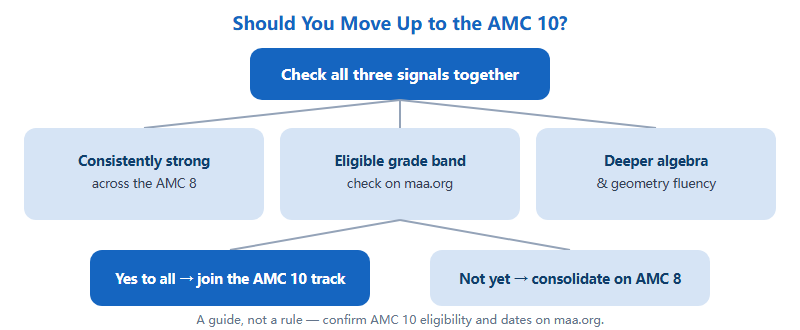
There is a real cost to moving up too early. A student pushed onto the AMC 10 before the three signals line up often meets a paper that is harder across the board, scores lower than they are used to, and reads that dip as failure rather than as the expected friction of a tougher contest. Confidence built patiently on the AMC 8 can erode quickly under a badly timed jump. When only one or two signals are present, another year of consolidating — deepening the shared foundations and finishing the AMC 8 strongly — is almost always the higher-return choice, and it costs nothing on the longer pathway.
One hard constraint sits outside those three signals, and it is new for 2027. MAA has said the AIME will be open only to students aged 13 and over, with no alternative arrangement for a qualifier who is younger. This does not change when a student should move up to the AMC 10 — that exam has no lower age limit and the readiness signals above are unaffected — but it does change what the move can lead to in the same cycle. A twelve-year-old who clears the AMC 10 qualifying score of 100 will not sit the AIME that February. MAA has not published which date the age is measured against, and says the full policies are still to come, so confirm with the centre that enters your child before planning a season around AIME qualification.
What Actually Changes: AMC 8 vs AMC 10
Understanding the jump helps you bridge it. The table below contrasts the entry tier with the next rung. Note that we state AMC 10 specifics conservatively: the MAA sets the current format, timing, and rules, and those should be verified on maa.org rather than assumed from the AMC 8.
| Dimension | AMC 8 | AMC 10 |
|---|---|---|
| Eligibility | Grade 8 and under | Grade 10 and under (confirm on maa.org) |
| Format | 25 questions, 40 minutes, no calculator | Multiple-choice, longer and harder; confirm current format on maa.org |
| Difficulty | Middle-school topics; rising ramp | Higher-school topics; steeper demands |
| Leads toward | Readiness for the AMC 10 track | Possible AIME qualification (confirm on maa.org) |
| Best mindset | Build breadth and confidence | Deepen technique and problem-solving stamina |
The headline is not “the AMC 10 is just a longer AMC 8.” It is a distinct contest that rewards deeper technique and more sustained problem-solving. Treating it as merely “more of the same” is the mistake that turns an exciting step up into a discouraging one.
For families, the most useful reframe is to stop asking “how much harder is it?” and start asking “what new habits does it reward?” The AMC 10 tends to reward sustained problem-solving, cleaner algebraic technique, and the composure to keep working through a longer paper — qualities built over months, not memorised in a week. A student who arrives having deliberately trained those habits experiences the step up as a challenge they are ready for; a student who arrives expecting “a longer AMC 8” experiences it as a wall. The difference is preparation, not talent.
How to Bridge the Jump
For a student who meets the signals, the transition is best treated as a deliberate bridging year rather than a cold leap. Three moves make it manageable.
- Deepen the shared foundations first. Algebra, number theory, geometry, and counting all appear on both contests — but the AMC 10 asks harder versions. Push each AMC 8 domain to a higher tier before adding brand-new material, so the transition feels like extension, not replacement.
- Build stamina and pacing. A longer, harder paper demands sustained concentration. Practising with longer problem sets and timing every session trains the endurance the AMC 10 assumes.
- Keep the AMC 8 in play during the bridge. An eligible student can continue sitting the AMC 8 while building toward the AMC 10. A strong final AMC 8 result confirms mastery of the foundation and keeps motivation high — the logistics for that January sitting are in our 2026–27 in-person AMC 8 guide.
Done this way, the move from AMC 8 to AMC 10 becomes what it should be: a natural next step for a student who has outgrown the entry tier, taken at the right moment, with the shared foundations already deep. No result at any tier guarantees admission or future success — but a well-timed, well-bridged transition gives a motivated student the best chance to keep climbing. Confirm every AMC 10 detail on maa.org before you commit to the calendar.
It helps to picture the bridge as a year, not a weekend. A workable rhythm is to spend the first stretch pushing each familiar AMC 8 domain to a harder tier, the middle stretch adding the extra technique and stamina the AMC 10 assumes, and the final stretch practising under realistic timed conditions so the longer paper feels familiar rather than daunting. Throughout, keep confirming the current AMC 10 format, timing, and eligibility on maa.org rather than assuming anything carries over from the AMC 8 — the two contests are set independently, and the details that matter for planning can change from year to year.
Frequently Asked Questions
When should a student move from AMC 8 to AMC 10?
Typically when they consistently handle most of the AMC 8 and are within the eligible grade band. Confirm AMC 10 eligibility on maa.org.
Can the AMC 8 lead directly to the AIME?
No. AIME qualification comes through the AMC 10 or AMC 12, not the AMC 8. Confirm the current qualification rules on maa.org.
Is the AMC 10 just a longer AMC 8?
No — it is a separate, harder contest with its own format and grade band. Confirm the current AMC 10 details on maa.org.
Which “AMC” is my child taking?
The US AMC 8 (MAA) differs from the Australian AMC (AMT) and AMO (SIMCC). Check the organiser before registering.
This is an independent guide operated by Hanlin Education for China-based international-school students. It is not affiliated with, endorsed by, or sponsored by the Mathematical Association of America (MAA). Competition details change — always confirm current dates, eligibility, format, and qualification rules on maa.org. Any error will be corrected within 7 working days.