When a parent sees an “Honor Roll” certificate for their child, or reads online that “a score of 18 guarantees an award,” they are often mixing two distinct realities. The AMC 8 does not have a single, universal award threshold that applies to every student in every country every year. Instead, at least two major award frameworks can operate at the same time: the MAA global system and the China-specific system administered through ASDAN and the China Organizing Committee. Confusing these leads to unrealistic expectations, unnecessary anxiety, and preparation strategies that miss the mark.
The core issue is that AMC 8 award cutoffs depend on both the year and the administering system. A percentile-based cutoff from a previous year does not guarantee the same threshold in 2027, nor does a global MAA line necessarily match a China organizer’s tier. Relying on copied numbers from forums can lead to unrealistic expectations. This article helps you identify which framework applies to your child’s registration and how to interpret their specific result notice accurately.
The Certificate Label: Year + System + Sitting
Every official AMC 8 result is defined by three coordinates: the calendar year, the administering body, and the specific test window. For example, the next January sitting will have its own unique distribution of scores. Because the difficulty of the questions varies slightly each year, the raw score required to reach a named award line changes annually for percentile-based recognitions. There is no fixed “magic number” for global rankings. A score of 19 might place a student in a high award band one year, while a different number is needed the next. That is not a defect in the system; it is how percentile-based recognition works.
Furthermore, the “system” matters. The Mathematical Association of America (MAA) sets the global competition and global award framework. In China, the competition is facilitated through authorized bodies including ASDAN, which is an MAA-authorized International Group Leader, and the China Organizing Committee. These bodies may issue certificates based on global rankings, but they may also provide additional China-specific recognition or report data differently. When you see a list of “award cutoffs,” check whether it says MAA global or a China organizer’s award tier. They are not interchangeable terms.
MAA Global Awards vs China/ASDAN Awards: Why Both Exist
The MAA global framework provides the common international reference. It allows a student in Shanghai and a student in New York to be compared on the same scale for the main global recognition. This is why the year and the global pool matter: the award line is not a fixed property of the test, but a consequence of how that year’s cohort performed.
In contrast, China-based organizers such as ASDAN and the China Organizing Committee operate within the MAA framework but serve a very large local population. They may adhere to MAA global definitions for the primary awards while also highlighting national rankings, participation recognition, or supplementary feedback reports. The key distinction is not that every award must move each year. It is that a percentile-linked cutoff is tied to the year and cohort, while a separately defined fixed-score recognition should be read exactly as its official label states. For percentile-based recognitions, the line can vary from one sitting to another and is confirmed against the relevant year and framework, not a pre-exam guess. Always read the actual award label, year, and region before treating any number as a target.
This is why the same raw score can appear to have different meanings in different years. Suppose a student scores 17 in one sitting and 17 in another. If the first year’s cohort found the paper easier, more students scored high, pushing a named award line up. If the second year’s cohort found the paper harder, the line might drop. By aiming only for a copied number, you might miss the award if the line rises, or you might waste energy chasing a safety margin that is not needed if the line falls.
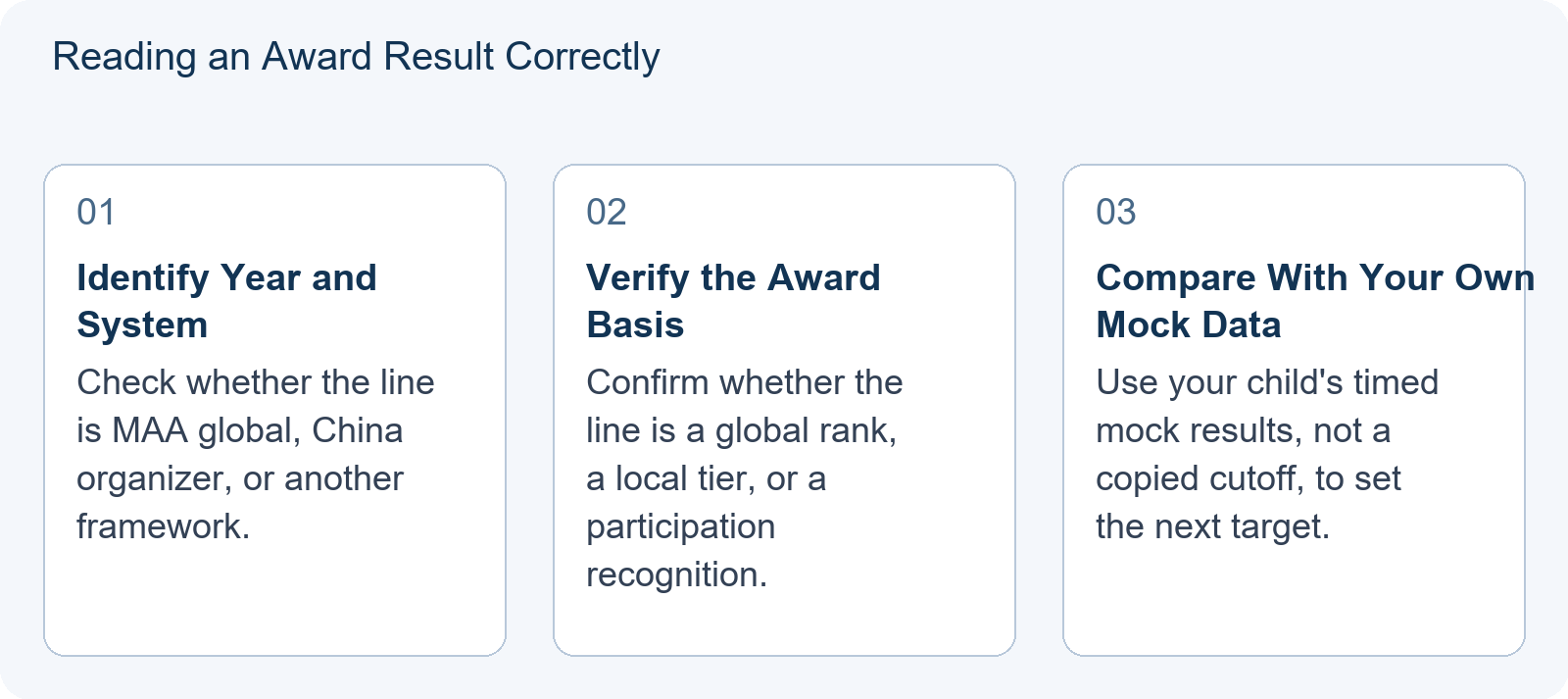
Why a Copied Cutoff From Another Year or System Is Not a 2027 Target
It is tempting to look at last year’s results and say, “My child needs 17 points.” This is dangerous logic. If one year’s paper was easier than average, more students scored high, pushing a named award line up. If the next paper is harder, the line might drop. By aiming only for a copied number, you might miss the award if the line rises, or you might waste energy chasing a safety margin that is not needed if the line falls.
Additionally, the composition of the test-taker pool shifts. More advanced students entering early grades can raise the bar. Conversely, a broader participation base might lower it. You cannot control the global distribution, so you cannot set a fixed raw-score target from a past result. Instead, you should aim for consistency and accuracy relative to your own potential. A student capable of scoring 20 should aim for 20, regardless of whether a past cutoff was 15 or 18. Chasing a moving target creates stress; mastering the material builds confidence.
The system label matters just as much as the year. A China organizer’s award tier is not automatically the same as an MAA global Honor Roll line. If a forum post says “18 is enough for Honor Roll” but the poster registered through a China channel that uses a different recognition structure, the advice may be incomplete or misleading even if the year is correct. Always ask: which framework issued this line?
How to Read an Honor Roll or Achievement Roll Line Without Making It Universal
When reviewing sample results or past award notices, always ask: “What year is this? What system is this?” An Achievement Roll or similar younger-student recognition may have its own official definition attached to that result. Even if a line looks like a fixed criterion, it still needs to be read in the context of the administering body and the year printed on the notice. An Honor Roll line, by contrast, is generally tied to the distribution of that year’s cohort.
Do not treat anecdotal evidence as policy. Online forums often share individual experiences where a student got an award with a certain score. This is survivorship bias. It does not mean everyone with that score gets an award. It means that particular student met the relevant criterion in that specific year and system. To understand what constitutes a “good” score, refer to our detailed breakdown in AMC 8 Score: Converting Raw Results Into a Next-Step Decision Framework, which explains how to interpret performance beyond the award label.
Also separate award interpretation from eligibility. A student may meet a score expectation but fail the basic entry rules. AMC 8 is for grade 8 and below, and the age rule must be checked carefully. Our article Are You Eligible for the January 2027 AMC 8? The Two-Part Test, a Birthday Cutoff Table, and a Grade-Name Decoder helps verify this prerequisite before award planning begins.
Building a Target From Practice Percentile and Error Profile
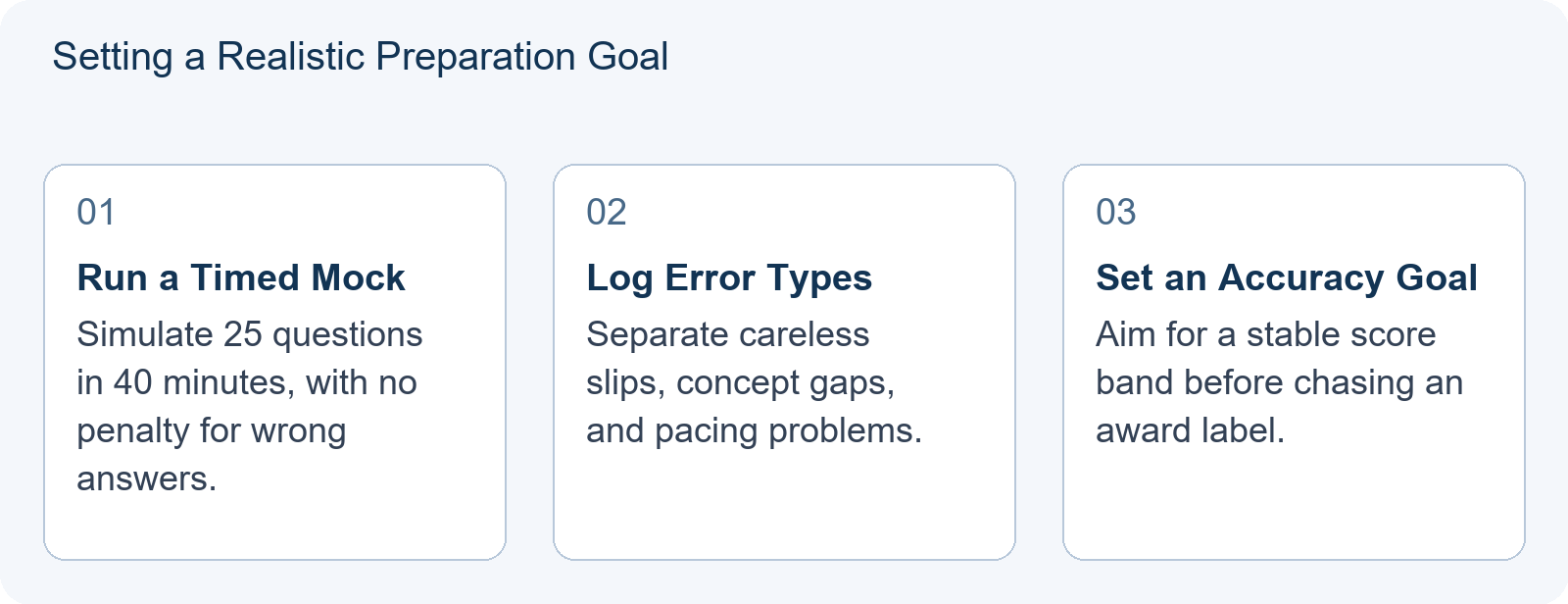
Since you cannot predict the exact cutoff, how do you prepare? Use diagnostic testing. Have your child take full-length mock exams under timed conditions: 25 multiple-choice questions in 40 minutes, with 1 point for a correct answer, 0 for a wrong answer, and no penalty for guessing. Track the raw score and, more importantly, the error profile. Are they losing points on geometry? On word problems? On careless arithmetic? On pacing?
If your child consistently scores 18–20 on mocks, they are likely in a strong competitive range. Their goal should be to eliminate careless errors and push toward 22 or higher. If they score 12–14, the focus should be on securing the first 15 questions correctly, building foundational speed, and reducing blank guesses that could have been narrowed down. The target is not “beat the cutoff,” but “maximize correct answers and reduce avoidable losses.”
This is where registration-system clarity also helps. If you registered through an authorized centre in China, ask which result notice and award framework you should expect. See AMC 8 Registration: Which Channel Fits Your Situation Before the 2027 Window Closes for guidance on ensuring your child is registered through a channel that will deliver valid results.
A Labelled Teaching Illustration
Teaching illustration, not a contest problem and not an official cutoff: Suppose a student’s 2025 result notice says “Honor Roll — 2025, System A.” Another student’s 2026 notice from a different system says “China Award Tier — 2026.” Both can be accurate because each line is scoped to its year and framework. The mistake would be to write “AMC 8 Honor Roll = 19” as a universal rule. A correct approach would be to record the student’s timed mock median, identify the top two error types, and set a practice goal such as raising the median from 15 to 18 while cutting geometry errors. Any percentile-linked official award line is then read only after the actual sitting; a separately defined fixed-score recognition would instead be read from its official label.
Decision Checklist Before You Compare Your Child to Any Posted Award List
Before reacting to any external data point, run through this checklist:
- Is the source current? Does it reference a recent completed season, or is it outdated?
- Is the system specified? Does it clarify whether this is MAA global recognition or a China organizer’s award tier?
- Is the context clear? Was the score achieved under standard conditions, and does the notice state the year?
- Does it apply to my child’s grade and age? Younger-student recognition and age eligibility rules are separate from raw-score bands.
- Have I consulted the authorized channel? For registration and award confirmation, rely on the centre or organizer that will issue the result. Do not treat a blog post as an official ruling.
Conclusion: Focus on Mastery, Not Just Labels
The AMC 8 is designed to challenge and inspire mathematical thinking. While AMC 8 awards are meaningful recognitions, they are secondary to skill development. A student who masters the content will naturally achieve high scores, regardless of where the cutoff lands. Do not let the uncertainty of percentile-linked yearly cutoffs paralyze your preparation. Instead, use mock tests to identify weaknesses, improve accuracy, and build speed. Read every award line as year plus system plus sitting. Trust the process, not the rumor mill.
Frequently Asked Questions
Is there a fixed score needed for the Honor Roll?
For percentile-linked Honor Roll recognition, no universal fixed score applies across every year and system. Those lines depend on the year, the administering framework, and the cohort that sat that paper. A separately defined fixed-score recognition should be read exactly as its official label states. Always read the official result notice rather than a copied number.
Do China and US students compete for the same awards?
For MAA global awards, the global pool is the reference. China-based organizers such as ASDAN and the China Organizing Committee may also provide China-specific recognition. The result label should state which framework applies.
Can I use last year’s percentile-linked cutoff to plan my study schedule?
You can use it only as a year-labeled historical reference, not as a guarantee. Focus on improving your child’s accuracy and speed through timed mocks and error review rather than chasing a specific historical number.