What Your AMC 8 Score Actually Represents
An AMC 8 score is more than a number on a certificate. It signals where a student currently stands against a global benchmark and what preparation choices make sense next. The exam includes several recognitions; for planning purposes, three score thresholds are especially useful, each carrying different implications for follow-up decisions.
According to the source guide (June 18, 2026), the key award thresholds are:
- Distinguished Honor Roll (top 1% globally): typically requires 21 or more correct answers out of 25
- Honor Roll (top 5% globally): generally requires 17 or more correct answers
- Achievement Award: for students in grade 6 or below who score 15 or more points
The exam is designed for students in grade 8 and below, with an age ceiling of 15.5 years. This grade-conditional structure means younger students with the same raw score may hold different trajectory implications than older students.
Distinguished Honor Roll Level: Assessing AMC 10 Readiness
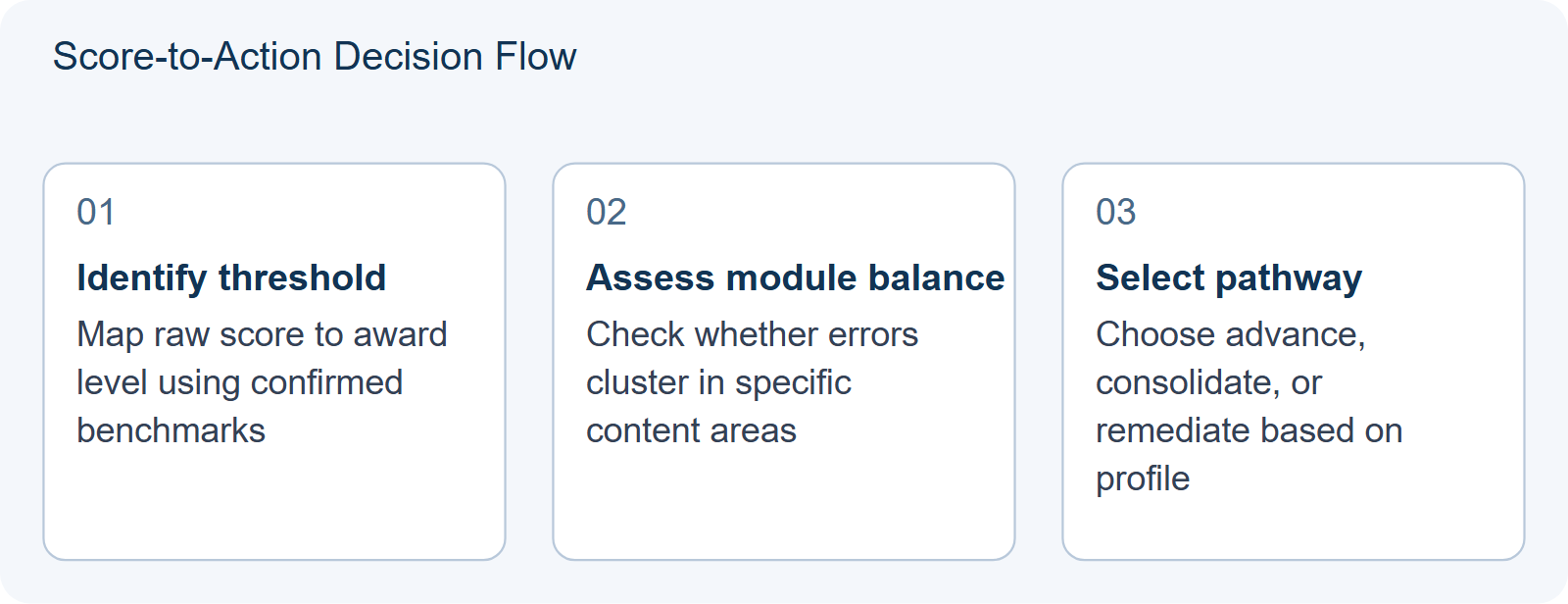
A score at or above the 21-point threshold suggests strong foundational mastery. Students at this level have demonstrated consistent accuracy across most problem types, including the more demanding questions that appear in the final third of the exam.
For families considering the next step, this threshold typically indicates readiness to explore AMC 10 preparation materials. However, readiness is not automatic. The jump from AMC 8 to AMC 10 involves broader content coverage and more complex problem structures that require solid command of foundational concepts.
Recommended evaluation: review whether the student’s correct answers reflect balanced strength across algebra, geometry, number theory, and combinatorics, or whether a high score masked weakness in one or two modules. A student who scored 22 but missed most geometry questions may need targeted work before advancing.
Honor Roll Level: Preserving Strengths While Closing Gaps
Scores in the 17–20 range represent solid performance with clear room for growth. Students at this level typically handle routine problems well but encounter difficulty with multi-step reasoning or unfamiliar problem structures.
The practical next step is diagnostic: identify which of the approximately 5–8 missed questions fell into which content category. The source guide identifies four core modules—algebra, geometry, number theory, and combinatorics—with algebra serving as the highest-proportion foundation.
Families should consider whether the student’s preparation approach has been systematic or ad hoc. Students who prepared informally and reached this threshold often have significant upside from structured practice. Those who already trained intensively may need to examine whether their study methods address problem-solving strategy or merely repeat familiar problem types.
Achievement Award for Younger Students: Why Trajectory Matters More Than Absolute Score
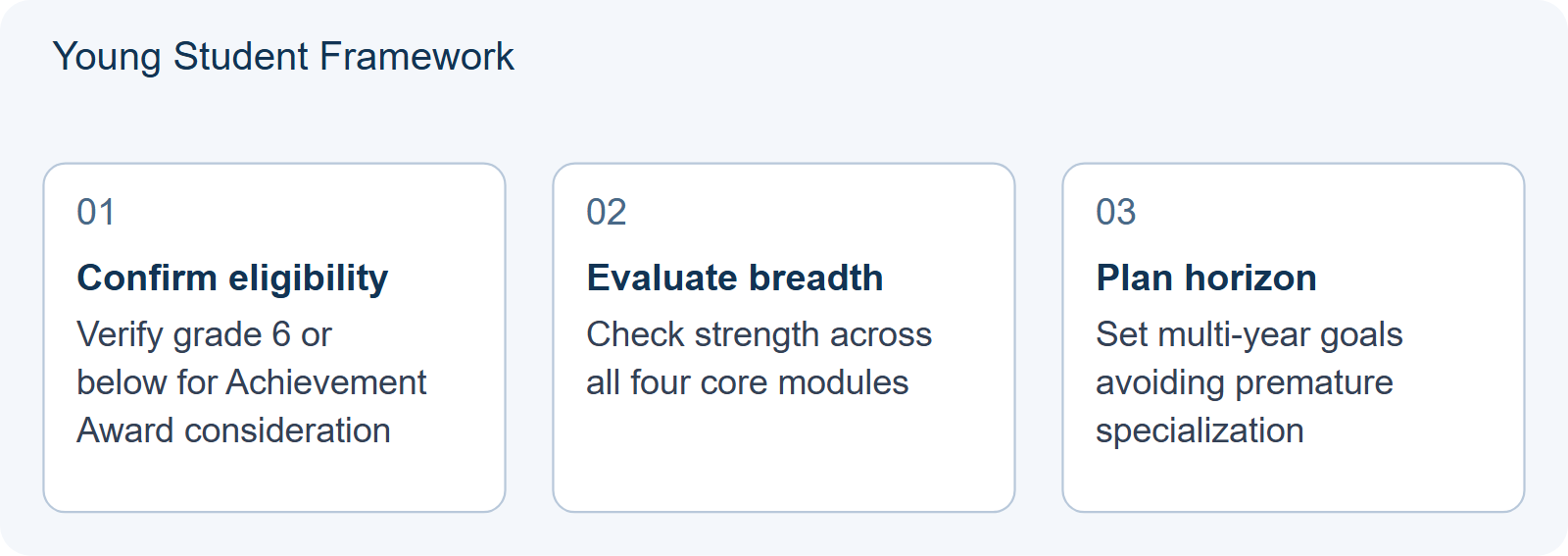
The Achievement Award applies specifically to students in grade 6 or below who score 15 or more points. This threshold exists because a performance at or above 15 from a 10-year-old and a 14-year-old carry different predictive weight.
For families of younger students, the key consideration is time horizon. A grade 5 student who scores 16 has multiple future attempts to build toward Honor Roll or Distinguished Honor Roll status. The priority should be sustainable engagement rather than accelerated advancement. Pushing such a student into AMC 10 material prematurely risks building fragile foundations and diminishing long-term interest.
Preparation advice for this group: maintain breadth across all four modules rather than specializing early, and prioritize problem-solving habits—showing work, checking answers, managing time—over raw score improvement.
Below Threshold: Mapping Gaps Without Overcommitment
Scores below established award thresholds indicate that foundational concepts need reinforcement. This is not a signal to abandon competition mathematics, but it does suggest that preparation should be more targeted and less intensive than for award-level students.
A practical framework: categorize the 25 questions by the four core modules and identify which areas produced the most errors. The source guide emphasizes algebra and geometry as central components of the exam, making them efficient starting points for remediation.
Families should be cautious about overcommitting to preparation volume. A student who scores below threshold after limited preparation may simply need more structured practice. One who prepared intensively and still fell short may benefit from reassessing whether the preparation method matched the exam’s emphasis on flexible problem-solving rather than pattern recognition.
Matching Score Outcome to Preparation Intensity
| Score Range | Typical Standing | Suggested Next Step |
|---|---|---|
| 21+ | Distinguished Honor Roll | Evaluate AMC 10 readiness; assess module balance |
| 17–20 | Honor Roll | Diagnostic review of missed problems by module |
| 15+ (grade 6 or below) | Achievement Award | Build breadth; avoid premature specialization |
| Below 17 | Below Honor Roll threshold | Targeted remediation in algebra and geometry |
This table represents a decision framework, not a rigid prescription. Individual circumstances—time available, other commitments, mathematical interest level—should shape how families apply these guidelines.
Preparing for a Consultation
If you are considering professional guidance, preparing the following information will help any discussion become productive:
- Exact score and which problems were attempted versus omitted
- Grade level and prior competition experience
- Current mathematics coursework and pace
- Specific problem types that felt unfamiliar or difficult
- Preparation methods used (self-study, school program, other)
For additional perspective on transitioning between competition levels, see AMC 8 to AMC 10 pathway considerations. For understanding how scores relate to broader preparation planning, this overview of exam structure provides useful context.
Key Takeaway
An AMC 8 score becomes useful only when it informs specific action. These award thresholds provide reference points, but the real decision for families lies in whether to advance, consolidate, or remediate—and how to do so in ways that match the student’s age, preparation history, and available time.
Frequently Asked Questions
Does a score of 20 mean my child is ready for AMC 10?
A score of 20 places a student in the Honor Roll range, which indicates solid performance but not automatic AMC 10 readiness. The decision depends on whether the student's preparation covered AMC 10 prerequisite topics and whether their errors showed conceptual gaps or careless mistakes. Consider a diagnostic review of specific missed problems before committing to AMC 10 preparation.
How should a grade 5 student with a 16-point score proceed?
This qualifies for the Achievement Award and represents strong performance for that age. The priority should be maintaining breadth across algebra, geometry, number theory, and combinatorics rather than accelerating into advanced material. With multiple future AMC 8 attempts available, focus on building durable problem-solving habits and sustained interest.
What if my child prepared intensively but scored below 17?
Intensive preparation that does not yield award-level results often indicates a mismatch between study methods and exam demands. AMC 8 rewards flexible problem-solving more than pattern recognition. Consider whether preparation addressed varied problem structures or repeated similar exercises, and whether time management and careful checking were emphasized.