For many students preparing for the AMC 8, AMC 8 past papers are treated as mere practice tests. You take the paper, check your score, and move on. This approach is inefficient. A single score tells you what you got wrong, but it rarely tells you why. To truly improve, you need to transform these papers into a diagnostic engine. By building a repeatable cycle of testing, logging errors, and targeted review, you can identify patterns in your weaknesses—whether they are conceptual gaps, calculation slips, or time management issues.
The Anatomy of the AMC 8 Exam
Before diving into diagnostics, understand the constraints. The AMC 8 consists of 25 multiple-choice questions to be completed in 40 minutes. Each question is worth 1 point, with no penalty for guessing. This means every second counts, and strategic guessing is essential. The questions generally progress in difficulty, with the first 10 being straightforward applications of basic algebra and geometry, while the final 5 often involve complex combinatorics or number theory.
Our goal is not just to solve more problems, but to solve them correctly under pressure. This requires analyzing your performance across four core modules: Algebra, Geometry, Number Theory, and Combinatorics/Probability.
Step 1: The Controlled Test Environment
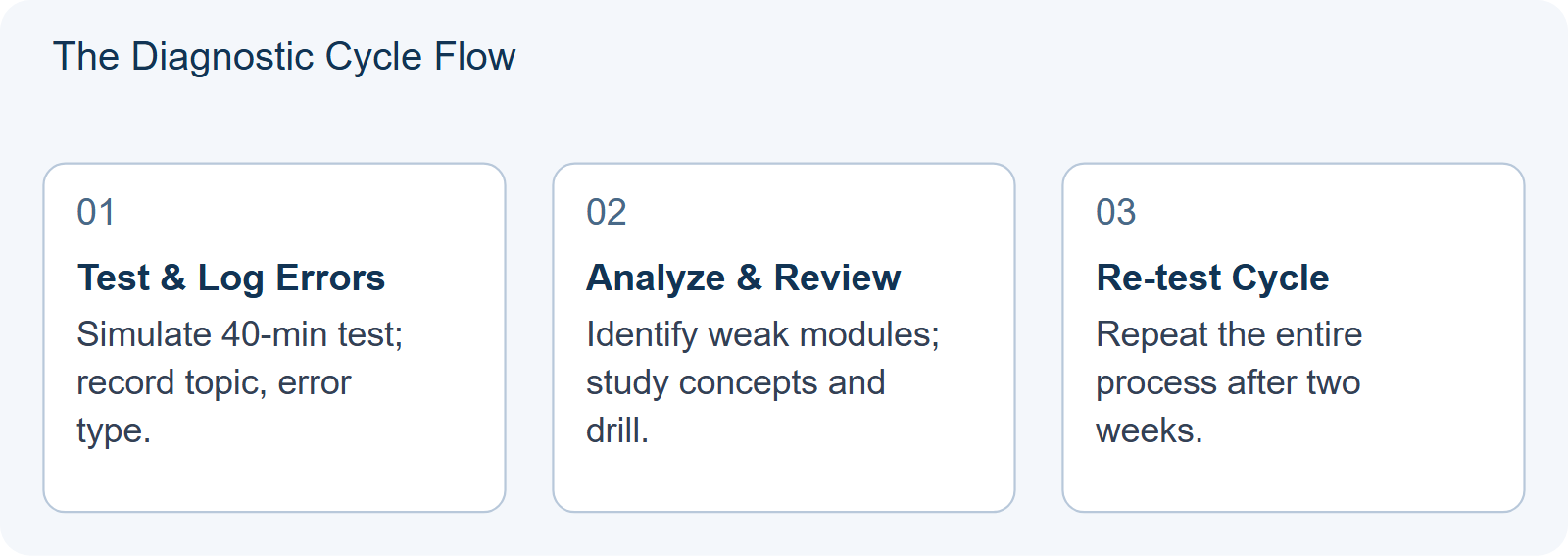
Simulate the real exam conditions strictly. Use a timer set to 40 minutes. No calculators, no external resources, and no interruptions. If you finish early, do not re-check answers unless you have a specific strategy for reviewing flagged questions. Record your raw score and, crucially, note which questions you guessed versus those you solved confidently.
Step 2: Building the Error Log
This is the most critical step. Most students skip this, leading to repeated mistakes. Create a spreadsheet or a dedicated notebook section with the following columns:
- Question Number: e.g., Q14.
- Topic Module: Classify each question into one of the four core areas (Algebra, Geometry, Number Theory, Combinatorics).
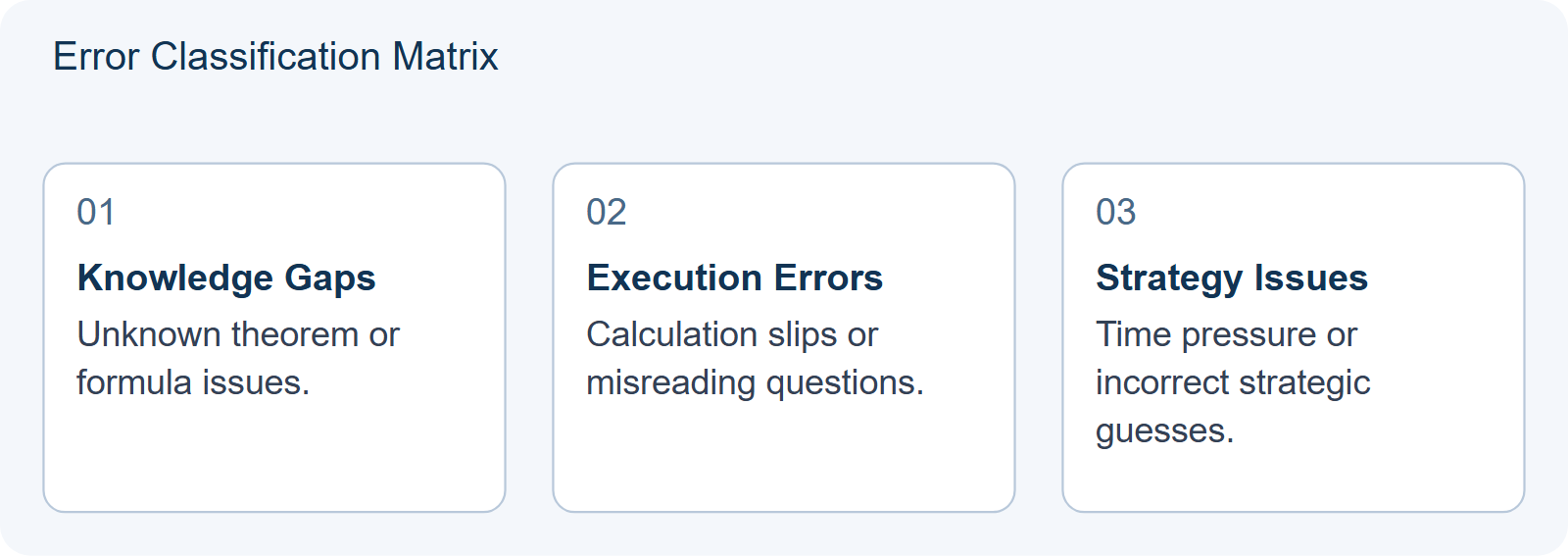
- Error Type: Categorize why you missed it. Common types include:
- Conceptual Gap: Did not know the theorem or formula.
- Calculation Slip: Knew the method but made an arithmetic error.
- Misread Question: Overlooked a key constraint like “positive integers” or “distinct”.
- Time Pressure: Ran out of time or rushed the solution.
- Strategic Guess: Guessed incorrectly when unsure.
- Correct Solution Path: Write down the optimal way to solve it, noting any shortcuts or standard templates.
- Review Date: When you will revisit this problem.
For example, if you miss a geometry problem involving area ratios, tag it as “Geometry – Conceptual Gap” if you didn’t know the similarity ratio rule, or “Geometry – Calculation Slip” if you misapplied the formula. This granular data allows you to see trends. If 60% of your errors are “Misread Question,” your focus should shift to reading strategies rather than math content.
Step 3: Targeted Review and Remediation
Once your error log is populated, analyze the distribution. Are you losing points primarily in Number Theory? Or are your errors concentrated in the last 5 questions due to time pressure?
If your errors are mostly Conceptual Gaps, return to foundational resources. For instance, if you struggle with modular arithmetic, review specific lessons on remainders and divisibility rules. Our site offers detailed breakdowns of common pitfalls. For example, understanding spatial reasoning is vital for geometry; you can strengthen this by studying AMC 8 Cubes, Nets and Views, which provides lookup tables and worked keys to help visualize 3D problems.
If your errors are Calculation Slips, implement a “double-check” protocol for high-stakes steps. Practice mental math drills to improve speed and accuracy. For logic-heavy problems, ensure you are using systematic tools. Reading about AMC 8 Logic Puzzles can introduce you to seven types of logical structures and four tools to deconstruct them, reducing the chance of oversight.
If your errors are Time Pressure, work on pacing. The AMC 8 rewards efficiency. Learn to recognize when a problem is too hard and flag it for later. Study pattern recognition to speed up sequence-based questions. Resources like AMC 8 Patterns and Sequences offer a seven-type lookup card and formulas that can help you instantly identify the nature of a sequence problem, saving valuable seconds.
Step 4: The Repeatable Cycle
A diagnostic cycle is only useful if it repeats. Schedule your next mock test for two weeks after your current one. Before taking it, review your error log from the previous session. Specifically, re-solve the questions you marked as “Conceptual Gap” or “Calculation Slip.” Do not look at the solutions immediately; try to derive them again. This active recall strengthens neural pathways associated with those concepts.
After the new test, update your error log. Compare the new error distribution with the old one. Have your “Calculation Slips” decreased? Has your accuracy in Number Theory improved? If not, adjust your study plan. Perhaps you need more focused drills on that specific topic rather than general practice.
Leveraging Bilingual Resources
For international students or those preparing in non-English speaking environments, language barriers can cause “Misread Question” errors. Ensure you are comfortable with mathematical terminology in both languages if applicable. Many students benefit from bilingual glossaries that clarify terms like “integer,” “prime,” or “median.” Understanding the precise wording of the question is half the battle.
Conclusion
Using AMC 8 past papers effectively requires more than just solving problems. It demands a structured approach to diagnosing errors. By building a detailed error log, categorizing mistakes, and targeting specific weaknesses, you turn passive practice into active improvement. Remember, the goal is not perfection on every paper, but continuous reduction in error rates over time. Start today with one past paper, build your log, and watch your confidence—and your score—grow.
Frequently Asked Questions
How many AMC 8 past papers should I complete?
Quality matters more than quantity. Aim for 5-10 recent papers, thoroughly analyzed with an error log, rather than rushing through 20 without review.
What if I don't know the correct answer to a past paper question?
Use reliable solution guides or consult with a tutor. Focus on understanding the *method* and *logic*, not just the final letter choice. Add it to your 'Conceptual Gap' list.
Is timing really important for AMC 8?
Yes. With 25 questions in 40 minutes, you average 1.6 minutes per question. Practicing under strict time limits helps develop pacing strategies and quick elimination techniques.