AMC 8 pattern and sequence questions fall into seven recurring types, and each one has a fixed first move: count steps, divide by the block length, generate terms, or read a difference table. This page is the card to keep beside your practice: the seven types with their signal words, the four formulas worth memorising, lookup tables for triangular numbers, powers of two and digit positions, and twelve original problems with a worked key.
The AMC 8 is 25 questions in 40 minutes with no calculator, sat in person during a January window; confirm the window on maa.org and your sitting day with your test centre, and see our 2026-27 in-person AMC 8 guide for how China-based families secure a sitting. That is 96 seconds a question. Sequence items are cheap marks when you name the type at once, and expensive ones when you start writing out terms towards the 2027th.
1. The seven types, and the first move each one demands
Classify by what the question gives you, not by how big the numbers look. If the terms are not printed, write the first five — most of the classifying happens while you write them — then find your row.
| # | Type | Signal in the question | First move | Where marks leak |
|---|---|---|---|---|
| 1 | Constant step | “increases by 7 each time”; a list such as 12, 19, 26, … | Term n = first + (n − 1) × step | Multiplying the step by n instead of n − 1 |
| 2 | Repeating block | “the pattern repeats”; letters, colours or seats in a cycle | Divide the position by the block length and use the remainder | Remainder 0 means the last item of the block, not the first |
| 3 | Rule-generated | “each term is obtained from the one before it by …” | Apply the rule and number every term until a value comes back | Assuming the repeat starts at term 1 |
| 4 | Growing figure, constant growth | “Figure n” built from sticks, tiles or dots, the same number added each stage | Count what one new stage adds, then first figure + (n − 1) × that amount | Counting a shared side twice |
| 5 | Growing figure, growing growth | Triangles of dots, staircases, squares of tiles | Write the gaps between counts; if the gaps rise by a fixed amount, extend them or use a figurate formula | Treating it as a constant step because the first two gaps look close |
| 6 | Doubling or halving | “doubles every day”, “half of what is left” | Count the doublings, then read the powers-of-two column | Off by one: day 1 is the starting amount, not the first doubling |
| 7 | Digit strings | “the whole numbers are written in a row”; “the 200th digit” | Count digits block by block: one-digit, two-digit, then three-digit numbers | Counting 89 two-digit numbers instead of 90 |
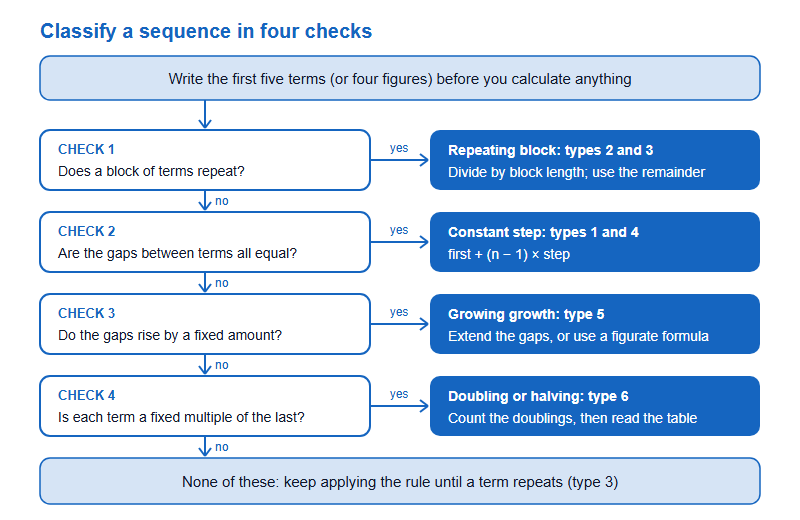
The seven types share four engines. A figure that grows by the same number of pieces each stage is a constant-step list in costume, and a rule-generated sequence becomes a repeating block the moment a value comes back, so you drill four moves, not seven.
2. Four formulas worth memorising, and the one to skip
Everything else on this card can be derived on the day; these four are worth learning as reflexes.
| Formula | What it gives you | Worked in one line |
|---|---|---|
| Term n = first + (n − 1) × step | Any term of a constant-step list | 5, 9, 13, …: term 25 = 5 + 24 × 4 = 101 |
| Count = (last − first) ÷ step + 1 | How many terms a constant-step list holds | 12, 19, …, 166: 154 ÷ 7 + 1 = 23 terms |
| Sum = (first + last) × count ÷ 2 | The total of a constant-step list | 1 + 2 + … + 100 = 101 × 100 ÷ 2 = 5050 |
| Triangular number = n(n + 1) ÷ 2 | Dots in a triangle of n rows; the sum 1 + 2 + … + n | 10 rows: 10 × 11 ÷ 2 = 55 |
The one to skip: fitting an algebraic formula to a growing-growth sequence. For 4, 7, 12, 19, 28 the gaps 3, 5, 7, 9 rise by 2, so compare the terms with the squares 1, 4, 9, 16, 25: each term is 3 more, so term n is n² + 3. If no comparison jumps out and the target term is close, simply extend the gaps.
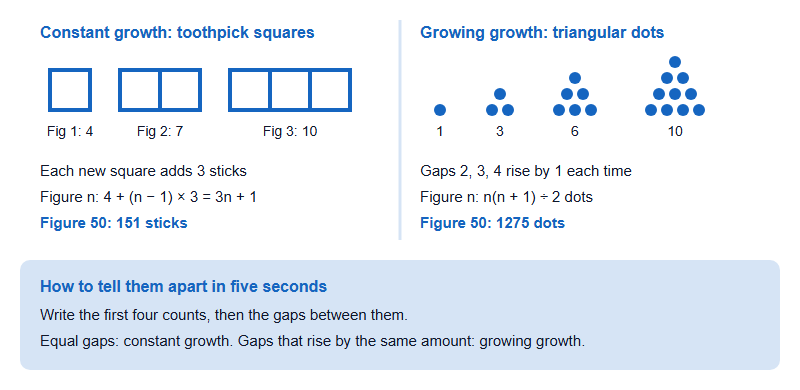
Two lookup tables finish the section: the first serves types 5 and 6, and the second is the whole method for type 7.
| n | Triangular number n(n + 1) ÷ 2 | 2n |
|---|---|---|
| 1 | 1 | 2 |
| 2 | 3 | 4 |
| 3 | 6 | 8 |
| 4 | 10 | 16 |
| 5 | 15 | 32 |
| 6 | 21 | 64 |
| 7 | 28 | 128 |
| 8 | 36 | 256 |
| 9 | 45 | 512 |
| 10 | 55 | 1024 |
| 11 | 66 | 2048 |
| 12 | 78 | 4096 |
| Block | How many numbers | Digits used | Positions in the string |
|---|---|---|---|
| 1 to 9 | 9 | 9 | 1st to 9th |
| 10 to 99 | 90 | 180 | 10th to 189th |
| 100 to 999 | 900 | 2700 | 190th to 2889th |
3. The slips that cost the most: fenceposts, remainder zero and the lead-in
Fenceposts. The list 12, 19, 26, …, 166 spans 154, which is 22 steps of 7. There is always one more post than there are gaps, so the list has 23 terms. The same slip hides in “whole numbers from 30 to 90 inclusive” (61, not 60) and “pages 45 to 118” (74).
Remainder zero. A necklace repeats red, red, blue, green, yellow. The 83rd bead: 83 = 5 × 16 + 3, so the third bead, blue. The 100th bead: remainder 0, which means a block has just ended, so it is the fifth bead, yellow — not the first. Units-digit and day-of-the-week questions run on the same engine, and our number theory card covers those cycles in full.
The lead-in. Rule-generated sequences often wander before they settle into a loop. Number every term, find the first value that comes back, and remove the lead-in terms from the position before dividing by the loop length. Problem 6 below is built to catch anyone who skips this.
4. Twelve original problems (about 19 minutes)
Written for this card, not taken from past papers, so they will not spoil a paper you are saving for a mock. Allow about 19 minutes with no calculator, and write the type number in the margin before starting each one.
- The list 12, 19, 26, 33, … continues by adding 7 each time. What is the 40th term?
- How many terms are in the list 15, 22, 29, …, 211?
- Find the sum 4 + 9 + 14 + … + 99.
- The word MATHS is written over and over with no spaces: MATHSMATHSMATHS… What is the 2027th letter?
- In the same string, how many of the first 2027 letters are S?
- A sequence starts at 25. Each term after the first is twice the sum of the digits of the term before it. What is the 100th term?
- Figure 1 is a single hexagon made of 6 sticks. Each new figure adds one hexagon to the end of the row, sharing one side with the hexagon before it. How many sticks are in Figure 40?
- In the same pattern, which figure uses exactly 316 sticks?
- Cans are stacked in rows: 1 can in the top row, 2 in the next row, 3 in the next, and so on. A complete stack uses 136 cans. How many rows does it have?
- The sequence 2, 5, 10, 17, 26, … continues in the same way. What is the 20th term?
- A pond plant covers 3 square metres on day 1 and doubles the area it covers every day after that. On which day does it first cover more than 1000 square metres?
- The whole numbers from 1 upwards are written in a row with no spaces: 123456789101112… What is the 200th digit written?
5. Worked key
| # | Type | Answer | Fastest route | The usual slip |
|---|---|---|---|---|
| 1 | 1 | 285 | 12 + 39 × 7 = 12 + 273 | Using 40 × 7 and reaching 292 |
| 2 | 1 | 29 | (211 − 15) ÷ 7 = 28 gaps, so 29 terms | Answering 28, the number of gaps |
| 3 | 1 | 1030 | Count first: 95 ÷ 5 + 1 = 20 terms. Then (4 + 99) × 20 ÷ 2 | Counting 19 terms, which gives a non-whole total — a free warning |
| 4 | 2 | A | 2027 = 5 × 405 + 2, so the 2nd letter of MATHS | Counting the remainder from zero and answering T |
| 5 | 2 | 405 | 405 complete blocks hold one S each; the 2 extra letters are M and A | Adding one more S for the unfinished block |
| 6 | 3 | 2 | 25, 14, 10, 2, 4, 8, 16, 14, … The loop 14, 10, 2, 4, 8, 16 starts at term 2. Term 100 is 98 places later; 98 = 6 × 16 + 2, so 2 places past 14 | Ignoring the lead-in: 100 = 6 × 16 + 4 points to the 4th entry, 4 |
| 7 | 4 | 201 | First hexagon 6, each later one adds 5: 6 + 39 × 5 = 5 × 40 + 1 | 40 × 6 = 240, counting every shared side twice |
| 8 | 4 | Figure 63 | 5n + 1 = 316, so n = 63 | Writing 6 + 5n = 316 and answering 62 |
| 9 | 5 | 16 rows | n(n + 1) ÷ 2 = 136, so n(n + 1) = 272 = 16 × 17 | Treating 136 as a square number and rounding its square root to 12 |
| 10 | 5 | 401 | Gaps 3, 5, 7, 9 rise by 2; each term is a square plus 1, so 20² + 1 | Adding 9 every time from 26 and reaching 161 |
| 11 | 6 | Day 10 | Day n covers 3 × 2n − 1: day 9 covers 768, day 10 covers 1536 | Answering day 9 by treating nine doublings as nine days |
| 12 | 7 | 0 | Positions 1 to 189 use up 1 to 99 (table B), so digit 200 is the 11th of the three-digit block: 100, 101 and 102 take 9, then the 2nd digit of 103 | Counting 89 two-digit numbers, which lands on the 1 of 104 |
Use the key as a sorting tool rather than a score. Two misses in one type column is a pattern worth a week of targeted drill; a single stray miss is usually a reading slip. Then plan that drill against a real date: the steps for China-based candidates are in our in-person AMC 8 guide for 2026-27, and the current window and rules are on maa.org.
Frequently asked questions
Do I need the arithmetic series formula for the AMC 8?
It helps. Sum = (first + last) x count / 2 turns a long addition into one line, but only after you count the terms correctly.
What does a remainder of 0 mean in a repeating pattern?
It means the position is the last item of the block, not the first. In a block of 5, the 100th item is the 5th item.
How do I tell a constant-step pattern from a growing one?
Write the gaps between terms. Equal gaps mean a constant step; gaps that rise by the same amount each time mean growing growth.
Are these problems taken from past AMC 8 papers?
No. All twelve were written for this card, so you can use them without spoiling a past paper you plan to sit as a mock.
This is an independent guide operated by Hanlin Education for China-based international-school students. We are not affiliated with, endorsed by, or sponsored by the Mathematical Association of America (MAA). Competition dates, rules and content descriptions can change between cycles: confirm all current details on maa.org and with your authorised test centre before acting on anything here. Any error reported to us is corrected within 7 working days.