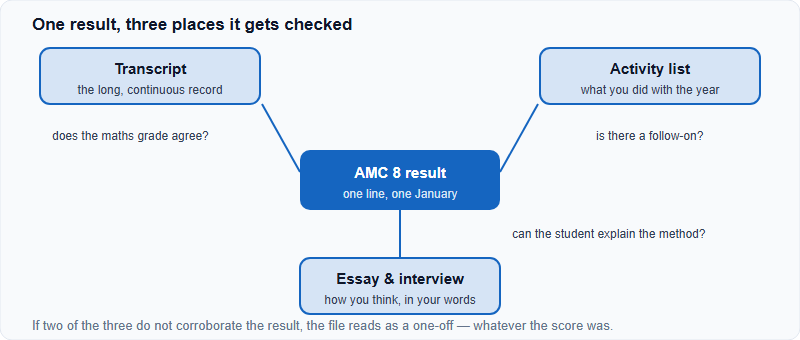
An admissions reader almost never reads a competition result on its own. They read it against the transcript, against the activity list, and against how the student writes and talks about their subject. A result that agrees with those three makes the whole file more believable; a result that sits alone, or contradicts them, does very little. This page is a worksheet for checking which one you have.
It assumes you already know what the AMC 8 is: 25 questions, 40 minutes, no calculator, grade 8 and under, sat in person during a January window through an authorized centre — the arrangements are in our 2026-27 in-person AMC 8 guide. What follows is what happens to the result afterwards, when it becomes one line among forty in a file.
1. The cross-validation grid
Work down this table with your own file open. For each row, write in the margin whether you have the corroboration, whether you have the contradiction, or neither. The rows are ordered by how often, in our own coaching conversations with families, each one gets probed in an interview.
| What the result implies | What corroborates it | What quietly contradicts it | What to do this term |
|---|---|---|---|
| This student can solve unfamiliar problems | Maths grades that hold up in the same year; a teacher who can describe how the student approaches a problem they have not seen | A strong contest score sitting beside a mid-range school maths record with no explanation | Ask the maths teacher what they would say about you if asked. If the answer surprises you, that is the gap |
| This student is genuinely interested in mathematics, not just tested on it | Something chosen rather than assigned: a club, a problem set kept for fun, a reading habit, coaching a younger student | A single sitting with no visible trace before or after it | Start one small, real thing now and let it accumulate. Duration is what an activity list cannot fake |
| This student works independently | Work produced without a class attached to it — a write-up, a solution set, a club they actually ran | Every item on the list is a paid course or an organised programme | Convert one thing you already do into something with an output someone else can see |
| This student performs at a level worth noting | The official result report, kept and retrievable, with whatever recognition tier it prints | A percentile or ranking claimed in words that the report does not state | Find the report file today. If you cannot find it, that is the first task, before any wording |
| The interest is sustained, not a phase | Two or more data points across different years, pointing the same way | A cluster of entries in one term and silence on either side | Put the next sitting in the calendar now rather than deciding in December |
2. Three things one AMC 8 line cannot do
Being clear about the limits is what makes the rest of the page usable.
- It cannot replace the school record. The transcript is the longest and most continuous piece of evidence in any file. A contest result adds a different kind of evidence beside it; it does not overwrite it.
- It cannot assert a percentile you have not been given. Whatever the official report states — score, and whatever recognition tier is printed on it — is what you may write. Anything beyond that is a claim you cannot evidence, and an unevidenced claim is worse than a modest one.
- It cannot stand in for an activity. Sitting an exam takes forty minutes. An activity list is asking what you did with the rest of the year. Those are different questions and a single sitting answers only the first.
3. The corroboration checklist
Tick honestly. Anything unticked is a task, not a failure — and most of them are cheap to fix if you start in September rather than in the term the applications are due.
- I can produce the official result report within five minutes, from a folder I will still have in two years.
- My school maths record for the same academic year points the same direction as the result.
- There is a second data point — a later sitting, a different contest, a role in a club — in a different school year.
- There is at least one thing I chose to do rather than was enrolled in.
- There is one piece of writing, however short, in which I explain a problem and how I approached it.
- There is a teacher who could describe my work in mathematics without being handed a script.
- Every number I plan to write on an application appears, in that form, on an official document.
On the fifth item, one first-party observation from our own coaching: the students who interview best are often not the highest scorers. They are the ones who once wrote down how they solved something. Writing a solution forces you to name the method, and naming the method is exactly what an interviewer is probing for when they ask about a result. A single page, kept, does more work later than most families expect.
4. The contradiction audit
| Mismatch | How it reads to someone checking | The repair |
|---|---|---|
| Strong contest result, ordinary school maths grades | Either the result is unrepresentative or the student is not applying themselves in class; both readings hurt | Close the classroom gap first. A contest result cannot be used to argue past a transcript |
| One sitting, nothing before or after | Reads as an attempt at a credential rather than an interest | Add a second point in a different year, or a role that lasted longer than a morning |
| A long list of one-time entries across many contests | Reads as collecting rather than pursuing; no single item is deep enough to ask about | Choose two and go deeper. Depth in one subject corroborates; breadth across ten rarely does |
| A percentile or rank stated in words but not on the report | The one thing that can make a whole file feel unreliable | Rewrite the line using only what the report states |
| A result the student cannot discuss | Answers stop at the score; the interview moves on | Re-solve two problems from that paper and write up one of them in your own words |
5. How to write the line itself
Precision reads as confidence. Vagueness reads as inflation. Compare:
| Weaker phrasing | Why it fails | Stronger phrasing |
|---|---|---|
| “Top of the country in a US maths olympiad” | Unverifiable, and names the contest wrongly | “AMC 8 (Mathematical Association of America), January 2026 — score and recognition exactly as stated on the official report” |
| “Award winner, AMC” | “AMC” alone is ambiguous — three different competitions share the initials | “AMC 8, the entry level of the US AMC series run by the MAA” |
| “Ranked in the top few percent” | A number you cannot show; the weakest line in the file | State the tier printed on the report, or state the score and stop |
| “Participated in maths competitions” | True and empty; gives the reader nothing to check | Name the contest, the organiser, the month and year, and one sentence on what you did afterwards |
6. What corroboration looks like over three years
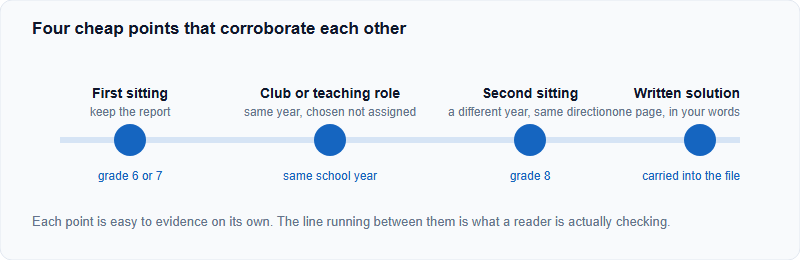
A closing note on what this page does not claim. No competition result guarantees an outcome anywhere, and any page that tells you otherwise is selling something. We publish no admission statistics of our own here, we make no promises about where any result leads, and results vary from student to student. What we do claim is narrower and, we think, more useful: a result that is corroborated by the transcript, by the activity list and by the way the student writes about their subject makes an entire file easier to believe, and that is a thing you can actually build over a school year.
The practical order is: sit the paper properly first, keep the report, then build the second and third points across the following year. For the January sitting itself — window, venue, and how registration works through authorized centres in China — see our in-person AMC 8 guide for 2026-27, and confirm the current date and rules on maa.org.
Frequently asked questions
Does an AMC 8 score guarantee anything in admissions?
No. It is one data point, checked against your transcript, activity list and essays. Nothing about a result is a guarantee.
How should I write an AMC 8 result on an application?
Name the contest and organiser, the month and year, and only the score and recognition tier printed on your official report.
Is one sitting enough?
One sitting shows a result; two across different years show a direction. A follow-on activity is usually easier to corroborate than a single score.
What weakens an AMC 8 line fastest?
A percentile you cannot evidence, and a strong score sitting next to a school maths record that says something different.
This is an independent guide operated by Hanlin Education for China-based international-school students. We are not affiliated with, endorsed by, or sponsored by the Mathematical Association of America (MAA). Competition rules, dates, score reporting and recognition tiers change: confirm current details on maa.org and with your authorized test centre before acting on anything here. Any error reported to us is corrected within 7 working days.