Many AMC 8 students can recite the definition of dependent events, yet still treat every draw as if the marbles magically return to the bag. The mistake sometimes comes from autopilot habit, and sometimes from a deeper confusion about how conditional information changes the sample space. This article is a worked clinic for that exact setup.
Why the Sample Space Shrinks
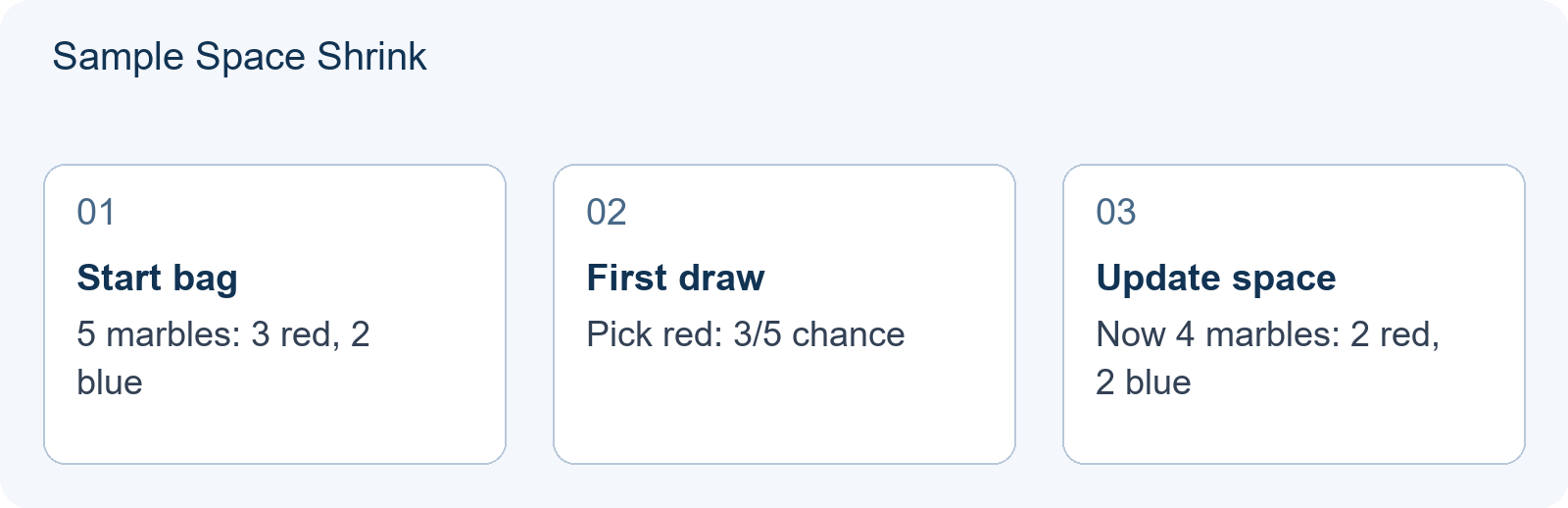
Consider a bag with 3 red and 2 blue marbles, for 5 total. You draw two marbles without replacement. The probability that both are red is not (3/5)×(3/5). After the first red marble is removed, only 4 marbles remain, and only 2 of them are red. The correct calculation is (3/5)×(2/4) = 6/20 = 3/10.
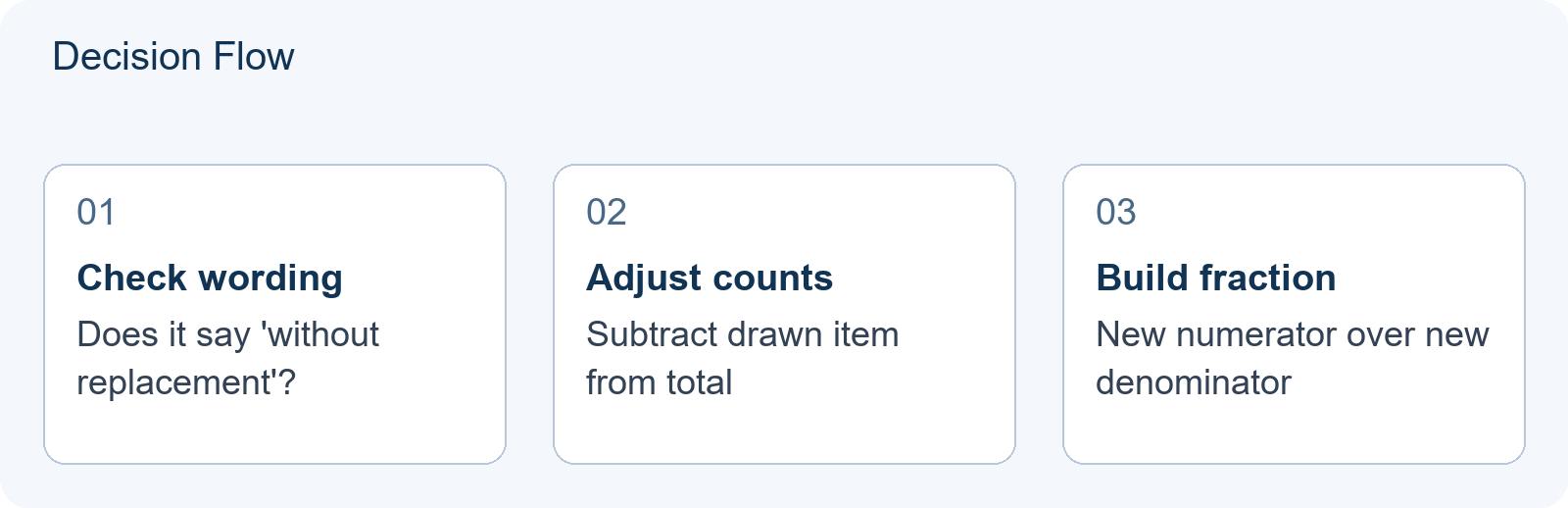
The key habit is: after every draw, write the new total and the new count of favorable items before you build the next fraction. This prevents the autopilot error of repeating the original denominator.
Teaching Illustration: Enumerating Ordered Outcomes
Label the marbles R1, R2, R3, B1, B2. The complete list of ordered pairs for two draws without replacement contains 5 × 4 = 20 equally likely outcomes. The favorable pairs with two reds are (R1,R2), (R1,R3), (R2,R1), (R2,R3), (R3,R1), (R3,R2)—six outcomes. This confirms 6/20 = 3/10. The enumeration is a teaching illustration, not a contest problem.
Conditional vs. Unconditional: A Checked Comparison
Students often confuse what happens on the second draw with what happens overall. Using the same 3-red, 2-blue bag, consider two different questions:
- Unconditional: What is the probability the second marble is red, with no information about the first?
- Conditional: What is the probability the second marble is red, given the first was red?
For the unconditional question, count all ordered pairs where the second entry is red: (R1,R2), (R1,R3), (R2,R1), (R2,R3), (R3,R1), (R3,R2), (B1,R1), (B1,R2), (B1,R3), (B2,R1), (B2,R2), (B2,R3)—twelve outcomes out of 20, so 12/20 = 3/5. This equals the original proportion of red marbles, as symmetry demands.
For the conditional question, we restrict to the six pairs where the first is red. Of those, (R1,R2), (R1,R3), (R2,R1), (R2,R3), (R3,R1), (R3,R2) have second red—but wait: with first fixed as R1, the second can only be R2, R3, B1, or B2. Four outcomes, two of them red. So the conditional probability is 2/4 = 1/2.
The lesson: the denominator shrinks from 5 to 4 only when we know the first draw’s result. If you do not know the first result, the second draw’s unconditional probability remains 3/5, though the underlying equally-likely outcomes are pairs, not single draws.
Replacement vs. No Replacement: Checked Fractions
| Scenario | First draw red | Second draw red | Combined |
|---|---|---|---|
| With replacement | 3/5 | 3/5 | 9/25 |
| Without replacement | 3/5 | 2/4 | 6/20 = 3/10 |
Notice that with replacement, the second fraction repeats 3/5 because the marble goes back. Without replacement, the second fraction must use the updated counts. The difference between 9/25 and 3/10 is small numerically but conceptually decisive.
When to Add Cases and When to Multiply
Students often confuse two structures:
- Multiply when events happen in sequence and all must occur: “first red AND second red.”
- Add when you have separate cases that achieve the same goal: “red then blue OR blue then red.”
For the bag with 3 red and 2 blue, the probability of one red and one blue in two draws is:
P(red then blue) + P(blue then red) = (3/5)×(2/4) + (2/5)×(3/4) = 6/20 + 6/20 = 12/20 = 3/5.
Each path is a product; the paths are added because they are mutually exclusive ways to reach the same outcome.
Three Diagnostic Problems With Worked Answers
Problem 1: Simple Two-Draw Dependence
A deck has 4 green and 6 yellow cards. Two cards are drawn without replacement. What is the probability both are green?
Solution: First draw green: 4/10. Second draw green from remaining: 3/9. Product: (4/10)×(3/9) = 12/90 = 2/15.
Problem 2: The Complement Trap
Using the same 4 green and 6 yellow deck, what is the probability of drawing at least one yellow in two draws?
Solution: It is easier to compute 1 − P(both green). From Problem 1, P(both green) = 2/15. Therefore P(at least one yellow) = 1 − 2/15 = 13/15.
Common error: Computing (6/10)×(5/9) = 30/90 = 1/3 for “both yellow” and stopping there, forgetting green-yellow and yellow-green. The complement method avoids case analysis.
Problem 3: Conditional Counting
A bag contains 2 red, 3 white, and 4 blue marbles. Three marbles are drawn without replacement. What is the probability they are drawn in the order red, white, blue?
Solution: P(red first) = 2/9. P(white second | red first) = 3/8. P(blue third | red and white gone) = 4/7. Product: (2/9)×(3/8)×(4/7) = 24/504 = 1/21.
Check for unsimplified sequential draws: the product denominator is 9×8×7 = 504. If you see 9×9×9, you have replacement where none was allowed. Note that after simplifying to 1/21, the single denominator 21 no longer reveals the sequential structure; the check applies to the unsimplified product.
What Repeated Denominator Errors Reveal About Your Next Lesson
| Error pattern | What it signals | Recommended next step |
|---|---|---|
| Second fraction keeps original denominator | Autopilot “with replacement” assumption or confusion about conditional vs. unconditional | Drill 10 problems forcing explicit “new total” annotation; revisit the conditional/unconditional comparison above |
| Correct structure but arithmetic errors | Weak fraction simplification under time pressure | Timed fraction-reduction drills, not more probability theory |
| Multiplies when should add, or vice versa | Confusion between “and” and “or” in probability | Return to AMC 8 Counting and Probability: The Four Setups That Cover Almost Every Question |
Building a Repeatable Check
Before finalizing any without-replacement probability, verify:
- Did the denominator decrease by 1 (or by the number of items removed) in the unsimplified sequential product?
- Did the numerator decrease if a favorable item was drawn?
- Does the product of all fractions have a denominator equal to the falling factorial of the original total?
For three draws from 9 items, the denominator of the final unsimplified product should be 9×8×7 = 504, as in Problem 3. If it is 9×9×9, you have replacement where none was allowed. After simplifying, a reduced fraction like 1/21 no longer shows the decreasing pattern; the check applies before reduction.
Connecting to Broader AMC 8 Preparation
This skill sits within counting and probability, a recurring topic domain on the AMC 8. For students ready to move beyond single-concept drills, the next layer involves combining probability with AMC 8 Venn Diagrams: Sorting Exactly One, At Least One and Neither or integrating probability estimates into AMC 8 Statistics and Data Displays: The Mean-Median-Mode-Range Card, Five Chart Types, and the Trap in Each. Students uncertain about their eligibility for the upcoming competition should review Are You Eligible for the January 2027 AMC 8? The Two-Part Test, a Birthday Cutoff Table, and a Grade-Name Decoder before registering.
Preparing for a Consultation or Course-Fit Discussion
If you are discussing preparation support with a tutor or program, bring a concrete sample of your work:
- One problem you solved correctly, with your written steps
- One problem where you used the original denominator twice
- One problem where you were unsure whether to add or multiply cases
This specific evidence allows an instructor to diagnose whether your gap is mechanical, conceptual, or pressure-related, and to assign targeted practice rather than generic review.
Handling “At Least One” Without Replacement: The Complement Shortcut
Sequential multiplication handles an AND path, while addition combines mutually exclusive OR paths. However, a frequent AMC 8 trap involves the phrase “at least one.” Students often attempt to enumerate every favorable path (e.g., Red-Blue, Blue-Red, Red-Red for “at least one red”), which is error-prone under time pressure. A more robust strategy uses the complement rule, but it requires careful adjustment of the sample space.
Consider a bag with 4 red and 6 blue marbles (10 total). We draw two without replacement. What is the probability of getting at least one red? The direct method requires summing three cases: P(RR) + P(RB) + P(BR). This is tedious. Instead, calculate the probability of the opposite event: no reds (i.e., both are blue).
For the complement, the first draw must be blue: 6/10. Since we do not replace, the second draw must also be blue from the remaining 9 marbles, where only 5 are blue: 5/9. Thus, P(no red) = (6/10) × (5/9) = 30/90 = 1/3. Therefore, P(at least one red) = 1 − 1/3 = 2/3.
This teaching illustration highlights a critical logical implication: the complement method works because the events “at least one red” and “zero reds” are mutually exclusive and exhaustive. However, students frequently fail by calculating the complement using replacement logic (e.g., (6/10)×(6/10)), leading to an incorrect answer of 1 − 0.36 = 0.64 instead of 0.667. Always verify that the denominator decreases in the unsimplified product when using complements for without-replacement scenarios.
Define the Complement Precisely: Overlapping Conditions
Be cautious when the condition involves multiple attributes. For example, if asked for “at least one red OR at least one blue,” the complement is “neither red nor blue” (i.e., all other colors). If the bag contains only red and blue, this probability is 1, making the question trivial. In complex setups with three or more colors, ensure the complement accurately captures the exclusion of all target categories simultaneously. For instance, with 3 red, 2 blue, and 5 green marbles, drawing two, the probability of “at least one red” is found by subtracting P(both non-red) from 1. Non-red count is 7. P(both non-red) = (7/10) × (6/9) = 42/90 = 7/15. Result: 1 − 7/15 = 8/15. Direct enumeration would sum the mutually exclusive paths RR, RG, GR, RB and BR. Paths GB, BG and GG contain no red and do not belong in that sum. The complement method reduces cognitive load significantly if applied correctly.
Frequently Asked Questions
Why do I keep getting the denominator wrong on the second draw?
Most students autopilot the original total, but some also confuse conditional and unconditional probability. Force yourself to write ‘After first draw: __ total, __ favorable’ before building the second fraction. If the problem gives no information about the first draw, the second draw’s unconditional probability uses the original proportion, not a reduced denominator.
Can I ever have the same denominator twice without replacement?
Only in a conditional probability where you are told the first draw’s result and treat that as a new starting point with its own sample space. In standard sequential draws, the unsimplified product must show decreasing denominators. After simplifying a fraction, the single denominator may not reflect this, so check the unsimplified product.
How does this connect to other AMC 8 probability topics?
The same update rule applies when probability questions involve cards, names in a hat, or selecting committee members. Mastering the denominator update lets you handle geometric probability and expected value problems that build on the same foundation.