Number theory is the AMC 8 domain that international-school curricula touch least, which makes it the fastest place to gain marks: divisibility, last digits and remainders can be installed in about three weeks. This guide rebuilds the three toolkits from zero, with worked examples, the traps that waste time, and a self-study block you can run over a summer.
Why This Is the Widest Gap for International-School Students
It is not true that IB MYP or IGCSE ignore number theory. Both teach prime factorisation, highest common factor and lowest common multiple. What they generally do not teach is the layer above: using a factorisation to count things, reading the last digit of a large power, or reasoning about what is left over after division. Those are exactly the moves that contest problems are built on.
The result is a student who can factorise 360 on request but has never been asked how many divisors it has — and who therefore meets that question for the first time under a 40-minute clock, with no calculator. The AMC 8 is described as covering middle-school mathematics (confirm the current syllabus description on maa.org), and number theory sits squarely inside that description even where school assessment never goes near it.
The good news is that this is a small, closed toolkit. Unlike geometry, which keeps expanding, the number theory a middle-school contest can reasonably ask about fits on two pages. It is genuinely learnable in a summer — which is why families planning a January sitting should be doing it now rather than in December. If the sitting itself is not yet arranged, our 2026–27 in-person AMC 8 guide covers finding an authorized center first.
Toolkit 1: Factor Structure
Everything in this toolkit descends from one habit: when a problem mentions divisors, factors, multiples, or “divides evenly”, factorise into primes before doing anything else. Students who skip this step end up listing numbers by hand and running out of time.
First, the tests worth memorising. These are not shortcuts to look clever — they are what lets you check a candidate in two seconds instead of doing long division.
| Divisible by | Test | Worked check |
|---|---|---|
| 2 | Last digit is even | 1,428 ends in 8 → yes |
| 3 | Digit sum is a multiple of 3 | 1,428 → 1+4+2+8 = 15 → yes |
| 4 | Last two digits form a multiple of 4 | 1,428 → 28 = 4 × 7 → yes |
| 5 | Last digit is 0 or 5 | 1,428 → no |
| 6 | Passes both the 2-test and the 3-test | 1,428 passes both → yes |
| 8 | Last three digits form a multiple of 8 | 1,428 → 428 = 8 × 53.5 → no |
| 9 | Digit sum is a multiple of 9 | 1,428 → 15 is not → no |
| 11 | Alternating digit sum is a multiple of 11 (including 0) | 2,915 → 2 − 9 + 1 − 5 = −11 → yes |
| 25 | Last two digits are 00, 25, 50 or 75 | 3,175 ends in 75 → yes |
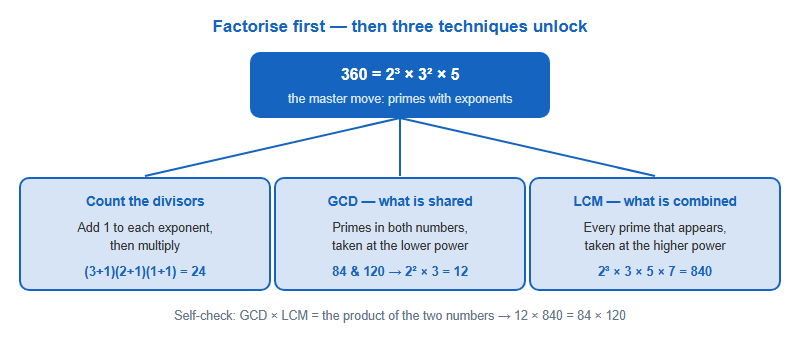
Counting divisors. Write the number as primes with exponents, add one to each exponent, multiply. For 360 = 23 × 32 × 51, the divisor count is (3+1)(2+1)(1+1) = 24. You never list them. This one formula converts a five-minute listing exercise into a fifteen-second calculation, and it is the single highest-value thing in this article.
GCD and LCM, understood rather than memorised. Line the factorisations up and the two ideas become obvious. Take 84 = 22 × 3 × 7 and 120 = 23 × 3 × 5. The greatest common divisor takes only the primes in both, at the lower power: 22 × 3 = 12. The lowest common multiple takes every prime that appears, at the higher power: 23 × 3 × 5 × 7 = 840. A useful self-check: GCD × LCM should equal the product of the two numbers — here 12 × 840 = 10,080 = 84 × 120.
One fact worth knowing cold: a number has an odd number of divisors exactly when it is a perfect square. 36 = 22 × 32 gives (2+1)(2+1) = 9 divisors, and indeed 1, 2, 3, 4, 6, 9, 12, 18, 36. Contest problems about lockers, lamps, or anything being toggled repeatedly are usually this fact wearing a costume.
Toolkit 2: Last Digits and Cycles
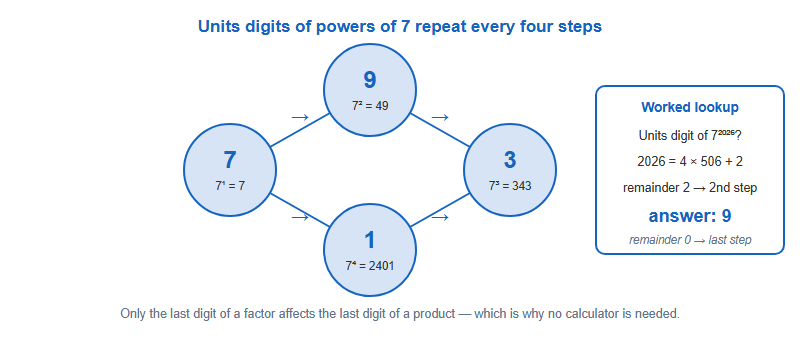
Any question asking for the units digit of a large power looks impossible without a calculator and is actually one of the quickest marks on the paper, because only the last digit of each factor affects the last digit of the product. Multiply 7 by itself repeatedly and watch only the final digit: 7, 49, 343, 2401, 16807 … giving 7, 9, 3, 1, then 7 again. The pattern closes after four steps and repeats forever.
| Base ends in | Cycle of units digits | Cycle length |
|---|---|---|
| 2 | 2, 4, 8, 6 | 4 |
| 3 | 3, 9, 7, 1 | 4 |
| 7 | 7, 9, 3, 1 | 4 |
| 8 | 8, 4, 2, 6 | 4 |
| 4 | 4, 6 | 2 |
| 9 | 9, 1 | 2 |
| 0, 1, 5, 6 | unchanged | 1 |
The lookup is then mechanical. To find the units digit of 72026: the cycle length is 4, and 2026 = 4 × 506 + 2, so 72026 sits in the same position as 72 — the answer is 9. The only place students slip is the wrap-around: when the remainder is 0, you are at the last entry of the cycle, not the first. So the units digit of 3100 is 1, because 100 is an exact multiple of 4.
Toolkit 3: Remainders, Without the Vocabulary
Remainder problems intimidate students because they sound like university mathematics. They are not. A remainder question is asking one thing: where does this land in a repeating pattern? No modular notation is needed at AMC 8 level.
Pattern one: repeating calendars and cycles. If today is Wednesday, what day is it 100 days from now? Days repeat every 7, and 100 = 7 × 14 + 2, so you land 2 days past Wednesday: Friday. Every problem about beads on a repeating necklace, seats around a table, or a rotating duty roster is the same calculation with different scenery.
Pattern two: two conditions at once. “Find the smallest positive whole number that leaves a remainder of 3 when divided by 7 and a remainder of 1 when divided by 4.” The efficient method is not algebra — it is a short, disciplined list. Write out the numbers satisfying the harder condition and test them against the easier one: 3, 10, 17. Stop: 17 leaves remainder 1 when divided by 4. The answer is 17.
Then the extension that separates prepared students from unprepared ones: further solutions repeat every LCM(7, 4) = 28. So the full family is 17, 45, 73, and so on — which instantly answers follow-up questions such as “how many such numbers are under 100?” (three). Notice how Toolkit 1 just paid for itself inside a remainder problem; this cross-linking is characteristic of the domain.
Pattern three: counting multiples in a range. How many multiples of 6 are there from 1 to 200? Divide and discard the remainder: 200 ÷ 6 = 33 remainder 2, so 33. For “multiples of 6 or 10”, count each, then subtract the overlap, which is the multiples of LCM(6, 10) = 30: 33 + 20 − 6 = 47. Subtracting the overlap is the step students forget, and it is worth rehearsing until it feels automatic.
A Three-Week Install Block
This domain rewards short, daily contact far more than weekend marathons, because most of it is recall under pressure rather than deep understanding. Thirty focused minutes a day for three weeks will install the whole toolkit.
| Week | Daily work (about 30 minutes) | You are ready when… |
|---|---|---|
| Week 1 — factor structure | 10 divisibility checks, then factorise 5 numbers and count their divisors | You can give the divisor count of any three-digit number in under a minute, without listing |
| Week 2 — digits and cycles | Rebuild each cycle from scratch (do not copy the table), then 5 units-digit questions with large exponents | You get the remainder-0 wrap-around right every time |
| Week 3 — remainders | 3 calendar-style problems, 2 two-condition problems, 2 counting-multiples problems | You reach for a short list rather than freezing or writing equations |
| Ongoing | Mixed set, timed, no calculator — and re-derive one cycle from memory each week | Speed holds up when the questions are not labelled by topic |
The instruction to rebuild the cycles from scratch rather than re-reading them is deliberate. In our editorial work with China-based students, the most common failure with this material is not misunderstanding — it is decay. A student learns the units-digit trick in August, never regenerates it, and has lost the wrap-around rule by January. Re-deriving takes ninety seconds and makes the knowledge durable in a way that re-reading never does. The drill items this block calls for — divisibility checks, units-digit questions and mixed timed sets — are the material we have gathered in our AMC 8 study package, which readers can ask us for. Time the block so it finishes well before the January window; check the current date on maa.org and, if a seat is still outstanding, see our registration and center guide.
The Three Traps
- Confusing factors with multiples. Factors of 12 are 1, 2, 3, 4, 6, 12 — a short list, all no bigger than 12. Multiples of 12 are 12, 24, 36, … — an endless list, none smaller. Under time pressure students reverse these constantly, and the resulting answer is usually still on the option list. Fix it by saying the word to yourself: factors go into, multiples come out of.
- Assuming a cycle length. Not every cycle has length 4 — bases ending in 4 or 9 repeat every 2, and 5 or 6 never change at all. Always generate the first three or four terms before dividing. Assuming is where a 30-second question becomes a wrong answer.
- Brute-forcing what factorisation would answer. If you find yourself writing out a long list of divisors, stop: you have missed a structural shortcut. Listing is the correct method for a two-condition remainder problem and the wrong method for a divisor-counting problem, and telling those apart quickly is most of the skill in this domain.
Frequently Asked Questions
How much number theory does the AMC 8 need?
Divisibility, factor structure, last-digit cycles and remainder reasoning cover it. Confirm the current syllabus description on maa.org.
How do I find the units digit of a large power?
Generate the cycle of last digits, divide the exponent by the cycle length, and use the remainder as the position. Remainder 0 means the last entry.
What is the fastest way to count divisors?
Factorise into primes, add one to every exponent, then multiply. For 360 = 2³ × 3² × 5 that gives 4 × 3 × 2 = 24.
Do I need modular arithmetic notation?
No. At AMC 8 level, remainder questions are handled with short lists and repeating patterns rather than formal notation.
This is an independent guide operated by Hanlin Education for China-based international-school students. It is not affiliated with, endorsed by, or sponsored by the Mathematical Association of America (MAA). All practice items above are our own constructions. Competition details change — always confirm current dates, eligibility, format, and syllabus information on maa.org. Any error will be corrected within 7 working days.