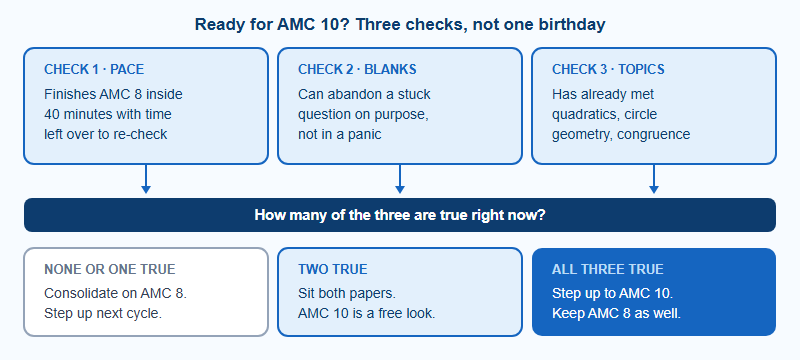
Step up when three things are true, not when your child reaches a certain grade: they finish AMC 8 inside 40 minutes with time left to check, they can leave a hard question alone on purpose, and they have already met quadratics, circle geometry and congruence. AMC 10 gives 180 seconds per question instead of 96, and pays 1.5 points for a blank — a genuinely different exam skill.
The decision is almost always made on the wrong variable
The conversation in most China-based households runs like this: “She’s in grade 8 now, so this is the last year she can do AMC 8 — should she just move to AMC 10?” The grade is doing all the work in that sentence, and grade is the one variable that tells you almost nothing about whether the student will cope with the paper.
AMC 8 is open to students in grade 8 and below. AMC 10 is open to students in grade 10 and below who are under 17.5 on competition day — which means the two windows overlap for a large group of students, and the overlap is deliberate. A student in grade 7 or 8 is not choosing between the two exams. They are choosing an order, a pace, and how much of the AMC 10 syllabus to front-load.
What follows is the readiness test we actually run before advising a family either way. Three signals, all observable at home this week, none of which require a mock exam score.
Signal 1 · Pace: is the student rushing, or thinking?
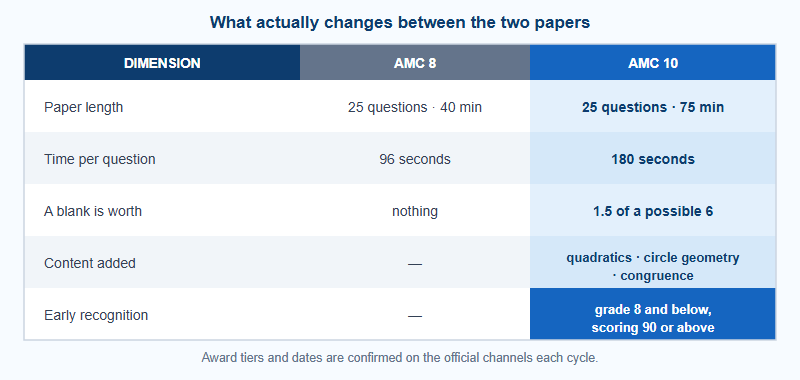
Here is the arithmetic almost nobody does. AMC 8 is 25 questions in 40 minutes — that is 96 seconds per question. AMC 10 is 25 questions in 75 minutes — 180 seconds per question, just under twice as long.
The instinct is to read that as “AMC 10 is more relaxed.” It is the opposite. The time allowance nearly doubles because the questions get materially deeper: multi-step algebra, geometry that requires a construction before any calculation begins, and counting problems where the setup is harder than the count. Three minutes on an AMC 10 question is not generous. It is roughly what the question costs.
So the test is not “can the student finish AMC 8?” It is: does the student finish AMC 8 with time in hand? A student who uses all 40 minutes and hands in the paper at the bell has no spare capacity. Give that student a question that costs three minutes of genuine thought and they will still be racing. A student who reaches question 25 at the 30-minute mark and spends the last ten minutes re-checking has demonstrated the thing AMC 10 actually pays for: the ability to sit with a problem.
Watch for the specific failure mode — a student who scores respectably on AMC 8 but always finishes with zero seconds to spare is usually pattern-matching, not reasoning. That works at 96 seconds a question. It stops working when the paper is built to punish it.
Signal 2 · Blank discipline: the scoring model changes the behaviour
This is the part families consistently miss, and it is the single largest behavioural difference between the two papers.
On AMC 8, a blank earns nothing. There is therefore never a reason to leave one — the correct instruction to a child is “fill in every single answer, guess if you have to.” Every AMC 8 student in China has been drilled on exactly this.
On AMC 10, the scoring is 6 points for a correct answer, 0 for a wrong one, and 1.5 for a question left blank, out of 150. That 1.5 is not a rounding detail — it is a quarter of the value of a correct answer (1.5 ÷ 6 = 0.25). A wild guess now has to come good more than a quarter of the time just to break even against doing nothing at all. How often a blind guess lands depends on how many options the current paper offers, which you should confirm on the official channels rather than assume — but the direction of the incentive is fixed, and it points the opposite way from AMC 8.
In practice this means a competent AMC 10 sitting looks like this: the student answers what they can see, deliberately abandons the questions that are out of reach, and banks 1.5 a time for doing so. Six strategic blanks are worth 9 points — the same as a correct answer and a half. A student who has spent two years being told “never leave a blank” will not do this. They will guess, score zero on those six, and lose 9 points they were entitled to.
Unlearning a trained reflex takes longer than learning a new topic. This is why we rate blank discipline as a readiness signal rather than a coaching afterthought — it is the skill most likely to still be missing on exam day.
Signal 3 · The three topics that actually block students
AMC 10 reaches beyond AMC 8 into quadratic and rational functions with coordinate geometry, inequalities, similarity, circle geometry, and elementary number theory — divisors, divisibility and congruence — alongside heavier counting and logic.
That is the full list, but in our experience only three of them decide the outcome for a student coming straight off AMC 8.
| Topic gap | Why it blocks an AMC 8 student | Realistic time to close |
|---|---|---|
| Quadratics (with coordinate geometry) | Vieta’s relations, discriminant reasoning and parabola-line intersection appear constantly. An AMC 8 student can often solve the underlying arithmetic but has no vocabulary to set the problem up. | The longest of the three — this is a syllabus block, not a trick |
| Circle geometry | Inscribed angles, power of a point, tangent conditions. AMC 8 geometry rewards decomposition into triangles and rectangles; circle problems reward a theorem the student has simply never been shown. | Fast once taught — high return per hour |
| Congruence (modular arithmetic) | Remainder, last-digit and cycle problems. Strong AMC 8 students often brute-force these; at AMC 10 length the brute force runs out of time before it runs out of correctness. | Fast — mostly notation and habit |
The useful implication: two of the three gaps close quickly. A student who is strong on signals 1 and 2 but weak on signal 3 is not “not ready” — they are a few focused weeks away. A student who passes signal 3 but rushes through AMC 8 in 40 flat is the harder case, because pace is a habit rather than a topic.
Why an early AMC 10 attempt is upside-only
Here is the fact that should change how most families frame this decision, and it is specific to exactly the age group this site serves.
AMC 10 carries a recognition for students in grade 8 and below who score 90 or above. That is 60% of the 150-point paper, achieved by a student who is not yet in high school. It is a distinct early-achievement marker, and it exists precisely because the organisers expect strong younger students to arrive early.
Work through what “90 or above” actually costs under the 6 / 0 / 1.5 model:
| Route to a score of 90 or above | Correct | Blank | Wrong | Score |
|---|---|---|---|---|
| Pure accuracy, no blanks | 16 | 0 | 9 | 96 |
| Solid core plus disciplined blanks | 14 | 5 | 6 | 91.5 |
| Narrow core, heavy blank discipline | 13 | 9 | 3 | 91.5 |
Look at the third row. A student who genuinely solves only 13 of 25 questions — barely over half — still clears the threshold at 91.5 provided they leave nine questions alone instead of guessing. Those nine blanks are worth 13.5 points. If that same student guesses on all nine and gets one right, they land on 84 — fourteen correct, eleven wrong, no blank credit at all — and miss the threshold by six points. The blank discipline from Signal 2 is not a nicety; on these margins it is the difference.
And the downside? There isn’t one worth the name. A low AMC 10 score costs the student one weekday evening and a registration fee. There is no penalty for attempting the paper early, nothing a student is obliged to report if the score is modest, and the paper itself is the single best diagnostic that exists for what to study next. This is why we generally advise strong grade 7 and grade 8 students to sit AMC 10 as well as AMC 8 rather than instead of it — the asymmetry is real.
For award context beyond the early-achievement marker: AMC 10 recognises a perfect 150, a global Distinguished Honor Roll at roughly the top 1%, and an Honor Roll at roughly the top 5%. The AIME qualifying threshold no longer moves: for 2027 MAA has set it at a fixed 100 out of 150 on the AMC 10, replacing the percentile line described in older guidance. The award rolls above are still percentile bands published after the papers are sat, so confirm those on the official channels before you set a target.
One ceiling has appeared above that floor, and it is new. MAA has said the 2027 AIME will be open only to students aged 13 and over, and that a qualifier under 13 cannot sit it, with no alternative arrangement offered. Read carefully what that does and does not touch. The AMC 10 itself still has no lower age limit, the grade-8-and-below recognition at 90 is unaffected, and a wrong answer still costs nothing — so everything above about an early attempt being upside-only holds. What changes is the far end of the ladder: a student who is not yet 13 can clear the AMC 10 qualifying score of 100 and still not sit the AIME that cycle. MAA has not said which date the age is measured against, and describes the full AIME policies as still to be posted, so treat this as a reason to ask your centre rather than a settled rule. For a family whose child would be 11 or 12 that February, the sensible reading is that an early AMC 10 sitting is still worth doing — for the score, the early-achievement recognition and the diagnosis — but not as a route to the AIME in that particular cycle.
The calendar makes “sit both” easier than families assume
A scheduling detail that resolves most of the anxiety: the 2026 AMC 10 A paper is on 5 November 2026 and the B paper on 13 November 2026. For the China region the local organising committee publishes a 17:00–18:15 sitting window for both, with bilingual papers — confirm your own date and slot with the authorised test centre before you plan around them. AMC 8 is sat in January — confirm the exact date and registration window on the official channels and with the authorised centre.
Two things follow. First, the two AMC 10 sittings are eight days apart, and the 17:00–18:15 slot is 75 minutes exactly, so a student who sits both papers is doing so on consecutive weeks rather than in a single crushing weekend. Second — and this is the part families miss — AMC 10 in November lands roughly two months before the January AMC 8, in the same academic year. The “step up” is not a fork in the road. It is a November event followed by a January event.
That ordering is a gift. A student sits AMC 10 in November while the stakes are low, discovers exactly which of the three topic gaps is real, spends December closing it, and walks into AMC 8 in January sharper than they would otherwise have been. The harder paper functions as preparation for the easier one.
What to do in the eight weeks before a first AMC 10
If the three checks point to stepping up, the preparation is narrower than families expect. It is not “cover the whole AMC 10 syllabus.” It is:
- Weeks 1–3 — close the circle geometry and congruence gaps. These are the two fast wins from the table above. Both are theorem-and-notation problems rather than deep skill problems.
- Weeks 4–6 — quadratics with coordinate geometry. The genuine syllabus block. Budget double the time of the other two combined.
- Weeks 7–8 — timed papers, and only timed papers, with a hard rule: the student must leave at least four questions blank on purpose. Practising the blank is the single highest-return thing you can do in the final fortnight, because it is a habit, and habits need repetitions rather than explanations. We have watched capable students lose double-digit points to a reflex they were never told to unlearn.
Past papers are the whole preparation once the topic gaps are closed, and there is no substitute for working through the real thing under the clock. We keep a collated set of AMC 8 and AMC 10 papers with worked solutions for many of the years — coverage is not complete for every year and we are still adding to it — and our readers are welcome to ask us for the current set rather than hunting for scattered copies. The self-study package is where that material sits, and the tutoring courses page covers the guided route for students who need the quadratics block taught rather than reviewed. When the decision is made, the registration channel handles the sitting itself through the authorised centre.
One de-identified data point on what the ceiling looks like for this age group: across a recent AMC 8 cycle, 103 students in Hanlin’s cohort reached Distinguished Honor Roll (per Hanlin; results are de-identified and vary by student). We do not have a published breakdown of that group by grade or by prior AMC 10 experience, and will not imply one. The narrower point this article rests on is an editorial observation rather than a statistic: the students who walk into January already knowing which of the three topic gaps is theirs are the ones who spend December on the right thing.
The one case where you should not step up
To be honest about the other side: if a student is finishing AMC 8 at exactly the bell, guessing on everything they cannot see, and has not met quadratics, then a November AMC 10 will produce a score in the twenties or thirties and a demoralised child. The exam is still harmless on the record — but the confidence cost is not nothing, and at that point the better use of the autumn is genuinely making AMC 8 comfortable.
That is the case for waiting. Notice it is a description of behaviour, not of a birth year. Which was the whole point.
Frequently asked questions
Can my child sit AMC 8 and AMC 10 in the same year?
Yes. AMC 8 is open to grade 8 and below and AMC 10 to grade 10 and below who are under 17.5 on competition day, so the windows overlap for grade 7 and 8 students. The calendar helps: the 2026 AMC 10 A paper is 5 November 2026 and the B paper 13 November 2026, and for the China region the local organising committee publishes a 17:00–18:15 sitting window for both, while AMC 8 is sat in January. AMC 10 therefore comes roughly two months before AMC 8 in the same academic year. Confirm your own dates, slot and current eligibility on the official channels and with the authorised test centre.
What score does a grade 8 student need on AMC 10 to be recognised?
AMC 10 carries a recognition for students in grade 8 and below who score 90 or above out of 150 — that is 60% of the paper. Under the 6 points correct, 0 wrong, 1.5 blank model, a student can reach 91.5 with 14 correct, 5 blank and 6 wrong, or with 13 correct, 9 blank and 3 wrong. Blank discipline is what makes those routes work. Other tiers — a perfect 150, global Distinguished Honor Roll at roughly the top 1% and Honor Roll at roughly the top 5% — are percentile bands confirmed on the official channels after the papers are sat. AIME qualification is no longer one of them: MAA has fixed it at 100 on the AMC 10 for 2027.
Is guessing on AMC 10 a good idea like it is on AMC 8?
No, and this is the biggest behavioural change between the two papers. On AMC 8 a blank earns nothing, so students are correctly drilled to answer every question. On AMC 10 a blank is worth 1.5 against a possible 6 — a quarter of the value of a correct answer — so a wild guess must come good more than a quarter of the time just to break even. Six deliberate blanks are worth 9 points. How often a blind guess lands depends on the number of options on the current paper, which you should confirm on the official channels.
Which topics should we cover first when moving up from AMC 8?
AMC 10 adds quadratic and rational functions with coordinate geometry, inequalities, similarity, circle geometry, elementary number theory including divisors, divisibility and congruence, plus heavier counting and logic. In practice three of these decide the outcome for a student coming off AMC 8: quadratics, circle geometry and congruence. Circle geometry and congruence close quickly because they are mostly theorem and notation; quadratics with coordinate geometry is the real syllabus block and deserves roughly double the time of the other two combined.
This site is an independent guide and prep resource for China-based families. We are not affiliated with, endorsed by or sponsored by the MAA; official rules, dates, eligibility and registration are published on maa.org and handled through authorised test centres. Student results referenced above are de-identified Hanlin data and vary by student. Confirmed errors are corrected within 7 working days.