Every wrong option on a well-written multiple-choice maths paper is engineered, not random: each one is the number you get if you make a specific, predictable mistake. Learn the five families of wrong answer and each question becomes a built-in self-check — landing on a distractor tells you exactly which error you just made. Here is how to read the options, and when to stop reading them.
Why the Wrong Options Are Not Random
The AMC 8 is a 25-question, 40-minute, no-calculator multiple-choice paper, with each question offering lettered options (confirm the current format on maa.org). That format has a consequence most students never think about: somebody had to choose the four numbers that are not the answer.
Writers of good multiple-choice mathematics do not choose them at random. Random wrong options would be useless — a student who made a serious error would produce a number not on the list, notice it, and simply fix the mistake. The wrong options are therefore written to catch the errors a competent student is most likely to make. That is the whole point of the format.
To be clear about what is being claimed here: this is an analytical model of how well-designed multiple-choice items work, not a statement issued by the MAA about how the AMC 8 is written. But it is a model that survives contact with reality, and it produces an insight worth building a habit around:
An answer that is not among the options is a free alarm. An answer that is among the options gives you no alarm at all. Students celebrate when their number matches an option — that match is exactly when they are most exposed, because a matching wrong answer feels identical to a matching right one. Reading the options as a mistake map is how you get the alarm back.
This is technique, not registration, so it only matters once a seat is booked. If that step is still open, our 2026–27 in-person AMC 8 guide covers the authorized-center route for China-based families.
The Five Distractor Families
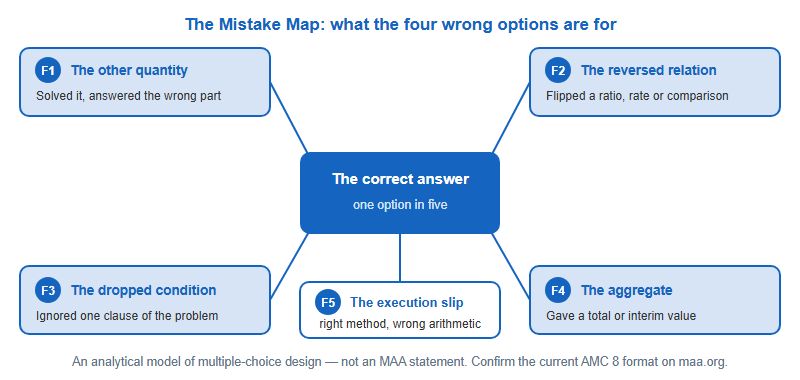
Across contest-style word problems, almost every engineered wrong answer belongs to one of five families. Learning the families is faster than learning individual traps, because the families repeat while the problems never do.
| Family | The mistake it catches | How to spot it in the options | Counter-move |
|---|---|---|---|
| F1 · The other quantity | You solved correctly, then reported the quantity you were not asked for | Two options differ by exactly the relationship stated in the problem | Underline the final question word before you start |
| F2 · The reversed relation | You flipped a comparison, ratio, rate, or “more than / less than” | An option sits symmetrically on the wrong side of the correct one | Say the relation aloud in your own words: “which one is bigger?” |
| F3 · The dropped condition | You ignored one clause — an extra constraint, an exclusion, a “not counting…” | An option is what a simpler, cleaner version of the problem would give | Tick each numerical clause as you use it |
| F4 · The aggregate | You gave a total, a sum, or an intermediate value your own work produced | An option equals the sum or product of the numbers you just wrote down | Ask: is this the part or the whole? |
| F5 · The execution slip | Right method, wrong arithmetic: off-by-one, factor of 10, minutes vs hours | An option is suspiciously close to yours, or exactly ten times it | Re-run only the arithmetic, not the reasoning |
F5 deserves a note. It is the only family that is not reliably pre-printed, because execution slips are unpredictable — which is precisely why it is the most dangerous one. When an arithmetic slip lands you on an option, nothing warns you. When it lands you off the list, the paper has done your checking for you.
A Worked Example, Built So You Can See All Five
The problem below is our own construction, written specifically so that each wrong option is produced by one identifiable error. It is not an AMC 8 question — it is a teaching model of one.
Practice item. A shop sells notebooks at 6 yuan each and pens at 4 yuan each. Mia buys 5 more notebooks than pens, and spends 80 yuan in total. How many notebooks did she buy?
(A) 5 (B) 6 (C) 8 (D) 10 (E) 15
Let the number of pens be p, so notebooks number p + 5. Then 6(p + 5) + 4p = 80, giving 10p + 30 = 80, so p = 5 and the number of notebooks is 10 — option (D). Check: 10 notebooks at 6 yuan is 60, plus 5 pens at 4 yuan is 20, total 80. Now look at what each wrong option is doing there.
| Option | Family | The exact error that produces it | Why it feels right |
|---|---|---|---|
| (A) 5 | F1 · The other quantity | Solved perfectly, then wrote down p = 5, the number of pens | The number came out of correct algebra |
| (B) 6 | F2 · The reversed relation | Read it as 5 more pens than notebooks: 6n + 4(n + 5) = 80 gives n = 6 | The arithmetic is flawless; only the direction was wrong |
| (C) 8 | F3 · The dropped condition | Forgot the “5 more” clause: 6n + 4n = 80 gives n = 8 | It is the answer to a tidier problem |
| (E) 15 | F4 · The aggregate | Found 10 and 5 correctly, then reported the total number of items | Both component numbers were right |
| (D) 10 | — | Correct | — |
Every wrong option here comes from a student who understood the problem. That is the uncomfortable lesson: on this kind of paper you rarely lose points because you could not do the mathematics. You lose them because you answered a slightly different question than the one printed.
The Ten-Second Option Scan
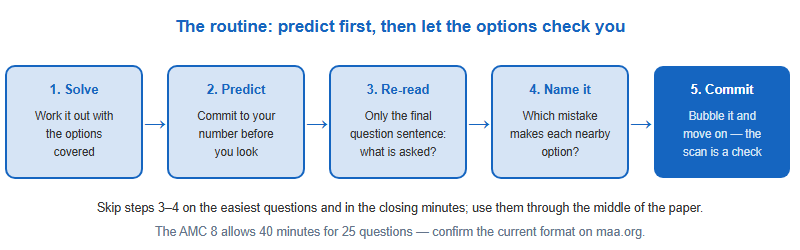
Reading options well is a fixed routine, not a talent. Four steps, and a rule about when to skip them.
- Predict before you look. Finish your working and commit to a number before your eyes go to the options. Once you have seen five numbers, one of them will start to look correct.
- Re-read the final question sentence. Not the whole problem — only the clause with the question mark. This single habit removes most of family F1 and F4.
- Ask which mistake makes each nearby option. If you can name the error that produces the option next to yours, you have just confirmed your answer from the outside. If you cannot — and especially if you can name the error that produces your own number — recheck.
- Move. The scan is worth about ten seconds. It is a check, not a second attempt.
When to skip it: on the earliest, most accessible questions, where the risk is spending time rather than making errors, and in the final minutes, when filling every remaining bubble matters more than auditing any one of them. The scan earns its keep in the middle of the paper, where problems are rich enough to have real traps but you still have time to use them.
Rebuild Your Review Log Around Families
Most students review by topic: “I got the geometry one wrong.” That produces the vague conclusion “do more geometry,” which rarely fixes anything, because the geometry was usually fine. Reviewing by distractor family produces a conclusion you can act on this week.
Add one column to your error log: which family did the option I chose belong to? After three practice papers, the pattern is normally embarrassing in its consistency. If you need papers to run the log on, our AMC 8 study package is the practice set we have gathered for exactly this, and readers can ask us for it. In our editorial work with China-based students, the pattern that recurs most is F1 combined with F4 — capable students who solve the problem and then answer a question adjacent to the one asked. That is a two-second reading habit, not a mathematical weakness, and it is one of the fastest score gains available to a student who already understands the content.
The counter-drills follow directly from the family, which is the point of naming them:
- Mostly F1 or F4? Drill the question sentence: for twenty problems, write down what is being asked before solving anything. Do not solve them at all.
- Mostly F2? Slow down on translation. Restate each comparison in your own words before writing an equation.
- Mostly F3? Tick every numerical clause as you consume it, and refuse to answer until all ticks are used.
- Mostly F5? This is an arithmetic-fluency problem wearing a strategy costume. Fix it with untimed accuracy work, not with more contest papers.
Guessing, Done Properly
Because the AMC 8 does not deduct marks for a wrong answer compared with leaving it blank (confirm the current scoring rule on maa.org), an empty bubble is never the better choice. But “always guess” is where most students stop, and that leaves value on the table.
A family-aware guess is meaningfully better than a blind one. If you got far enough to know the problem involves a part and a whole, you can often discard the aggregate option. If you know which quantity is larger, F2 candidates fall away. Two eliminations turn a one-in-five guess into a one-in-three guess — and unlike most exam advice, this costs you only the seconds you have already spent understanding the problem.
One caution: never let elimination replace solving on a question you could actually finish. Option-reading is a checking tool and a salvage tool. It is not a method for doing mathematics, and students who try to use it that way stall somewhere in the middle of the paper and cannot explain why. If you are still working out the practical side of test day — centers, timing, what to bring — start with the in-person AMC 8 registration guide, then come back to technique.
Frequently Asked Questions
Are AMC 8 wrong answers designed to trick students?
Well-written options catch predictable errors rather than trick anyone. Treat each one as a named mistake you can learn to avoid.
Should I look at the options before solving?
Usually no. Commit to your own number first, then use the options as a check — seeing them early biases your working.
Is it worth guessing on the AMC 8?
A blank is never better than a filled bubble under current scoring — confirm the rule on maa.org — so eliminate what you can, then answer.
Which mistake family costs students the most?
Most commonly, answering the wrong quantity or giving a total instead of a part — a reading habit, not a maths gap.
This is an independent guide operated by Hanlin Education for China-based international-school students. It is not affiliated with, endorsed by, or sponsored by the Mathematical Association of America (MAA). The practice item above is our own construction, not an AMC 8 question. Competition details change — always confirm current format, scoring, and rules on maa.org. Any error will be corrected within 7 working days.