AMC 8 logic questions look like one-off riddles, but they fall into seven recurring types solved by four tools: assume and test for liars, a grid for matching and ordering, a quantity that cannot change for tournaments and parity, and the least helpful case for guarantees and must-be-true statements. This card gives the lookup table, each tool on a worked example, and ten original problems with a worked key.
Logic items carry little arithmetic, which suits a paper of 25 questions in 40 minutes with no calculator, sat in person during a January window (confirm the window on maa.org and your sitting day with your test centre; our 2026-27 in-person AMC 8 guide covers how China-based candidates find a sitting). Their real cost is reading time: reread a four-clue puzzle in prose and you can burn two questions’ worth of the 96-second budget.
1. The seven types, the four tools and the first move
Name the type from the wording, pick up its tool, and make the first move before rereading.
| # | Type | Signal in the question | Tool | First move | Trap |
|---|---|---|---|---|---|
| 1 | Truth-tellers and liars | “exactly one of them is lying”, “only one statement is true” | Assume and test | Find two statements that contradict each other: exactly one of that pair is true | Testing cases in prose and losing track |
| 2 | Ordering and ranking | “finished before”, “is taller than”, “sits immediately left of” | Grid (one row) | Write the positions, then place every “immediately” clue as a fixed block | Reading “after” as “immediately after” |
| 3 | Matching | each person has a different pet, club or instrument | Grid | One row per person, one column per option; a circle clears its whole row and column | Forgetting to clear the column after placing a circle |
| 4 | Round-robin tournaments | “every team plays every other team once” | What cannot change | Games = n(n − 1) ÷ 2; each result adds fixed points to the total | Counting each game twice |
| 5 | Parity and invariants | “is it possible”, “after any number of moves”, odd and even | What cannot change | Find a quantity whose odd or even status survives every move | Trying moves at random |
| 6 | Guarantees | “how many must you take to be sure”, “at least how many” | Least helpful case | Give an imaginary opponent every unhelpful outcome first, then add one | Answering with the lucky case |
| 7 | Must be true | “which statement must be true”, “which could be true” | Least helpful case | Hunt for a counterexample to each option; one counterexample rules out “must” | Trusting one friendly example |
Working backwards and splitting into cases are general moves rather than logic tools; both are in our six problem-solving moves.
2. Tools 1 and 2 worked: assume and test, then the grid
Assume and test. Exactly one of Dan, Eve and Finn has the key. Dan says, “I have it.” Eve says, “Dan does not have it.” Finn says, “I do not have it.” Exactly one statement is true. The safe method is one row per possible situation:
| Suppose the key is with… | Dan: “I have it” | Eve: “Dan does not” | Finn: “I do not” | True statements |
|---|---|---|---|---|
| Dan | true | false | true | 2 — rejected |
| Eve | false | true | true | 2 — rejected |
| Finn | false | true | false | 1 — fits |
Faster: Dan and Eve contradict each other, so exactly one of them is truthful. That uses up the only true statement, so Finn’s is false and Finn has the key. Look for a contradicting pair before building any table.
The grid. Four students, Joy, Kai, Lin and Mei, each join a different club: art, chess, drama or robotics. Joy is in neither art nor chess. Kai is in robotics. Mei is not in drama. Lin is not in chess. Who is in chess? The diagram shows the finished grid and the order of work.
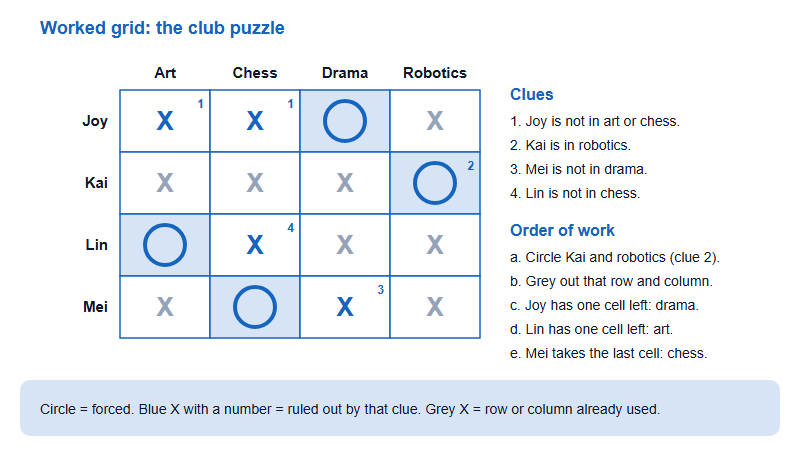
Two habits make the grid work: after every circle, grey out its row and column before reading another clue, and circle any row or column down to one blank cell. Clue 4 is not decoration — without it, Lin and Mei could swap art and chess, so a grid that ends with two answers means a skipped clue.
3. Tools 3 and 4 worked: what cannot change, and the least helpful case
Tournaments. In a round robin every pair meets once, so there are n(n − 1) ÷ 2 games. What cannot change is the number of points each game adds to the table, so read the scoring rule in the question before using the lookup.
| Teams | Games | Total with no draws (win 3, draw 1 each) | Total under win 1, draw half each |
|---|---|---|---|
| 3 | 3 | 9 | 3 |
| 4 | 6 | 18 | 6 |
| 5 | 10 | 30 | 10 |
| 6 | 15 | 45 | 15 |
| 8 | 28 | 84 | 28 |
| 10 | 45 | 135 | 45 |
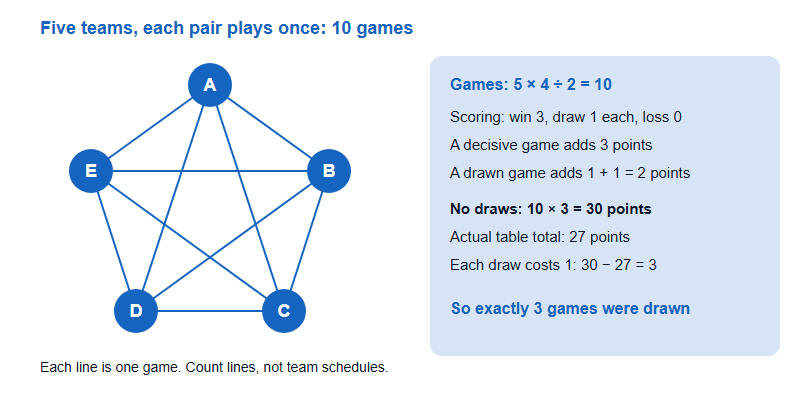
Parity. Every handshake adds 1 to two people’s counts, so the total of everyone’s counts is always even. Seven people therefore cannot each shake exactly 3 hands: 7 × 3 = 21 is odd.
Invariants. Five coins show heads, and a move flips exactly two coins. Can all five show tails? Each move changes the number of heads by 2, 0 or −2, so it stays odd; zero is even, so no. Find what every move preserves, compare start and target, and stop trying moves.
The least helpful case. For a guarantee, let an imaginary opponent hand you the worst items for as long as possible. A box holds 6 red, 4 blue and 2 yellow pens; to be sure of one of each colour, the opponent gives you all 10 red and blue pens first, so the answer is 11. With plenty of every category, c categories need c(k − 1) + 1 items to guarantee k of one kind: 4 socks for a pair from three colours.
For must-be-true questions the same opponent builds counterexamples. A rectangle with whole-number sides has perimeter 20. Must its area be at least 16? The 9 by 1 rectangle gives 9, so no. At most 25? Yes: the possible areas are 9, 16, 21, 24 and 25. Try the most lopsided case first, then the most balanced.
4. Ten original problems (16 minutes)
Written for this card, not taken from past papers. Allow 16 minutes for all ten, and write the type number beside each one before you start it.
- Four friends each make one statement. Ava: “Exactly one of us is lying.” Bea: “Exactly two of us are lying.” Cal: “Exactly three of us are lying.” Dee: “All four of us are lying.” How many of the four are telling the truth, and who?
- Fay, Gus, Dev, Eli and Hana ran a race with no ties. Dev finished after Fay but before Eli. Gus finished immediately after Fay. Hana finished last. Who finished second?
- In Problem 2, suppose the clue about Gus is removed but every other clue stays. How many different finishing orders are possible?
- Ava, Bo, Cy and Di each play a different instrument: piano, violin, flute or drums. Ava plays neither piano nor drums. The violinist is either Bo or Di. Cy plays neither violin nor drums. Di does not play drums. Who plays the drums?
- Six teams play a round robin, each pair meeting once. A win earns 3 points, a draw 1 point to each team, a loss 0. The teams finish with 40 points in total. How many games were drawn?
- At a meeting, some pairs of people shake hands once. Which could be the number of people who shook an odd number of hands: 3, 5, 6, 7 or 9?
- The numbers 1 to 10 are on a board. A move erases two numbers and writes their difference, larger minus smaller. After nine moves one number is left. Could it be 4?
- A drawer holds 10 red, 8 blue and 5 green socks. In the dark, how many must you take out to be certain of two green socks?
- How many students must a class have to guarantee that at least 3 were born in the same month?
- Five different positive whole numbers have a mean of 10. Which statement must be true? (A) One of the numbers is 10. (B) The largest number is at least 12. (C) The smallest number is at most 6. (D) At least two of the numbers are even. (E) The median is 10.
5. Worked key
| # | Type | Answer | Route | The usual slip |
|---|---|---|---|---|
| 1 | 1 | One person: Cal | The statements contradict one another, so at most one is true. If none were, all four would be lying and Dee would be right. So exactly one is true, three people lie, and Cal is right | Answering “nobody” without testing Dee’s statement |
| 2 | 2 | Gus | Fay-Gus is a fixed block; Dev follows it and precedes Eli; Hana is fifth: Fay, Gus, Dev, Eli, Hana | Reading “after Fay” as “immediately after Fay” and placing Dev second |
| 3 | 2 | 4 | Hana is fifth; Fay, Dev and Eli keep their order in places 1 to 4, and Gus takes any of the four slots | Also rearranging Fay, Dev and Eli, which the clues forbid |
| 4 | 3 | Bo | Ava: not piano or drums, and not violin by clue 2, so flute. Cy: not violin or drums, and flute is taken, so piano. Di: not drums, so violin. Bo takes drums | Placing Ava’s flute but not clearing the flute column for Cy |
| 5 | 4 | 5 draws | 15 games; with no draws the total would be 45; each draw gives 2 points instead of 3, and 45 − 40 = 5 | Counting 30 games by adding each team’s five |
| 6 | 5 | 6 | The total of all counts is twice the number of handshakes, so it is even, which forces an even number of odd counts. Only 6 is even; three separate handshakes show it can happen | Picking an odd option because the question says odd |
| 7 | 5 | No | The sum 1 + 2 + … + 10 = 55 is odd. Replacing a and b (a larger) with a − b lowers the sum by 2b, an even number, so the sum stays odd and the last number cannot be 4 | Trying a few move sequences and guessing |
| 8 | 6 | 20 | All 10 red, all 8 blue and 1 green is 19 socks with one green; the 20th must be green | Applying the plenty-of-each shortcut and answering 4 |
| 9 | 6 | 25 | 2 students in each of 12 months is 24 with no three sharing; the 25th makes three | Answering 36 by putting three in every month |
| 10 | 7 | (B) | Counterexamples: 1, 2, 3, 4, 40 rules out (A) and (E); 8, 9, 10, 11, 12 rules out (C); 1, 3, 5, 7, 34 rules out (D). For (B), a largest of 11 or less caps the total at 7 + 8 + 9 + 10 + 11 = 45, short of 50 | Testing only 8, 9, 10, 11, 12, where (A), (B), (D) and (E) all hold |
Sort misses by tool, not by problem. Misses on 1 to 4 often mean the grid or table came too late; on 5 to 7, that you searched for moves instead of something fixed; on 8 to 10, that you pictured a lucky case. For a real date, our in-person AMC 8 guide for 2026-27 covers the January sitting for China-based candidates; maa.org has the current window and rules.
Frequently asked questions
How do I start a truth-teller and liar question?
Look for two statements that contradict each other. Exactly one of that pair is true, which often settles every other statement at once.
How many games are played in a round-robin tournament?
With n teams, n(n – 1)/2 games, because each pair of teams meets once. Six teams play 15 games, not 30.
What is the worst-case method for guarantee questions?
Give an imaginary opponent every unhelpful draw until one more item forces the result. That count plus one is the guarantee.
How do I rule out a must-be-true option?
Find one example that meets every condition in the question but breaks the statement. A single counterexample is enough.
This is an independent guide operated by Hanlin Education for China-based international-school students. We are not affiliated with, endorsed by, or sponsored by the Mathematical Association of America (MAA). Competition dates, rules and content descriptions can change between cycles: confirm all current details on maa.org and with your authorised test centre before acting on anything here. Any error reported to us is corrected within 7 working days.