Most AMC 8 questions are not won by knowing an obscure formula — they are won by knowing which thinking move to reach for. AMC 8 is a 25-question, 40-minute, no-calculator paper run by the MAA for students in grade 8 and below, so the students who score well are usually the ones with a small toolkit of repeatable strategies, not the ones who have memorised the most. This guide breaks down six of those moves — the heuristics that work across topics — with our own worked examples you can practise tonight.
Why heuristics beat formula-hunting on AMC 8
A syllabus tells you what mathematics can appear: arithmetic, ratio and proportion, basic number theory, counting, probability and geometry. It does not tell you how to attack an unfamiliar problem in 90 seconds. That gap is where most reachable marks are lost. A student who has drilled formulas but never practised problem-solving moves freezes the moment a question does not look like a worked example.
Heuristics close that gap. They are general-purpose moves — working backwards, casework, counting the complement, and so on — that turn a strange-looking problem into a familiar one. Because AMC 8 questions are deliberately written to be approachable from several directions, having two or three moves to try means you rarely stare at a blank. One more reason they matter: there is no penalty for a wrong or blank answer on AMC 8 (each correct answer is worth a set number of points with no deduction — confirm the current scoring on maa.org), so a heuristic that gets you to “two plausible options” is already worth an educated guess.
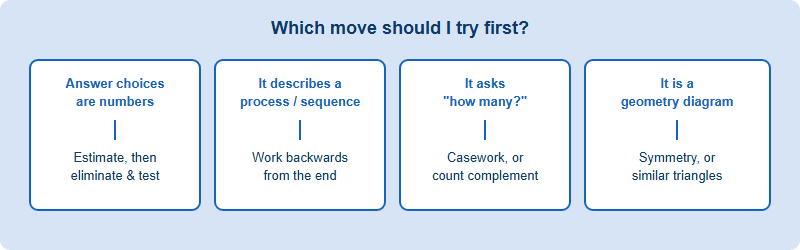
Move 1 — Work backwards from the answer
When a problem describes a process — “a number is doubled, then 3 is added, then halved, and the result is 10” — it is often faster to start at the end and reverse each step than to set up algebra. Reversing “halved” is “double,” reversing “add 3” is “subtract 3,” and so on.
A worked example in this flavour (our own, not a past AMC problem): “Think of a number. Multiply by 4, subtract 6, and you get 26. What was the number?” Work backwards: 26 + 6 = 32, then 32 ÷ 4 = 8. Done in one line, no equation written. The same move also powers answer-testing: because the five options are right there, you can sometimes plug a likely option back into the problem and check whether it works, which is often quicker than solving forward.
Move 2 — Casework: split into a few clean cases
Many “how many ways” questions look tangled until you break them into a small number of exhaustive, non-overlapping cases. The art is choosing a split that is both complete (covers everything) and clean (cases do not double-count).
Example (our own): “How many two-digit numbers have digits that add to 5?” Rather than guessing, do casework on the tens digit. Tens digit 1 → units 4 (14). Tens digit 2 → units 3 (23). Continue: 32, 41, 50. That is five numbers — and the structure guarantees you have not missed any. Casework feels slow at first, but it is the most reliable way to avoid the two classic counting errors: leaving cases out and counting the same thing twice.
Move 3 — Count the complement
Sometimes the thing you are asked to count is messy, but its opposite is easy. The move is: count the total, count the easy “bad” cases, and subtract. This is one of the highest-leverage tricks in counting and probability.
Example (our own): “How many three-digit numbers contain at least one digit 7?” Counting “at least one 7” directly forces messy casework. Instead, count the complement. Total three-digit numbers: 900 (from 100 to 999). Three-digit numbers with no 7: the hundreds digit has 8 choices (1–9 except 7), tens has 9 (0–9 except 7), units has 9, giving 8 × 9 × 9 = 648. So “at least one 7” is 900 − 648 = 252. The complement turned a hard count into two easy ones.
| Move | The signal that triggers it | What it does for you |
|---|---|---|
| Work backwards | A described process or “I did X then Y, result is Z.” | Reverses steps so you skip setting up algebra. |
| Casework | “How many ways / numbers / arrangements?” | Prevents missed and double-counted cases. |
| Count the complement | “At least one,” “not all,” messy direct counts. | Replaces a hard count with total minus easy bad cases. |
| Pick numbers | Abstract problem with a variable or ratio, numeric options. | Turns abstraction into a concrete arithmetic check. |
| Estimate, then eliminate | Numeric answer choices spread far apart. | Rules out impossible options before exact work. |
| Look for symmetry | A balanced figure, repeated structure, equal parts. | Lets you reason about one piece and multiply. |
Move 4 — Pick numbers for abstract problems
When a problem is stated abstractly — in terms of “a number,” a ratio, or an unknown — and the answer choices are concrete, you can often substitute a convenient value, work the problem with that value, and see which option matches. This converts an intimidating abstract question into ordinary arithmetic.
Example (our own): “A price is increased by 20%, then the new price is decreased by 20%. The final price is what fraction of the original?” Pick a friendly number: start at 100. Up 20% → 120. Down 20% of 120 → 120 − 24 = 96. So the final price is 96/100 = 24/25 of the original — and you have just learned the small lesson that a 20% rise then a 20% fall does not return to the start. Picking 100 made it instant.
Move 5 — Estimate first, then eliminate
Because every AMC 8 question is multiple choice, the five options are part of the problem. When the choices are numbers spread far apart, a quick estimate can eliminate two or three of them before you do any exact calculation — and on a no-penalty exam, narrowing to two choices and guessing is a legitimate, mark-earning strategy when time is short.
Example of the habit: if a question asks for a total cost and you can see in your head that it must be “a bit more than 50,” any option below 50 or far above it can go immediately. You have not solved the problem, but you have improved a blind 1-in-5 guess into a 1-in-2 or better — and sometimes the remaining options are close enough that a 10-second exact check finishes the job. Estimation is not sloppiness; on AMC 8 it is a tool.
Move 6 — Look for symmetry and repeated structure
Geometry and counting problems often hide a symmetry that lets you solve one piece and multiply, or pair things up so they cancel. The instinct to ask “is part of this figure a mirror or rotation of another part?” saves a great deal of grinding.
Example (our own): a square is divided by both diagonals into four triangles. Instead of computing each triangle’s area separately, notice the four triangles are identical by symmetry — so each is exactly one quarter of the square. If the square’s area is 36, each triangle is 9, with almost no calculation. The same idea appears in counting: when arrangements are symmetric, you can count one representative case and multiply by the number of symmetric copies, then adjust for any overcounting.
How to drill heuristics so they become reflexes
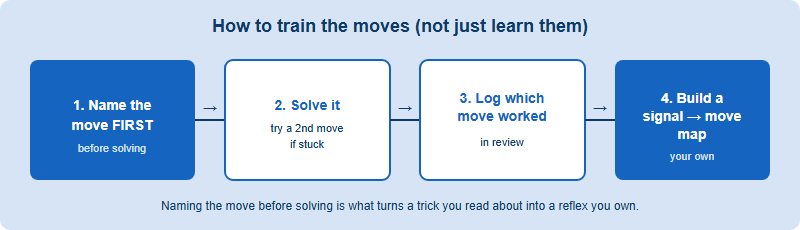
Reading about six moves changes nothing on test day; training them deliberately does. The single most effective habit is to name the move before you solve. Open a mixed practice set and, for each problem, write one word first — “complement,” “backwards,” “casework” — then solve. You are training the diagnosis, which is the part that fails under pressure.
- Name first, solve second. Force yourself to commit to a move before computing. Wrong guesses about the move are fine — they are how the map gets built.
- Keep a two-column log. In review, note the problem type and which move actually cracked it. Patterns emerge fast: you will see that “at least one” almost always means complement.
- Have a fallback move. If your first choice stalls within a sensible time, switch to a second move rather than grinding. Flexibility, not stubbornness, scores marks on the clock.
- Practise the guess discipline. On timed sets, never leave a blank at the end — use estimation and elimination to make every leftover an educated guess, because nothing is lost by trying.
If you want to see where this technique layer sits within a longer preparation arc — fundamentals, then techniques, then timed papers — our AMC 8 guide home page maps the rungs, and the broader US AMC pathway (AMC 8 → AMC 10/12 → AIME) gives these moves somewhere to grow into.
Frequently asked questions
Are these heuristics enough on their own to do well on AMC 8?
No — they amplify solid fundamentals, they do not replace them. A student fluent in arithmetic, ratio and basic geometry will get far more out of these moves than one still shaky on the basics.
Is guessing really a good idea on AMC 8?
An educated guess is, because wrong answers are not penalised (confirm the current scoring on maa.org). Use estimation and elimination to narrow the options first, then never leave a blank at the end.
How many of these moves should I try per question?
Start with the one the question's surface features suggest. If it stalls within a sensible time, switch to a second move instead of grinding, and come back later if needed.
Where can I confirm AMC 8 format and eligibility?
AMC 8 is a 25-question, 40-minute, no-calculator paper for students in grade 8 and below (and under 15.5 on competition day). Always confirm current format, eligibility and dates on maa.org.
This is an independent English-language guide operated by Hanlin Education for China-based international-school students. It is not affiliated with, endorsed by, or sponsored by the MAA (Mathematical Association of America). Exam format, eligibility, scoring, registration channels, dates and fees change; confirm all current details on maa.org before relying on them. Any factual error will be corrected within 7 working days of notice.