The best AMC 8 preparation for a grade 6–8 student is not a last-minute cram — it is a steady, several-month arc that moves from fundamentals, to named techniques, to timed full papers. AMC 8 is a 25-question, 40-minute, no-calculator paper run by the MAA for students in grade 8 and below, so pace and accuracy matter as much as cleverness. This roadmap shows parents and students what to do in each phase — and, just as importantly, what not to rush.
The principle: build the base before you chase hard problems
A common and understandable mistake is to hand a young student a stack of the hardest competition problems on day one. It feels ambitious, but it usually backfires: the student grinds, gets discouraged, and never builds the fluency that makes hard problems tractable later. The order that works is the reverse of panic.
Think of it as three layers stacked over time. You do not move up a layer because the calendar says so — you move up when the layer below is genuinely solid. For a student with several months of runway, a realistic shape is something like the phases below. Treat the week ranges as flexible scaffolding, not a contract; a younger or newer student may spend longer on the base, and that is exactly right.
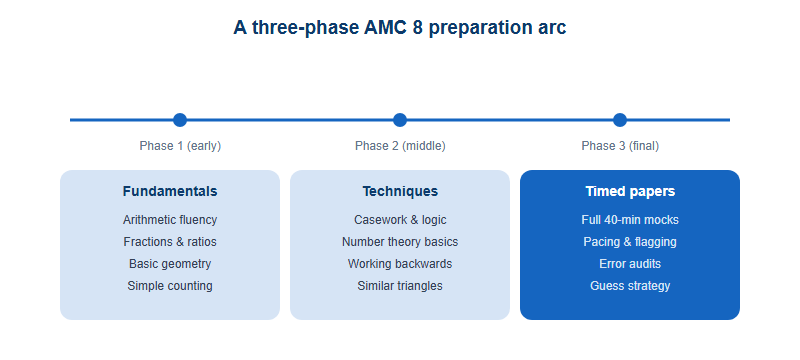
Phase 1 — Fundamentals (the longest phase for younger students)
This phase is about making the easy things automatic. On a 40-minute paper, a student who hesitates on basic arithmetic or fraction work has already lost the time they need for the harder back-end questions. The goal here is not to be impressive; it is to be fast and reliable on the foundations.
Concrete focus areas:
- Mental arithmetic without a calculator — multiplication, division, percentages, and quick estimation, because the exam allows no calculator.
- Fractions, ratios and proportions — these underpin a large share of approachable problems.
- Foundational geometry — perimeter, area, angles, and reading a diagram correctly.
- Simple counting and patterns — systematic listing before formal combinatorics.
A short illustrative example of the flavour (our own, not a past AMC problem): “A rectangle is twice as long as it is wide, and its perimeter is 36. What is its area?” A student fluent in fundamentals sets width = w, length = 2w, solves 6w = 36 so w = 6, then computes 6 × 12 = 72 — calmly, in well under a minute. That calm is what Phase 1 buys.
Phase 2 — Named techniques and topic work
Once the base is steady, the student learns the recurring moves that competition problems reward. The shift here is from “can I compute this?” to “what kind of problem is this, and what tool does it call for?” Naming techniques explicitly helps younger students recognise patterns under pressure.
| Technique | What it is | A problem type it unlocks |
|---|---|---|
| Casework | Splitting a problem into a few clean, exhaustive cases. | Counting outcomes that depend on a condition. |
| Working backwards | Starting from the answer or end state and reversing. | Process or sequence puzzles. |
| Number theory basics | Divisibility, factors, remainders, parity. | “What is the smallest number such that…” problems. |
| Similar triangles & ratios | Using proportional sides in geometry. | Length and area problems with shared angles. |
| Smart guessing | Eliminating impossible options to improve a guess. | Any question you can't fully solve in time (no penalty for wrong answers). |
The way to drill this is by topic, not by random mixed sets. Spend a stretch on counting until casework feels natural, then a stretch on number theory, and so on. Mixed practice comes later, in Phase 3, once the individual tools exist. For students who want to see how these topics map onto the wider pathway, our AMC 8 guide home page frames where this rung sits.
Phase 3 — Timed full papers and the error audit
The final phase is where preparation meets the clock. The student now sits full 40-minute mock papers under realistic conditions — no calculator, no pausing, no looking up a method mid-question. This is also where the single most valuable habit is built: pacing.
Two pacing skills decide a lot of marks for younger students:
- Flag and move on. If a question is not yielding within a sensible time, mark it, skip it, and come back. Many students lose reachable points simply by refusing to leave a stubborn problem.
- Guess on what's left. Because wrong answers are not penalised, every blank at the end should become an educated guess. This is a discipline, not a gamble — and it is easy to forget under stress.
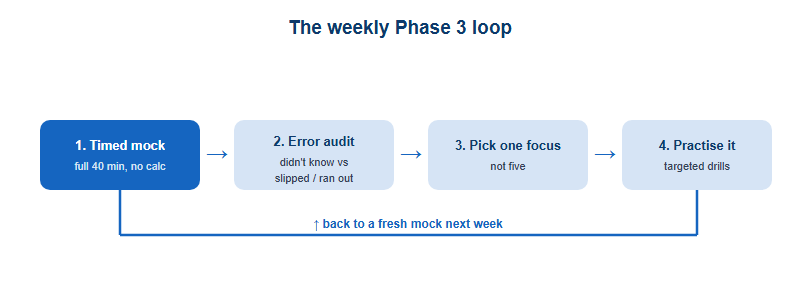
After every mock, run an error audit: sort each dropped mark into “didn't know the method” versus “knew it but slipped or ran out of time.” In our experience with younger students, the second category is often the larger one — and it responds to timed practice and calm, not to more theory. That single sorting exercise tells you exactly what next week's practice should target.
The Phase 3 rhythm is best thought of as a weekly loop rather than a one-off event. Each cycle feeds the next, so the plan keeps tightening around the student's real weak spots instead of drifting through generic problem sets.
What a balanced practice week can look like
Parents often ask for something concrete, so here is an illustrative weekly shape for a student in the middle phases. It is a starting template to adapt, not a prescription — the right load depends on the child's age, energy, and school workload. The point is the balance: short, frequent, varied, with rest built in.
| Session | Focus | Roughly how long |
|---|---|---|
| Session A | Fundamentals drill (arithmetic / fractions speed, no calculator) | Short and brisk |
| Session B | One named technique, worked in depth (e.g. casework) | The longest of the week |
| Session C | Mixed problems or, in Phase 3, a timed mini-set | Medium |
| Review slot | Error audit of the week's mistakes; pick next week's focus | Brief but non-negotiable |
| Rest | No maths competition work at all | At least a couple of days |
Notice that rest is on the schedule deliberately. For younger students, recovery is not the absence of progress — it is part of how progress consolidates. A plan with no breathing room is the fastest route to a child who quietly decides they “don't like maths.”
Common preparation mistakes to sidestep
Across the younger students we coach, the same avoidable missteps recur. Knowing them in advance saves months:
- Skipping the fundamentals phase. It feels slow, so families jump to hard problems. The result is a student who can occasionally crack a tricky question but drops easy marks under time pressure. Build the base first.
- Practising only untimed. A student can look strong on relaxed practice and then unravel on the clock. Introduce timed conditions in Phase 3 so pacing becomes a trained reflex, not a test-day surprise.
- Never doing the error audit. Without sorting mistakes into “didn't know” versus “slipped,” practice becomes busywork. The audit is what makes each week target the real gap.
- Confusing volume with progress. Hundreds of problems skimmed shallowly teach less than a dozen worked thoroughly and understood. Depth wins, especially young.
- Leaving logistics to the last minute. Registration channels and dates run on an external calendar set by the authorised centre and the MAA. Confirm them early on maa.org so the study plan is not derailed by a missed window.
A note for parents: protect the motivation
For a grade 6–8 student, the long game is everything. AMC 8 is the entry rung of a ladder that can run for years (AMC 8 → AMC 10/12 → AIME → USA(J)MO), so the goal in these early phases is to build a student who enjoys being challenged, not one who is burned out before secondary school. A few practical guardrails:
- Consistency over volume. Three focused sessions a week beat one exhausting marathon. Young brains consolidate better with spacing.
- Celebrate process, not just scores. Praise a clean error audit or a well-paced mock, not only the number — it keeps the student engaged through plateaus.
- Resist comparison. A score that is modest in grade 6 with steady improvement is a strong trajectory. The number on one paper is feedback, not a verdict.
- Anchor logistics to the official source. Whether and how your child registers — through an authorised test centre — plus exact dates, time zones and fees, are all “confirm on maa.org / with the centre.” Don't let calendar uncertainty derail the study plan; verify it early and move on.
One reassuring fact for families here: unlike some US-only olympiads higher up the ladder, AMC 8 can generally be sat by international-school students in China through authorised test centres — so this roadmap leads somewhere real and accessible, provided the registration details are confirmed officially.
Frequently asked questions
How long does it take to prepare for AMC 8?
A steady several-month arc suits most grade 6–8 students: fundamentals first, then techniques, then timed papers. Younger or newer students should expect to dwell longer on fundamentals.
Should my child start with hard competition problems?
No. Building arithmetic and topic fluency first makes hard problems tractable later. Starting with the hardest sets tends to discourage younger students and skip the base.
How often should we practise?
Consistency beats volume — a few focused sessions per week, with spacing, generally outperforms occasional marathons for younger learners. Always end Phase 3 mocks with an error audit.
Can a China-based international-school student take AMC 8?
Generally yes, through an authorised test centre. Registration channels, dates, time zones and fees vary, so confirm the current details on maa.org or with your centre.
This is an independent English-language guide operated by Hanlin Education for China-based international-school students. It is not affiliated with, endorsed by, or sponsored by the MAA (Mathematical Association of America). Exam format, eligibility, registration channels, dates and fees change; confirm all current details on maa.org before relying on them. Any factual error will be corrected within 7 working days of notice.