An AMC 8 score is out of 25 (one mark per correct answer, no penalty for wrong answers, since it is a 25-question, 40-minute, no-calculator paper run by the MAA). But the raw number matters far less than two things: your grade relative to the paper and what the result tells you to do next. A 16 from a sixth-grader and a 16 from an eighth-grader mean very different things. This guide shows you how to read the signal and turn it into a concrete plan — without inventing any cutoff the MAA hasn't published.
First, understand how AMC 8 is scored
The mechanics are simple and widely established, and they shape strategy:
- 25 questions, 1 point each, maximum 25. There is no deduction for incorrect answers, so a blank and a wrong answer cost the same — which means there is no reason to leave a question blank if you can make an educated guess.
- 40 minutes, no calculator. That is well under two minutes per question on average, so pace and arithmetic fluency matter as much as cleverness.
- Difficulty ramps up. Early questions are designed to be approachable; the last several are genuinely hard. Most students' scores are decided by how far up the ramp they climb before time or difficulty stops them.
Recognition such as an Honor Roll or Distinguished Honor Roll is awarded by the MAA, but the exact qualifying score is set each year and is not a fixed number — so we will not quote one. If you want to know the current threshold, that is “confirm on maa.org.” What we can do is help you interpret your own result sensibly.
Read your score against your grade, not against a stranger’s
Because AMC 8 is open to grade 8 and below, the same paper is sat by students who may be two or three years apart in schooling. A score that is unremarkable for an eighth-grader can be excellent for a sixth-grader who has years of runway left. The most useful question is never “is this a good score?” in the abstract — it is “is this a good score for where my child is now, and what is the trajectory?“
The framework below is an interpretive guide for parents and students — a way to think, not an official band. It is deliberately expressed in trajectory terms rather than as a ranking.
| Where you land (out of 25) | What it usually signals | Sensible focus next |
|---|---|---|
| Roughly the first third | You can handle approachable problems but the middle ramp is still shaky. | Lock down fundamentals: arithmetic fluency, fractions/ratios, basic geometry and counting. Consistency beats tricks here. |
| Roughly the middle | Solid foundation; you stall on multi-step or unfamiliar problems. | Build named techniques: casework, working backwards, number theory basics, similar triangles. Time-box practice. |
| Upper range | Strong command of the paper; only the hardest items elude you. | Train the back-end problems and start looking toward AMC 10 content. Depth over breadth. |
| Near the top | The AMC 8 ceiling is close; you are under-challenged. | Move up the ladder — AMC 10 is the next rung. Treat AMC 8 as a warm-up, not the destination. |
Notice what this table does not do: it does not promise an award at any score, and it does not rank students against each other. Its only job is to translate a number into a direction of travel.
A first-party reading: where points are actually won and lost
In our experience coaching younger students for this paper, two patterns repeat far more often than any “talent gap”:
- Avoidable arithmetic slips on early questions. A student who can solve the hard problems sometimes drops two or three of the easy ones to careless errors under time pressure. Those are the cheapest points to recover — and the most overlooked.
- Pacing collapse in the back third. Students burn minutes on one stubborn mid-paper question and never reach problems they could have solved. Learning to flag, move on, and return is often worth more marks than learning a new technique.
The practical takeaway: before you buy a harder problem set, do an error audit of the last practice paper. Sort every dropped mark into “didn't know how” versus “knew how but slipped or ran out of time.” For most grade 6–8 students, the second pile is bigger than they expect — and closing it needs discipline and timed practice, not more theory.
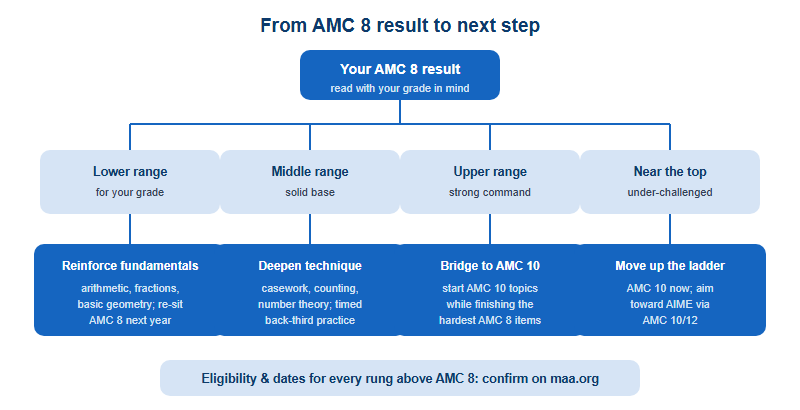
The next-step decision tree
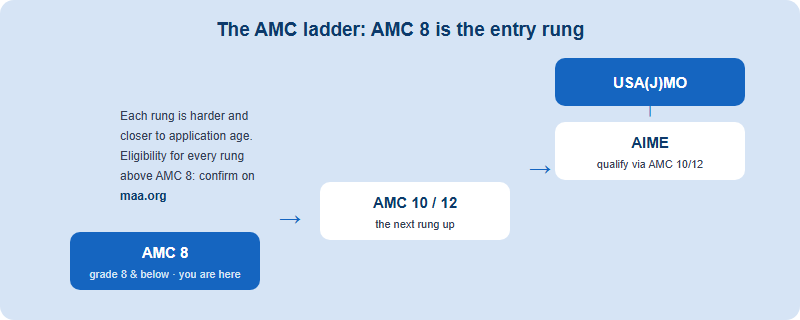
AMC 8 is the entry rung of a ladder: AMC 8 → AMC 10/12 → AIME → USA(J)MO. Your score is most valuable as a pointer to which rung you belong on next. The tree below maps a result onto a sensible next move. It is guidance, not a guarantee, and the actual eligibility and dates for any exam above AMC 8 are always “confirm on maa.org.”
How the AMC 8 result fits a longer admissions story
For families thinking about university applications down the line, it helps to be honest about what an AMC 8 result is and is not. It is an early, age-appropriate signal of mathematical promise and discipline — a credible starting point that shows a student is willing to be tested beyond the classroom. It is not, on its own, a headline credential for selective admissions; those tend to reward results higher up the ladder (AMC 10/12, AIME, and beyond) achieved closer to application age.
The constructive way to use AMC 8, then, is as the first data point in a trajectory. A modest score in grade 6 followed by steady improvement tells a much better story than a single isolated result. Treat the number as feedback for the next 12 months of study, not as a final grade on your child's ability. For the bigger picture of how the rungs connect, our AMC 8 guide home page lays out the pathway.
It helps to picture the full ladder so you can see how far a single rung sits from the top. AMC 8 is the very first step — a strong result there is an invitation to climb, not the summit.
Four ways parents misread an AMC 8 score
A score arrives, and the instinct is to react immediately — usually too strongly in one direction or the other. Here are the misreadings we see most, and the calmer interpretation in each case:
- Treating a one-off result as fixed ability. A single paper on a single morning is a noisy measurement. Illness, nerves, or one unlucky stretch of hard questions can move the number several marks. Look for a trend across attempts, not a verdict from one.
- Comparing across grades. Posting a child's score next to an older student's is meaningless — they sat the same paper from different starting lines. The only fair comparison is to the same student over time.
- Chasing the award threshold instead of the learning. Because honor-roll cutoffs shift yearly, fixating on hitting an exact number can distort study toward score-gaming rather than genuine understanding. The threshold is “confirm on maa.org,” and it should not be the whole point.
- Over-correcting after a dip. A lower-than-hoped result tempts families to pile on hours and pressure. For a grade 6–8 student that often backfires. A focused error audit and one targeted fix beats a punitive workload.
The healthiest stance treats the score the way a coach treats a training time: useful data, immediately actionable, and never the final word on the athlete.
A simple post-result routine
Whatever the score, the same three-step routine serves almost every student:
- Audit the errors. Separate “didn't know” from “slipped/ran out of time.” This tells you whether to study content or to train pacing.
- Pick one focus, not five. A single weak area worked deeply for a few weeks beats skimming everything. Younger students especially benefit from narrow, consistent practice.
- Set the next checkpoint. Decide now whether the goal is a stronger AMC 8 next cycle or a first AMC 10 attempt — and confirm that exam's eligibility and dates on maa.org so the plan is anchored to reality.
Frequently asked questions
What is a good AMC 8 score?
It depends on your grade and goal — read the result as a trajectory, not an absolute. A score that is average for grade 8 may be strong for grade 6. Award thresholds are set yearly; confirm on maa.org.
Is there a penalty for wrong answers on AMC 8?
No. Each correct answer earns one point out of 25 and incorrect answers are not penalised, so it is worth making an educated guess rather than leaving a question blank.
What score do I need for the Honor Roll?
The MAA sets honor-roll thresholds each year, so there is no fixed number we can quote. Check the current cutoff on maa.org for the cycle you are sitting.
When should a student move from AMC 8 to AMC 10?
When AMC 8 feels under-challenging and the hardest items are within reach. Confirm AMC 10 eligibility and dates on maa.org before planning the switch.
This is an independent English-language guide operated by Hanlin Education for China-based international-school students. It is not affiliated with, endorsed by, or sponsored by the MAA (Mathematical Association of America). Scoring rules, award thresholds, eligibility and dates change; confirm all current details on maa.org before relying on them. Any factual error will be corrected within 7 working days of notice.