For a China-based international-school student, the practical answer is usually AMC 8 — not because it is "better" mathematics, but because of access. AMC 8 is an individual 25-question, 40-minute exam open to students in grade 8 and below worldwide through authorised test centres, while MATHCOUNTS is a multi-round, team-based programme built around U.S. middle schools. Both are excellent; they simply suit different situations. This guide compares them honestly so you can choose with eyes open.
The headline difference: individual exam vs school-team programme
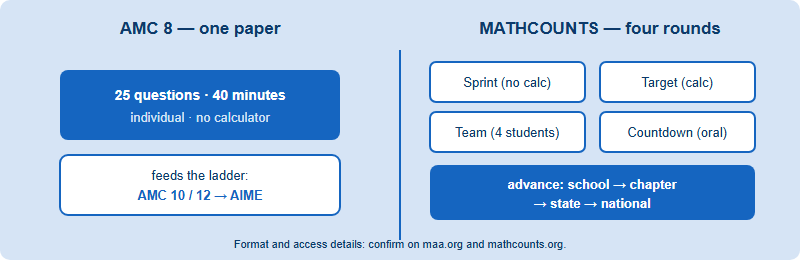
The two contests are built on different philosophies. AMC 8, run by the MAA (Mathematical Association of America), is a single sitting: one 25-question, 40-minute, no-calculator paper, taken individually, with each student earning their own score. It is the entry rung of the wider US AMC pathway (AMC 8 → AMC 10/12 → AIME).
MATHCOUNTS, run by the MATHCOUNTS Foundation, is a season-long competition series with four levels — school, chapter, state and national — and four rounds within a competition: Sprint, Target, Team and Countdown. Crucially, it is organised through U.S. middle schools, and registration is by school, with one team of up to four students per school (per the official MATHCOUNTS rules). The Team Round can only be taken officially by the four students on a school's team. That structure is wonderful in an American middle school — and a genuine obstacle for a student in an international school in China, where there may be no registered MATHCOUNTS chapter to advance through.
| Dimension | AMC 8 (MAA) | MATHCOUNTS (MATHCOUNTS Foundation) |
|---|---|---|
| Format | One 25-question, 40-minute, multiple-choice paper | Four rounds: Sprint, Target, Team, Countdown (about 3 hours total) |
| Calculator | Not allowed on any question | Mixed: no calculator on Sprint & Countdown; calculator assumed on Target & Team |
| Eligibility | Grade 8 and below, and under 15.5 on competition day | Students enrolled in grades 6–8 |
| Unit of entry | Individual student | School-based; one team of up to 4 per school |
| Progression | Score on one paper; feeds the AMC 10/12 → AIME ladder | Advance school → chapter → state → national |
| Access from China | Generally available via authorised test centres | Built around U.S. schools/chapters — confirm availability |
One honest caveat on that last row: MATHCOUNTS access for students outside the United States, and any international or DoDEA-style arrangements, change over time and are set by the MATHCOUNTS Foundation, not by us. If MATHCOUNTS appeals to you, confirm current eligibility and any international pathway on mathcounts.org before building a plan around it. We will not invent an access route that may not exist for your school.
How the formats actually feel different
Beyond logistics, the two contests train slightly different muscles. AMC 8's single multiple-choice paper rewards steady accuracy and pacing across 25 questions with no calculator — and because the answers are multiple choice with no penalty for a wrong answer (each correct answer is worth a set number of points with no deduction; confirm current scoring on maa.org), estimation and elimination are real strategies.
MATHCOUNTS spreads the challenge across distinct round types:
- Sprint Round — 30 problems in 40 minutes, no calculator. This is the round most similar in spirit to AMC 8: speed and accuracy under time pressure.
- Target Round — four pairs of harder problems, six minutes per pair, calculator assumed. This rewards deeper multi-step reasoning.
- Team Round — 10 problems in 20 minutes for a four-student team, calculator assumed. This adds genuine collaboration, which AMC 8 simply does not test.
- Countdown Round — a fast, head-to-head oral round, up to 45 seconds per problem, no calculator (optional at lower levels).
If your child thrives on teamwork and fast oral problem-solving, MATHCOUNTS's variety is a real draw. If they prefer a clean, self-contained individual challenge they can sit anywhere with a centre, AMC 8's format fits better. Neither preference is "more serious" mathematics.
Which one should a China-based student choose?
Here is our honest editorial take, and it is about fit, not prestige. For most international-school students in China, AMC 8 is the more practical starting point for three reasons:
- Access. AMC 8 can generally be sat through authorised test centres without needing a registered U.S. school chapter, whereas MATHCOUNTS is structured around U.S. middle schools and chapter progression.
- A clear ladder. A strong AMC 8 result leads naturally into AMC 10/12 and, for top scorers, AIME — a continuous, internationally recognised pathway your child can climb for years.
- Lower coordination overhead. AMC 8 is an individual exam, so there is no need to assemble and register a school team to take part.
That said, MATHCOUNTS is a superb fit if your school already participates or there is a legitimate pathway for your situation. Its team round and countdown format build collaboration and fast recall that a solo paper cannot. The two are also not mutually exclusive: the underlying topics overlap heavily, so MATHCOUNTS-style practice (especially the no-calculator Sprint Round) is excellent preparation for AMC 8, and vice versa. Many strong students simply do both where access allows.
A quick word on the "which looks better" question
Families sometimes ask which contest "looks better" for university applications. The honest answer: a meaningful result in either is a positive signal, and neither guarantees an admissions outcome. What admissions readers respond to is genuine engagement and achievement over time, not the logo on a certificate. Choose the contest your child can actually access and enjoy, prepare properly, and let the results speak for themselves. Do not pick a path you cannot realistically enter just because a name sounds impressive — an AMC 8 your child can sit and grow from beats a MATHCOUNTS pathway that is closed to your school.
A short decision guide
To make this concrete, here is how we would steer a family who asked us directly:
- No MATHCOUNTS chapter at your school? Start with AMC 8 via an authorised test centre. It is the accessible, ladder-connected choice.
- Your school already runs MATHCOUNTS? Do it — and add AMC 8, since the practice transfers and AMC 8 opens the AMC 10/12 ladder.
- Child loves teamwork and fast oral rounds? MATHCOUNTS's format is the bigger draw, where accessible.
- Child prefers a clean individual challenge? AMC 8's single paper suits that temperament and is easy to sit from China.
Whichever way you lean, verify the current logistics at the source: AMC 8 eligibility, format, registration channels and dates on maa.org; MATHCOUNTS eligibility, structure and any international pathway on mathcounts.org. If you want help mapping AMC 8 specifically, our AMC 8 guide home page lays out the format, preparation arc and registration basics for students in China.
Frequently asked questions
Can a student in China take MATHCOUNTS?
MATHCOUNTS is built around U.S. middle schools and chapter progression. Any international pathway is set by the MATHCOUNTS Foundation and changes over time, so confirm current availability on mathcounts.org.
Is AMC 8 or MATHCOUNTS harder?
Neither is uniformly harder; they test differently. AMC 8 is one no-calculator paper; MATHCOUNTS spreads difficulty across Sprint, Target, Team and Countdown rounds, some with calculators.
Does practising one help with the other?
Yes. The topics overlap heavily, so MATHCOUNTS Sprint-style no-calculator practice is strong preparation for AMC 8, and AMC 8 work transfers back to MATHCOUNTS.
Which one is better for university applications?
A meaningful result in either is a positive signal, and neither guarantees admission. Choose the contest your child can access and enjoy, then prepare and compete seriously.
This is an independent English-language guide operated by Hanlin Education for China-based international-school students. It is not affiliated with, endorsed by, or sponsored by the MAA (Mathematical Association of America) or the MATHCOUNTS Foundation. Contest format, eligibility, access and dates change; confirm AMC 8 details on maa.org and MATHCOUNTS details on mathcounts.org before relying on them. Any factual error will be corrected within 7 working days of notice.