You do not need to solve a single competition problem to be a powerful AMC 8 supporter. The most valuable things a parent provides are not mathematical: a steady routine, the right environment, calm logistics, and protected motivation. AMC 8 is a 25-question, 40-minute, no-calculator paper run by the MAA for students in grade 8 and below — and your job is to build the conditions around the maths, not to teach the maths. Here is what actually helps, what quietly backfires, and the things only you can do.
The mindset shift: you are the coach, not the tutor
Many parents who were not strong in mathematics assume they can only help by re-learning the material alongside their child. That is rarely the best use of anyone's energy, and it often adds pressure. A more useful model is the one elite sport uses: a coach who manages preparation, recovery and morale does not need to outperform the athlete. Your child has resources for the maths itself — books, classes, problem sets, perhaps a teacher. What they often lack is the structure and steadiness that turn scattered effort into progress.
That reframe is freeing. It means a parent who never enjoyed maths can still be the single biggest factor in whether preparation goes well, because the things that derail a young student — chaotic schedules, last-minute logistics panic, burnout, fear of one bad score — are exactly the things a calm adult can manage.
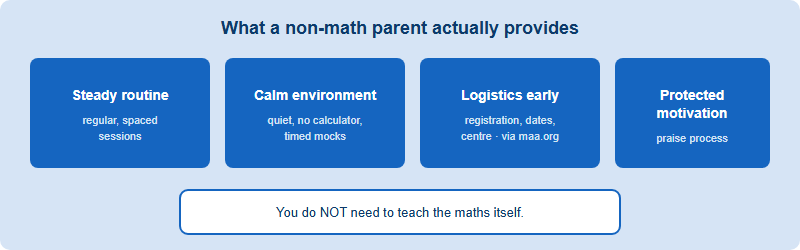
High-leverage support that works (no maths required)
These are the levers with the biggest payoff, none of which require you to understand a single problem:
- Protect a regular practice rhythm. A few short, spaced sessions each week beat occasional long ones for young learners. You do not need to know what is practised — only that it happens consistently and is not crammed.
- Build the right environment for timed mocks. When your child sits a full 40-minute mock paper, you can make it realistic: a quiet room, a timer, no calculator, no phone, no interruptions. Recreating exam conditions is pure logistics, and it materially improves test-day calm.
- Be the timekeeper and the snack-and-sleep manager. Make sure your child is rested before practice and the exam. A tired brain loses easy marks; protecting sleep is a maths intervention in disguise.
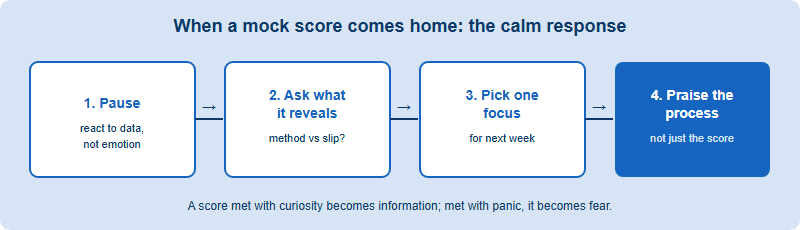
- Ask one good review question. After a practice set you can ask, "Which ones did you get wrong because you didn't know the method, and which because you slipped or ran out of time?" You do not need to understand the problems to prompt that sorting — and it is one of the most valuable habits in all of competition prep.
- Handle the paperwork. Registration channels, dates, the test centre, time zones and fees are an adult's job. Owning these removes a real source of stress from a 12- or 13-year-old.
Well-meant habits that quietly backfire
Equally important is knowing what to stop doing. The following are common, understandable, and counter-productive:
| Well-meant habit | Why it backfires | Do this instead |
|---|---|---|
| Hovering during practice | Breaks concentration and signals the child can't cope alone. | Set up the conditions, then leave the room. |
| Reacting hard to a low mock score | Turns a feedback tool into a source of fear; child starts hiding scores. | Treat scores as data: "What did this tell us to work on?" |
| Piling on extra problem sets | Volume without depth exhausts young students and crowds out rest. | Trust the plan; protect rest days deliberately. |
| Comparing to other children | Damages motivation and self-belief, especially around grade 6–7. | Compare the child only to their own past papers. |
| Trying to teach maths you're unsure of | Risks confusion and tension; mixes the coach and tutor roles. | Route maths questions to the book, class or teacher. |
| Leaving registration to the last minute | A missed window can derail months of work. | Confirm dates and channel early on maa.org / with the centre. |
The thread running through all of these is the same: your calm is contagious, and so is your anxiety. A young student largely takes their emotional temperature from the adults around them. If a single mock score sends the household into crisis, the child learns that AMC 8 is dangerous; if the same score is met with curiosity, the child learns it is just information.
The logistics only a parent can own
This is the part of preparation where a non-math parent is not just helpful but essential. A 12- or 13-year-old should be spending their energy on mathematics, not on navigating registration systems and time zones. Here is what to take off their plate — and a firm reminder to verify each item officially, because details change and we will not guess them for you:
- Eligibility. AMC 8 is for students in grade 8 and below who are also under 15.5 years of age on the day of the competition. Confirm your child qualifies on maa.org before planning.
- Registration channel and dates. Whether your child sits AMC 8 through an authorised test centre, and the exact registration window and competition date, are set externally. Confirm them on maa.org or directly with the centre — early.
- Time zone. Because this is a US-administered competition sat from China, pay close attention to how the competition window maps to local time. Do not assume; verify it with the centre so there is no test-day surprise.
- What is allowed in the room. The permitted materials are limited — broadly writing utensils, blank scratch paper, rulers and erasers, with no calculators, phones or smart devices. Confirm the current rules on maa.org so your child packs correctly and nothing jeopardises their score.
- Fees. Any participation costs are set by the MAA and the centre. Confirm current figures officially rather than relying on old information.
A reassuring fact for families here: unlike some US-only olympiads further up the ladder, AMC 8 can generally be sat by international-school students in China through authorised test centres — so once you have confirmed these logistics, the path is real and accessible.
Protecting motivation for the long game
AMC 8 is the entry rung of a ladder that can run for years (AMC 8 → AMC 10/12 → AIME → USA(J)MO). For a grade 6–8 student, the real prize is not one score — it is a child who still enjoys being challenged by hard problems years from now. That long view should shape every decision:
- Praise the process, not just the number. Notice a clean error review or a well-paced mock out loud. It keeps your child engaged through the inevitable plateaus.
- Normalise struggle. Hard problems are supposed to be hard; getting stuck is the work, not a failure. A child who believes that keeps going.
- Keep perspective on one paper. A modest score in grade 6 with steady improvement is a strong trajectory. The number is feedback, never a verdict on your child.
- Let it stay theirs. The most durable motivation is the child's own curiosity. Your role is to protect and resource it — not to own the goal for them.
If you want to understand the preparation arc your child is moving through, so your support lines up with it, our AMC 8 guide home page lays out the format, the fundamentals-to-timed-papers progression, and the registration basics for students in China — written so a non-specialist parent can follow it.
Frequently asked questions
Do I need to be good at maths to help my child with AMC 8?
No. The highest-leverage support — a steady routine, calm environment, logistics handled, and protected motivation — is entirely non-mathematical. Route the maths itself to books, classes or a teacher.
How should I react to a disappointing practice score?
Treat it as data, not a verdict. Ask what it reveals (a missing method, or a slip under time?), pick one focus for next week, and praise the effort and review rather than the number.
What logistics should I, as the parent, handle?
Eligibility, registration channel and dates, the test centre, time zone and fees. Confirm every one on maa.org or with the authorised centre — early — so nothing derails the study plan.
Can my international-school child in China even sit AMC 8?
Generally yes, through an authorised test centre. Eligibility is grade 8 and below and under 15.5 on competition day; confirm the current channel, dates and rules on maa.org.
This is an independent English-language guide operated by Hanlin Education for China-based international-school students. It is not affiliated with, endorsed by, or sponsored by the MAA (Mathematical Association of America). Exam format, eligibility, registration channels, dates and fees change; confirm all current details on maa.org before relying on them. Any factual error will be corrected within 7 working days of notice.