AMC 8 questions about solids reduce to four counting jobs: painted cubes, nets and opposite faces, stacks read from their views, and the surface area of glued cubes. Each has a formula or a fixed routine, so none of them depends on being good at imagining shapes. This card gives four lookup tables, the rule behind each one, and ten original problems with a worked key.
Our geometry reference card gives solids one row; this page expands it. The AMC 8 is 25 questions in 40 minutes with no calculator, sat in person during a January window (confirm the window on maa.org and your sitting day with your test centre; our 2026-27 in-person AMC 8 guide covers how China-based candidates find a sitting). No blocks sit on the desk, and only a routine fits inside 96 seconds.
1. The painted cube: one table, four formulas
Paint an n × n × n cube and cut it into n³ unit cubes. Each small cube belongs to one of four groups, decided by where it sat:
- Corners: 8 cubes, each with 3 painted faces.
- Edges: 12 edges, each holding n − 2 cubes with 2 painted faces.
- Face centres: an (n − 2) × (n − 2) square on each of the 6 faces, with 1 painted face each.
- Core: peel one layer off every side and an (n − 2)-cube with no paint is left.
| Side n | 3 faces painted | 2 faces painted | 1 face painted | No paint | Total n³ |
|---|---|---|---|---|---|
| 2 | 8 | 0 | 0 | 0 | 8 |
| 3 | 8 | 12 | 6 | 1 | 27 |
| 4 | 8 | 24 | 24 | 8 | 64 |
| 5 | 8 | 36 | 54 | 27 | 125 |
| 6 | 8 | 48 | 96 | 64 | 216 |
| Any n ≥ 2 | 8 | 12(n − 2) | 6(n − 2)² | (n − 2)³ | n³ |
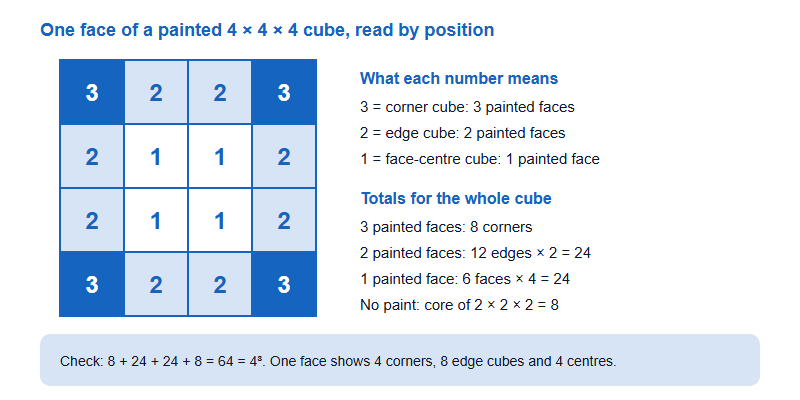
Run the table backwards: 8 unpainted cubes means (n − 2)³ = 8, so n = 4. For an a × b × c box with every side at least 2, keep the 8 corners; two-face cubes number 4[(a − 2) + (b − 2) + (c − 2)], one-face cubes 2[(a − 2)(b − 2) + (b − 2)(c − 2) + (a − 2)(c − 2)], and the core (a − 2)(b − 2)(c − 2).
2. Nets: finding opposite faces without folding
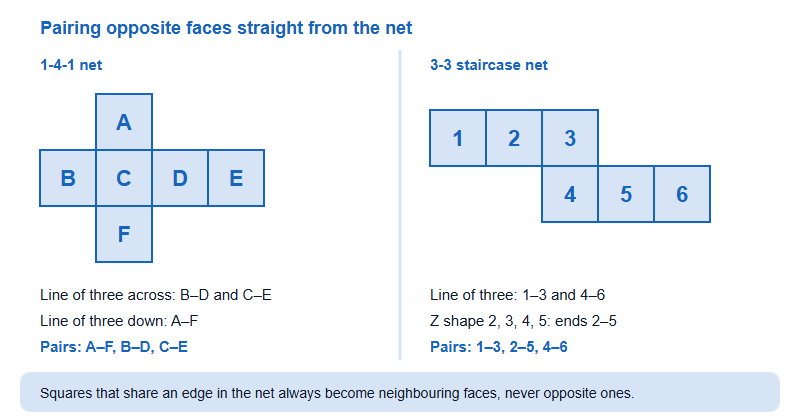
A cube has exactly 11 different nets, counting rotations and reflections as the same net. You need not memorise them: five rules pair opposite faces straight from the flat shape, and we checked each rule against all 11 nets.
| Rule | Pattern in the net | On the cube |
|---|---|---|
| Touching | Two squares share an edge | Neighbouring faces, never opposite |
| Line of three | Two squares in a straight line with exactly one square between them | Opposite faces |
| Row of four | The net has a straight row of four squares | The two squares off the row are opposite each other |
| Z shape | Four squares in an S or Z: two, a step sideways, then two more the same way | The two end squares are opposite |
| Last pair | Two opposite pairs already found in a genuine net | The remaining two squares are opposite |
Before pairing, reject shapes that cannot fold: not exactly 6 squares; a 2 × 2 block, since only three faces meet at a corner; 5 or more squares in a row, since a row of four already wraps round; or a square that the rules give two different opposites. These checks are fast but not a proof: of the 35 shapes made from six joined squares, 12 pass the first three and still fail to fold. For “which is a net” questions, fold any doubtful flap in your head.
3. Views and height maps: counting a stack you cannot fully see
A perspective drawing hides cubes, so convert it straight into a height map: the top view with each column’s height written in its square. A front-to-back line of squares becomes one column of the front view; a left-to-right line becomes one column of the side view.
| You have | Do this | You get |
|---|---|---|
| A picture of a stack | Write each column’s height in its top-view square | A height map |
| A height map | Add every number | The number of cubes |
| A height map | For each front-to-back line of squares, take its tallest number | The front view |
| A height map | For each left-to-right line of squares, take its tallest number | The side view |
| Front, side and top views | In each filled square, write the smaller of the two heights the views allow | The greatest possible number of cubes |
| Front, side and top views | Put 1 in each filled square, then raise as few squares as possible to match both views | The least possible number of cubes |
Example: a stack covers a 2 × 2 square, and the front and side views each show two columns of height 2. The greatest count puts 2 everywhere: 8 cubes. For the least, every line of squares needs one 2, and a square where two tall lines cross serves both, so put the 2s on a diagonal and 1s elsewhere: 6 cubes.
4. Surface area of glued cubes
Each glued contact hides two faces, one on each cube, so any solid made of unit cubes has surface area 6 × (number of cubes) − 2 × (number of glued pairs). A straight row of n cubes has n − 1 contacts, giving 4n + 2. The rule never asks about shape, only about contacts.
| Removed from a 3 × 3 × 3 cube (surface area 54) | Faces it showed | Faces it uncovers | Change | New surface area |
|---|---|---|---|---|
| A corner cube | 3 | 3 | 0 | 54 |
| A cube in the middle of an edge | 2 | 4 | +2 | 56 |
| The cube in the centre of a face | 1 | 5 | +4 | 58 |
The shortcut 2 × (front + side + top view areas) is safe only when every face is visible from one of the six straight-on directions. Five cubes in a U — three in a row, plus one behind each end — have 5 × 6 − 2 × 4 = 22 square units of surface, but the shortcut gives 2 × (5 + 3 + 2) = 20, because the two faces looking at each other across the gap are hidden from every view. With a dent, gap or tunnel, use the glued-pairs rule.
5. Ten original problems and the worked key (16 minutes)
Written for this card, not taken from past papers. Allow 16 minutes for all ten, and name the lookup table you need before starting each one.
- A 5 × 5 × 5 cube is painted on all six faces and cut into 125 unit cubes. How many have paint on exactly two faces?
- A painted cube is cut into unit cubes, and exactly 27 of them have no paint. How many have paint on exactly one face?
- A 3 × 4 × 5 box is painted on all six faces and cut into 60 unit cubes. How many have paint on exactly one face?
- In a cube net, squares 2, 3, 4 and 5 lie in a straight row in that order, square 1 is attached above square 2, and square 6 below square 5. When it is folded, which square is opposite square 1?
- Three dice are stacked in a tower on a table, and on each die opposite faces add up to 7. The top face shows 5. What is the total of the numbers on the five faces touching the table or another die?
- A stack of cubes stands on a 2 × 3 grid. Seen from above, the front row of squares holds columns of 2, 2 and 1 cubes from left to right, and the back row 3, 1 and 2. How many cubes are there, and what is the area of the front view?
- A stack of unit cubes covers a 3 × 3 grid, with at least one cube on every square. From the front it looks 3, 2 and 1 cubes tall from left to right; from the right-hand side, 3, 2 and 1 cubes tall from front to back. What is the greatest number of cubes it could contain?
- For the stack in Problem 7, what is the least number of cubes it could contain?
- From a 3 × 3 × 3 cube of 27 unit cubes, the cube in the centre of one face is removed. What is the new surface area?
- Six unit cubes are glued into a U on a table: four in a row, plus one behind each end cube. What is the surface area of the solid?
| # | Table | Answer | Route | The usual slip |
|---|---|---|---|---|
| 1 | 1 | 36 | 12 edges × (5 − 2) cubes on each | Counting whole edges, 12 × 5 = 60, corners included |
| 2 | 1 | 54 | (n − 2)³ = 27, so n − 2 = 3, and one-face cubes number 6 × 3² | Stopping at n = 5 and answering 125 |
| 3 | 1 | 22 | Centre patches on the six faces: two 1 × 2, two 2 × 3 and two 1 × 3, so 2 × (2 + 6 + 3) | Treating the box as a 4-cube and answering 6 × 2² = 24 |
| 4 | 2 | Square 6 | Squares 1 and 6 sit off the row of four, so they are opposite; the line rule adds 2–4 and 3–5 | Answering 4, which is opposite square 2, not square 1 |
| 5 | — | 16 | Bottom and middle dice each hide a top and a bottom, 7 + 7; the top die hides only its bottom, 7 − 5 = 2 | Counting the top face as hidden, or leaving out the face on the table |
| 6 | 3 | 11 cubes; front view 7 | Cubes: 2 + 2 + 1 + 3 + 1 + 2 = 11. Front view: the taller of each front-and-back pair, 3 + 2 + 2 | Adding each pair instead of taking the taller |
| 7 | 3 | 14 | Each square takes the smaller of its two allowed heights: front row 3 + 2 + 1, middle row 2 + 2 + 1, back row 1 + 1 + 1 | Using a larger height somewhere, which changes a view |
| 8 | 3 | 12 | 1 in all nine squares, then raise the front-left square to 3 and the centre to 2: 9 + 2 + 1 | Putting the 2 in the front row, so the middle row still needs a 2: one extra cube |
| 9 | 4 | 58 | A face-centre cube had 1 face outside and uncovers 5: 54 − 1 + 5 | Subtracting the lost face only and answering 53 |
| 10 | 4 | 26 | 6 × 6 − 2 × 5 glued pairs | The three-view shortcut, 2 × (6 + 4 + 2) = 24, misses the two faces across the gap |
Sort misses by table: on table 3 they usually mean a skipped height map, and on table 4 a shortcut trusted on a solid with a gap. For a real date, our in-person AMC 8 guide for 2026-27 covers the January sitting for China-based candidates; maa.org has the current window and rules.
Frequently asked questions
How many different nets does a cube have?
Eleven, if rotations and reflections of the same shape count as one net. Every other arrangement of six squares fails to fold.
Does removing a corner cube change the surface area?
No. The corner cube showed 3 faces and its removal uncovers 3 hidden faces, so the total stays exactly the same.
Can I find surface area from the front, side and top views?
Only when no face is hidden in a dent, gap or tunnel. The safe rule is 6 times the cubes minus 2 for every glued pair.
How many unit cubes have no paint inside a painted n-cube?
The unpainted core is a cube of side n – 2, so there are (n – 2) cubed of them. For a 5-cube that is 27.
This is an independent guide operated by Hanlin Education for China-based international-school students. We are not affiliated with, endorsed by, or sponsored by the Mathematical Association of America (MAA). Competition dates, rules and content descriptions can change between cycles: confirm all current details on maa.org and with your authorised test centre before acting on anything here. Any error reported to us is corrected within 7 working days.