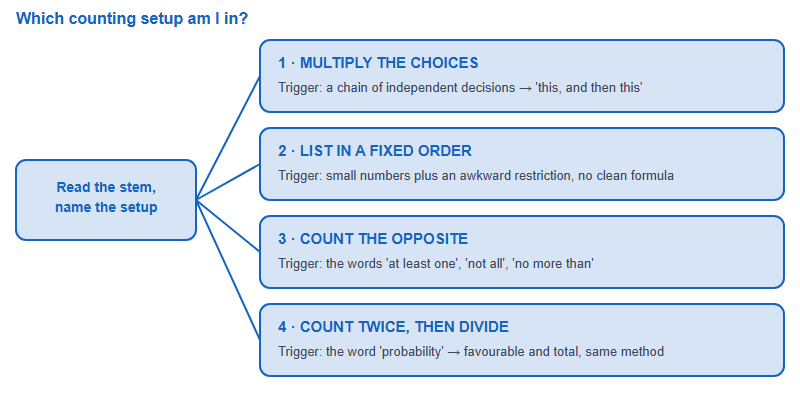
Nearly every counting or probability question on the AMC 8 is one of four setups: multiply independent choices, list cases in a fixed order, count the opposite and subtract, or count favourable and total outcomes the same way. Naming the setup takes about ten seconds and does most of the work. The formulas matter far less than the discipline of not missing a case.
Why this domain punishes students who are fast at arithmetic
The AMC 8 is 25 questions in 40 minutes with no calculator — roughly 96 seconds per question. Students who arrive from a computation-heavy background usually convert that pressure into an advantage on arithmetic, ratio and number-theory questions. Counting is where the advantage disappears, and it surprises families every year.
The reason is structural. On an arithmetic question, the difficulty sits in the calculation, and a fast calculator wins. On a counting question, the calculation is almost trivial — a multiplication, or adding up a list of nine things. The difficulty sits entirely in deciding what to calculate, and in not double-counting or skipping a case while you do it. Speed does not help with either. Worse, speed actively hurts: a student who starts writing before they have named the setup will produce a number that is close to correct, and close-to-correct is exactly the number waiting for them among the five answer choices.
That is the trap worth naming out loud. On a five-option paper, a plausible-but-wrong count is almost never punished by looking absurd. It looks like an answer. So the defence has to happen before the counting starts, not after.
What follows is the four-setup framework we use in editorial work with China-based students. It is deliberately small. A student under time pressure cannot run a decision tree with fifteen branches; they can run one with four.
Setup 1 · Multiply the choices
If the situation is a chain of independent decisions — pick one of these, and then one of those — the count is the product of the number of options at each stage. A canteen with 3 mains, 4 sides and 2 drinks offers 3 × 4 × 2 = 24 different meals. There is nothing to list.
Two questions decide whether the plain product is correct, and a student should ask both every time:
- Does order matter? Arranging 4 books on a shelf is 4 × 3 × 2 × 1 = 24, because a different order is a different arrangement. Choosing 2 of those 4 books to take home is not 4 × 3 = 12; that counts every pair twice, once in each order, so the answer is 6. Deciding whether the question cares about order is the whole game.
- Can something repeat? A 3-digit code from the digits 0–9 with repeats allowed is 10 × 10 × 10 = 1000. Without repeats it is 10 × 9 × 8 = 720. The stem always tells you, usually in four words that are easy to read past at speed.
The failure mode here is not conceptual. It is reading. Under 96 seconds a student sees a familiar shape and multiplies on autopilot, without registering that the question said “no digit is used twice”. Circling the constraint words in the stem before calculating costs three seconds and prevents most of the losses in this setup.
Setups 2 and 3 · List in an order, or count the opposite
Setup 2 is systematic listing, and it is far more respectable than students think. When the numbers are small and the restriction is awkward, listing is not a fallback for people who forgot the formula. It is the fastest correct method, and it is the method most likely to survive a strange condition.
The condition is that you list in a fixed order. Take: how many two-digit numbers have digits summing to 9? Working upward by the tens digit gives 18, 27, 36, 45, 54, 63, 72, 81, 90 — nine numbers, and you can see at a glance that nothing is missing, because the tens digit runs 1, 2, 3, …, 9 without a gap. A student who writes the same numbers down in the order they occur to them gets the same nine values on a good day and eight on a bad one, with no way to tell which day it is.
The ordering rule is simple: pick one quantity, run it from smallest to largest, and for each value ask what the rest must be. Pairs (a, b) from 1 to 6 with a < b and a + b = 7? Let a run upward: (1, 6), (2, 5), (3, 4), and at a = 4 the requirement a < b fails. Three pairs, and the stopping point is visible rather than guessed.
Setup 3 is complementary counting, and it is triggered by specific language: “at least one”, “not all”, “at least two”. Counting these directly means counting several separate cases and adding them, which is slow and leaks cases. Counting the opposite is usually one line.
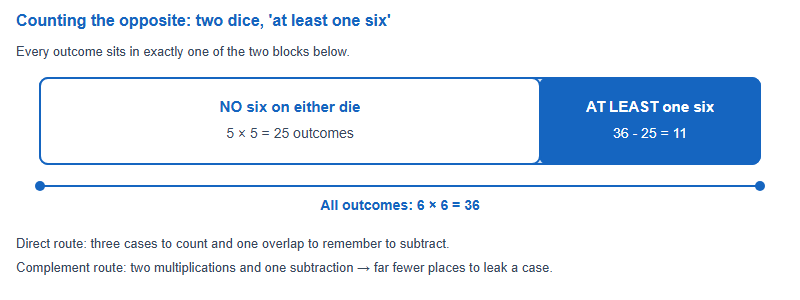
Roll two dice. How many outcomes contain at least one six? Directly, you would count the outcomes where the first die is a six, then where the second is, then remember to subtract the double-six you counted twice — three steps and one classic trap. By complement: there are 6 × 6 = 36 outcomes in total and 5 × 5 = 25 with no six anywhere, so 36 − 25 = 11 contain at least one. Two multiplications and a subtraction.
Setup 4 · Probability is two counts done the same way
At AMC 8 level, probability is not a separate subject. It is counting, twice: favourable outcomes over total outcomes, where every outcome in the total is equally likely. Almost every wrong answer in this setup comes from counting the top and the bottom by different rules.
A bag holds 3 red and 5 blue counters; you take two without looking. What is the probability both are red? Two routes, and they must agree:
- Counting ordered picks: total = 8 × 7 = 56, favourable = 3 × 2 = 6, giving 6/56 = 3/28.
- Counting unordered pairs: total = 28 pairs, favourable = 3 pairs, giving 3/28.
Both are right because each one is internally consistent. What produces a wrong answer is mixing them — an ordered numerator of 6 over an unordered denominator of 28. The self-check is quick and worth teaching as a reflex: if the fraction is greater than 1, or if it is uglier than the answer choices allow, you counted the two halves by different rules.
One more habit worth building here. AMC 8 scoring gives one point for a correct answer and nothing for a wrong one, with no penalty for guessing — so on a five-option question there is never a reason to leave a probability question blank, even when the counting has fallen apart. Confirm the current scoring rules on maa.org, then have your child bubble something for every question they abandon. On the in-person January paper that habit is worth roughly one extra point for every five questions abandoned, which is not nothing.
Choosing the setup in ten seconds — and a four-week drill block
Below is the reference table we hand students. The right-hand column is the part that actually gets used: knowing what your specific wrong answer means lets you fix a cause rather than re-reading a solution.
| Setup | Trigger in the stem | What you write down | What your wrong answer usually means |
|---|---|---|---|
| Multiply the choices | A chain of independent decisions | A product, one factor per stage | Answer too large → you ignored “no repeats” or counted order that does not matter |
| List in a fixed order | Small numbers, an awkward restriction | An ordered list, one line per case | Answer off by one or two → you missed a boundary case or repeated one |
| Count the opposite | “At least one”, “not all” | Total, minus the “none” case | Answer far too small → you counted cases directly and forgot the overlap |
| Count twice, divide | The word “probability” | Two counts, same method, as a fraction | Fraction above 1 or unusually ugly → numerator and denominator counted differently |
Four weeks is enough to move this domain from a weakness to a neutral, provided the work is done in this order. Trying to learn all four setups at once is the standard mistake; they blur together and the student ends up guessing which one to use, which is precisely the skill the block was meant to build.
| Week | Focus | Drill | You are ready to move on when… |
|---|---|---|---|
| 1 | Multiplication principle | 10 items, half with a “no repeats” or ordering twist | You circle the constraint words before you write a product |
| 2 | Systematic listing | 8 items, each solved with a written ordered list | Your list has a visible stopping point rather than a guessed one |
| 3 | Complementary counting | 8 “at least one” items, each done both ways once | You reach for the complement before counting cases |
| 4 | Probability plus mixed set | 12 mixed, timed at 90 seconds each, unlabelled by setup | You name the setup within ten seconds of finishing the stem |
Week 4 is the one families skip, and it is the only week that trains the skill the paper actually tests. A student who is told “this is a complementary counting question” will solve it. On the real paper nobody tells them. Mixing the setups and removing the labels is what converts knowledge into points.
Time the block so it ends comfortably before the January sitting rather than running into it — the AMC 8 is taken in person during a January window, and the exact dates and registration arrangements should be confirmed on maa.org and against our in-person registration and test-centre guide. A drill block that collides with the week of the exam produces anxiety, not points.
Frequently Asked Questions
Does the AMC 8 require the combinations formula?
No. Questions at this level are reachable with the multiplication principle, careful listing and complementary counting. Confirm the current syllabus description on maa.org.
Is listing out cases a sign of a weak student?
The opposite. With small numbers and an awkward restriction, an ordered list is the fastest reliable method and the least likely to lose a case.
How do I know whether order matters?
Ask whether swapping two chosen items gives a genuinely different outcome. Arrangements care about order; selections usually do not.
My child’s probability answers are always slightly wrong. Why?
Almost always the numerator and denominator were counted by different rules — one ordered, one unordered. Fix the method, not the arithmetic.
This is an independent guide operated by Hanlin Education for China-based international-school students. It is not affiliated with, endorsed by, or sponsored by the Mathematical Association of America (MAA). All worked examples above are our own constructions. Competition details change — always confirm current dates, eligibility, format, scoring and syllabus information on maa.org. Any error will be corrected within 7 working days.