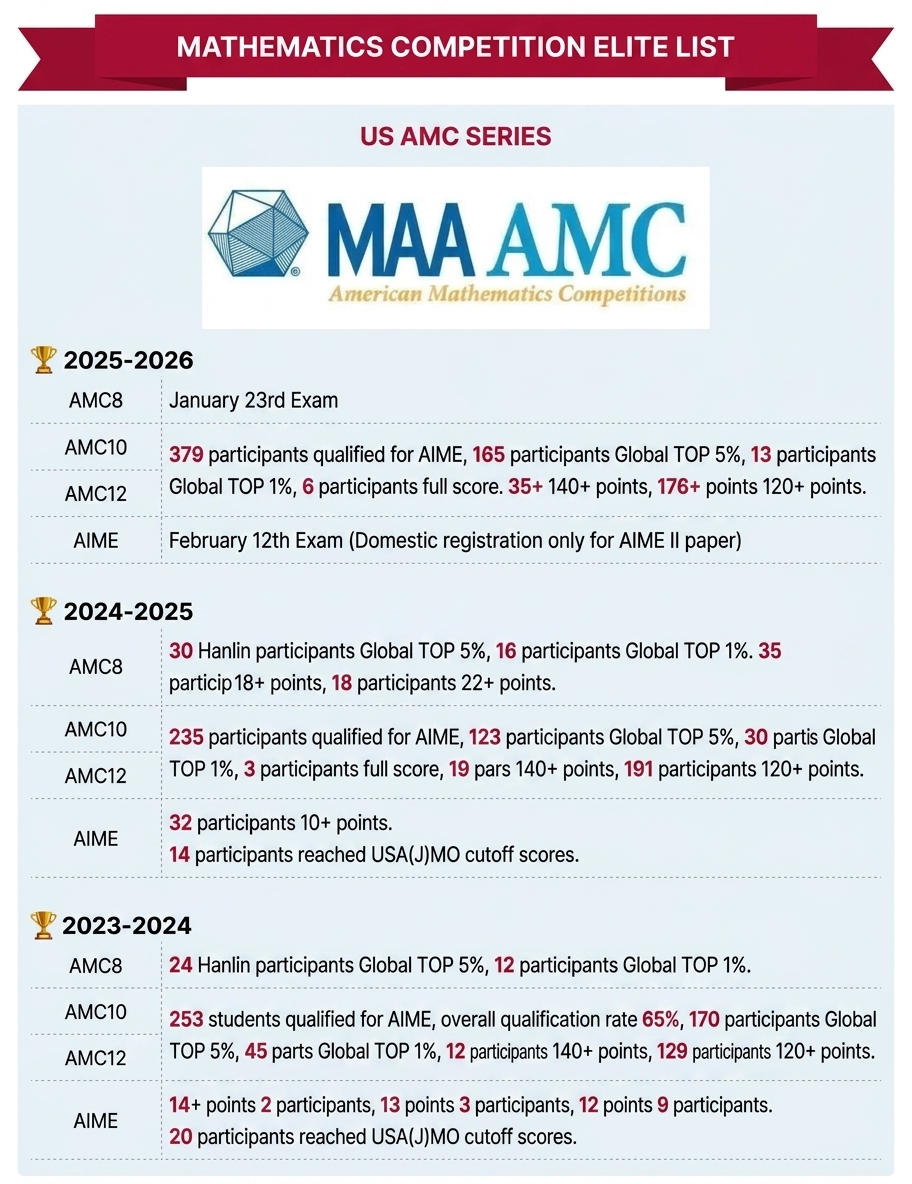

The 2026 AMC8 (American Mathematics Competition for grades 8 and below) season has successfully concluded. As one of the most influential mathematics competitions for elementary and middle school students worldwide, this year's competition saw significant changes in format, problem design, and competitive landscape. With the opening of the 2027 preparation window, this article provides a comprehensive reference guide for mathematics competition enthusiasts through four dimensions: a full review of the 2026 season, award data analysis, test trend interpretation, and 2027 preparation planning.
I. Full Review of the 2026 Season: Three Parallel Versions and Difficulty Differentiation
1. 2026 AMC8 Basic Exam Information
| Item | Details |
|---|---|
| Exam Date | January 22–28, 2026 (slight differences in exam times for different versions) |
| Exam Duration | 40 minutes |
| Number of Questions | 25 multiple-choice questions |
| Scoring | Full score 25 points (1 point per question) |
| Eligibility | Students in grade 8 and below (age ≤ 14.5) |
| Exam Format | In-person paper-based and online exams conducted simultaneously |
| Paper Versions | Three independently designed versions: US version, ASDAN version, China Organizing Committee version |
| Global Participation | 80,975 students (2026 data) |
2. Difficulty Comparison of the Three Paper Versions
The most notable change in the 2026 AMC8 was the introduction of multiple parallel versions for the first time, with significant differences in difficulty, style, and focus among versions.
| Version Type | Overall Difficulty | Problem Style | Key Features | Target Audience |
|---|---|---|---|---|
| US Version | Lowest | Straightforward wording, low computation | Focuses on direct application of basic concepts; final challenging questions are moderately difficult | First-time participants, students with average foundation |
| ASDAN Version | Medium | Increased problem traps and computational complexity | Some questions require information transformation; final questions involve probability, geometric construction | Students with some competition experience aiming for intermediate awards |
| China Organizing Committee Version | Highest | Comprehensive, leans toward domestic Olympiad style | Extensive coverage of advanced topics such as number theory, permutations and combinations, complex geometry | Experienced competition students aiming for top awards |
Key Interpretation: As a first attempt at independent problem design, the China Organizing Committee version is significantly more difficult than the traditional US version. Its problem design places greater emphasis on solid fundamentals and logical rigor, particularly increasing difficulty in the number theory and combinatorics modules, making them key differentiators.

II. Award Data Analysis: Cutoff Scores Continue to Rise
1. 2026 Cutoff Score Predictions and Award Percentages
Based on post-exam analysis and historical trends, the award thresholds for the 2026 AMC8 continue to rise.
| Award Level | Award Percentage | Estimated Cutoff Score | Certificate Name | Recent Trend |
|---|---|---|---|---|
| Global Distinguished Honor Roll | Top 1% | 22–24 points | Distinguished Honor Roll | Rising for 4 consecutive years, reaching an all-time high in 2026 |
| Global Honor Roll | Top 5% | 19–21 points | Honor Roll | Rising for 4 consecutive years, breaking 20 points for the first time |
| Global Achievement Roll | Top 50% | Approx. 15 points | Achievement Roll | Remains relatively stable |
Data Deep Dive:
- Intensifying Competition: The Top 5% cutoff has risen consecutively from 17 points in 2023 to 21 points in 2026, a 4-point increase over 4 years, reflecting the overall improvement in participant ability and increased competition.
- Higher Requirements for Perfect Scores: The Top 1% cutoff has risen from 21 points in 2023 to 24 points in 2026, meaning that aiming for top awards requires near-perfect performance.
- Fundamentals Remain Critical: The Top 50% (Achievement Roll) cutoff remains stable at around 15 points, indicating that ensuring all basic questions are correct is the fundamental guarantee for winning awards.
2. Award Distribution Characteristics by Grade
Although the AMC8 does not award prizes separately by grade, the following patterns can be observed from participant demographics and score distribution:
| Grade | Participation Share | Award Advantages | Preparation Recommendations |
|---|---|---|---|
| Grade 8 | Approx. 35% | Most complete knowledge system, main force for high scores | Goal should be set at Top 1%; requires systematic mastery of challenging questions |
| Grade 7 | Approx. 30% | One year of preparation time, significant room for improvement | First-time participants focus on gaining experience; aim for high scores the following year |
| Grade 6 | Approx. 20% | Clear age advantage, 2–3 opportunities to participate | Build competition thinking, gradually raise goals |
| Grade 5 and below | Approx. 15% | Demonstrate mathematical talent, lay foundation for the future | Focus on participation experience, cultivate interest in mathematics |
III. Test Question Trends and Topic Distribution
1. Overall Characteristics of 2026 Questions
| Dimension | Specific Performance | Implications for Preparation |
|---|---|---|
| Difficulty Gradient | Questions 1–15: basic; 16–20: intermediate; 21–25: challenging | Differentiated question-answering strategies needed based on target score |
| Problem Style | Enhanced "anti-routine" and comprehensiveness; introduction of new operations | Rote memorization ineffective; need to cultivate flexible application ability |
| Computation Requirements | Low computation for basic questions, complex for challenging ones | Balance speed and accuracy; avoid careless errors |
| Information Extraction | Problem statements still contain significant information; high reading comprehension required | Strengthen problem-reading training; improve information processing efficiency |
2. Distribution and Difficulty of the Four Major Knowledge Modules
| Module | Share Range | High-Frequency Topics | Difficulty Characteristics | Preparation Priority |
|---|---|---|---|---|
| Algebra | 35%–40% | Equation solving, percentage applications, rate and distance, sequences | Basic questions simple; challenging questions highly comprehensive | ★★★★★ (Core) |
| Geometry | 30%–35% | Perimeter and area of plane figures, Pythagorean theorem, basic solids | Lowered requirement for figure recognition; enhanced logical reasoning | ★★★★★ (Core) |
| Number Theory | 15%–20% | Divisibility, remainder analysis, greatest common factor | Significantly increased difficulty; key differentiator | ★★★★☆ (Key focus) |
| Combinatorics & Probability | 10%–15% | Basic probability, permutations and combinations, logical reasoning | Increased share; challenging questions often involve this module | ★★★☆☆ (Master basics) |
Module Preparation Strategies:
- Algebra and Geometry: Together account for over 70% of the test; they are the foundation for winning awards; ensure high accuracy.
- Number Theory: Difficulty has significantly increased; systematically learn core concepts such as divisibility and congruences.
- Combinatorics and Probability: Master basic question types; challenging problems may be strategically skipped to avoid spending too much time.
3. Analysis of 2026 Innovative Question Types
| Question Type Innovation | Specific Performance | Ability Requirements | Coping Strategy |
|---|---|---|---|
| Defining New Operations | Introduce new symbol rules, requiring quick learning and application | Learning transfer ability, rule comprehension | Regularly expose yourself to new definition problems; cultivate adaptability |
| Multi-knowledge Point Integration | Comprehensive problems combining algebra + geometry + logical reasoning | Knowledge integration ability, cross-module thinking | Strengthen comprehensive problem training; build knowledge connections |
| Real-life Modeling | Practical problems such as truck cargo calculations, electric vehicle range | Abstract real problems into mathematical models | Pay attention to applications of mathematics in daily life |
| Logical Reasoning Return | Three logical reasoning questions, increased share | Logical chain construction, elimination method application | Specialized training on logic problems; master reasoning techniques |
IV. 2027 Season Complete Preparation Guide
1. 2027 AMC8 Key Timeline Forecast
| Phase | Estimated Time | Core Tasks | Precautions |
|---|---|---|---|
| Preparation Start | April–August 2026 | Build knowledge system, solidify foundation | 9 months of golden preparation period starting now |
| Registration Open | September–October 2026 | Complete registration, choose exam version | Popular test centers fill up quickly; register early |
| Intensive Breakthrough | September–November 2026 | Past paper practice, targeted breakthroughs | Practice by module; summarize solution patterns |
| Sprint Mock Exam | December 2026–January 2027 | Full-length mock exams, time optimization | 2–3 timed mock exams per week; fully simulate test conditions |
| Exam Period | Fourth week of January 2027 | Take the exam, perform steadily | Adjust daily routine before the exam; maintain optimal condition |
| Results Release | February–March 2027 | Check scores, plan next steps | Develop next competition plan based on results |
2. Grade-Specific Preparation Planning Table
| Current Grade | Preparation Cycle | Target Award | Phase Planning | Key Tasks |
|---|---|---|---|---|
| Grades 3–4 | 1–2 years | Achievement Certificate (Top 50%) | Year 1: Cultivate interest, build foundation Year 2: Systematic preparation, aim for awards |
1. Advance study of school content 2. Exposure to competition thinking problems 3. Participate in practice exams |
| Grade 5 | 6–9 months | Global Honor Roll (Top 5%) | Foundation phase (1–3 months): Core test points Intensive phase (4–6 months): Past paper practice Sprint phase (7–9 months): Full-length mock exams |
1. Complete systematic study of all modules 2. Master challenging problems in the last 5 questions 3. Timed simulation training |
| Grade 6 | 3–6 months | Global Distinguished Honor Roll (Top 1%) | Foundation + Intensive + Sprint integration | 1. Zero errors on basic questions (1–15) 2. At most 1 error on intermediate questions (16–20) 3. Aim for 1–2 correct on challenging questions (21–25) |
| Grades 7–8 | 3–6 months | Top 1% + AIME preparation | Transition to AMC10 preparation | 1. Focus on challenging questions to aim for perfect score 2. Begin studying AMC10 content to bridge to higher-level competitions |
AMC8 Preparation Courses
Our instructors are graduates from top global universities. With precise curriculum planning and comprehensive learning tracking, we ensure your score improvement and award-winning success!
| Class Type | Hours | Class Size | Start Date |
|---|---|---|---|
| Winter Break Class | 30H | 3–8 students | Consult teacher for details |
| Systematic Course | 20H | 1v1 / 3–8 students | Consult teacher for details |
| Problem-Solving Class | 20H | 1v1 / 3–8 students | Consult teacher for details |