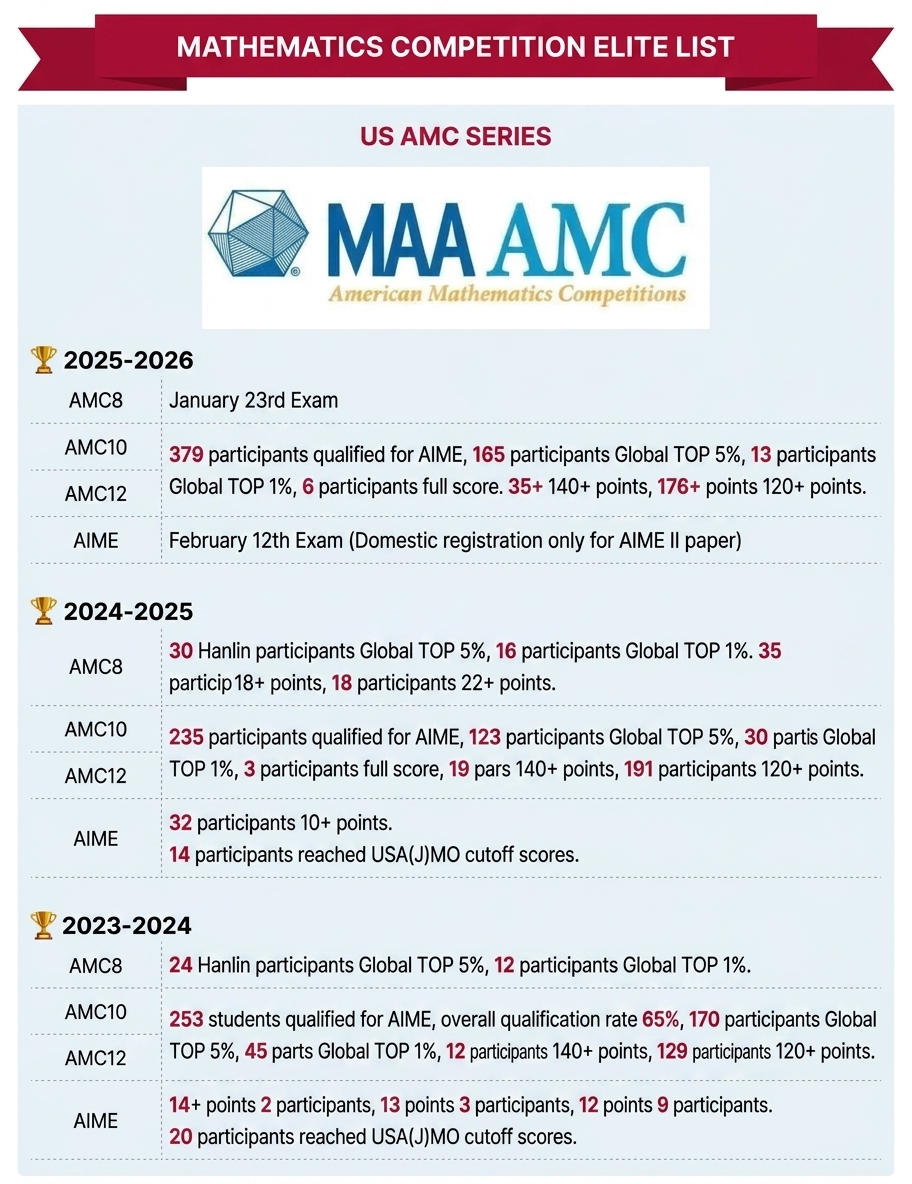

As one of the most influential youth math competitions in the world, AMC8 attracts over 300,000 students each year. With important updates to the 2026 competition rules and preparation strategies, this article provides a comprehensive analysis of the latest trends to help you gain an edge in this intellectual battle.

I. Competition Schedule and Rule Updates
The 2026 AMC8 will be held as an online exam on January 22 from 10:00 to 10:40 AM (Beijing Time), starting 7 hours earlier than previous years. Registration opens on October 22, 2025, and closes on January 13, 2026. Students should note three key changes:
Age Limit: Students who are under 14.5 years old on the day of the exam are eligible. The trend is toward younger participants—in Shanghai, a third-grade student has already successfully reached the Global Top 1%.
Question Type Innovations: Among the 25 multiple-choice questions, geometry now accounts for 30%, with new question types that may combine 3D net diagrams with coordinate systems.
Score Certification: Instant download of electronic transcripts is now available, allowing score inquiries through the official system 2 weeks after the exam.
II. Awards Battle: Cutoff Score Predictions and Value Analysis
The 2026 award structure follows the pyramid model, but competition intensity continues to rise:
Global Distinguished Honor Roll (Top 1%): Projected cutoff score 21–23 points (out of 25). In key cities like Shanghai, a score of 23 or higher may be required.
Global Honor Roll (Top 5%): Projected cutoff score 17–19 points, serving as a baseline for international school admissions.
Low-Age Achievement Award: Sixth graders and below who achieve 15 points can receive this honor, which top schools like Zhongguancun No. 3 Primary School in Beijing use as an indicator for experimental class selection.
The value of the competition continues to rise. AMC8 scores have become an "invisible key" to top global secondary schools. Top-tier Shanghai schools explicitly include Top 1% scores as a bonus factor in interview evaluations, and some international schools directly use AMC8 past paper questions as part of their entrance exams.
III. Complete Topic Overview: Strategies for the Four Major Modules
Algebra Module (35%–40%): Focus on breaking through multi-variable equations and sequence applications. For profit growth rate calculations, master mixed operations of fractions and percentages. Use the "last-digit elimination method" to improve calculation speed.
Geometry Module (25%–30%): New 3D net diagram questions are included. Master the 11 patterns of cube nets. The classic Pythagorean theorem is often tested alongside circle areas; use the "cutting-and-pasting method" to solve irregular shape problems.
Number Theory Module (15%): Prime factorization and modular congruence are must-know topics. Master the Chinese Remainder Theorem for problem-solving. Typical problems include finding the least common multiple and greatest common factor combinations of three numbers.
Combinatorics Module (15%–20%): Permutations and combinations appear more frequently. Beware of the trap between "with replacement" and "without replacement." Use tree diagrams to visualize complex scenarios.
IV. Preparation Roadmap: Three Phases to Achieve Rapid Progress
Phase 1: Foundation Building (June–August): Spend 30 minutes daily reinforcing core concepts from grades 5–6. Carefully study the first 15 questions of past papers from 2015–2020, and maintain an error log. Focus on mastering fraction operations and basic geometry formulas.
Phase 2: Skill Advancement (September–November): Dedicate 4–6 hours per week to targeted training to systematically tackle intermediate and advanced difficulty questions. Complete questions 16–20 under timed conditions, mastering practical techniques like the "option substitution method." Build geometric model thinking, such as deriving proportional relationships in similar triangles.
Phase 3: Peak Sprint (December–Before Exam): Take daily full-length mock exams (using 2021–2025 past papers). Develop a "3-minute problem-solving mindset": complete the first 10 questions within 12 minutes. Focus on the final challenging questions, mastering reverse thinking and extreme value verification methods.
V. Parent Guidance Guide: Three Core Support Strategies
Resource Toolkit: It is recommended to build an electronic question bank containing past papers from 2000–2025, supplemented by a high-frequency formula booklet for fragmented learning. A 5-minute mental math challenge during daily breakfast time can be helpful.
Psychological Construction Method: Use "growth mindset training": treat mistakes as "opportunities to fill knowledge gaps." Hold weekly family problem-solving sessions to explore fun math puzzles together.
Academic Progression Planning: Award-winning students can challenge the AMC10 the following year, forming a competition achievement progression path. The Global Distinguished Honor Roll certificate can serve as a core competitiveness proof for international school applications.
AMC8 Preparation Courses
Our instructors are graduates from top global universities. With precise curriculum planning and comprehensive learning tracking, we ensure your score improvement and award-winning success!
| Class Type | Hours | Class Size | Start Date |
|---|---|---|---|
| Winter Break Class | 30H | 3–8 students | Consult teacher for details |
| Systematic Course | 20H | 1v1 / 3–8 students | Consult teacher for details |
| Problem-Solving Class | 20H | 1v1 / 3–8 students | Consult teacher for details |