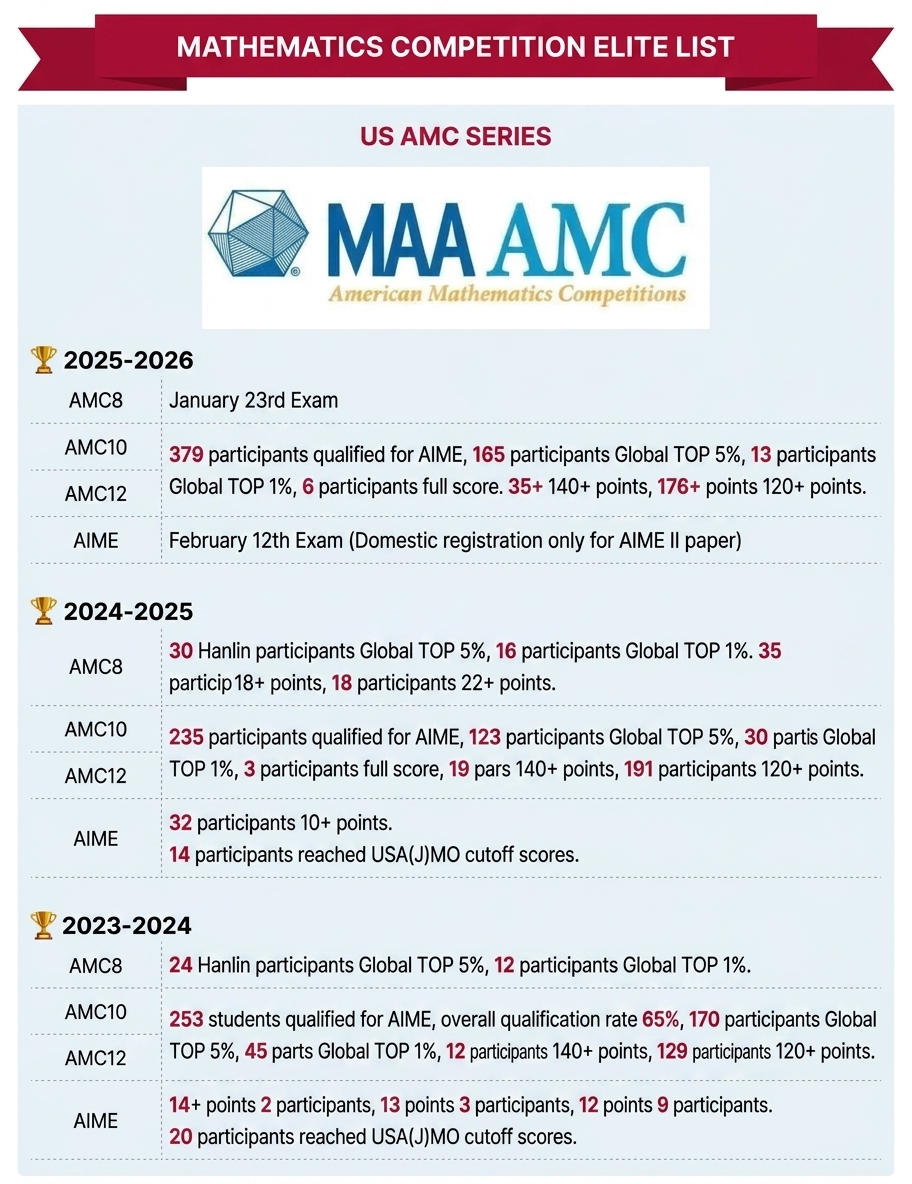
For students with an average math foundation or those who have never been exposed to competition math, the road to preparing for the AMC8 may seem challenging, but through a scientific and systematic plan, it is entirely possible to go from zero foundation to winning an award in a year or even less. This article provides a detailed preparation blueprint tailored for beginners, covering the entire process from entry to the final sprint.
I. Understanding the AMC8 Competition and Goal Setting
First, it is essential to clarify the format and core characteristics of the AMC8 competition as a prerequisite for developing an effective plan.
| Item | Specifics |
|---|---|
| Target Participants | Students in grade 8 and below (typically upper elementary to 8th grade students in China). |
| Exam Format | 25 multiple-choice questions, 40 minutes. |
| Scoring | +1 point for a correct answer, 0 points for incorrect or unanswered, full score 25 points. |
| Core Abilities Tested | Focuses on logical reasoning, problem-solving, and mathematical intuition, rather than complex calculations. |
| Zero Foundation Definition | Only familiar with school math; no systematic training in Olympiad or competition thinking. |
| Realistic Goal (First Year) | Achieve an Achievement Roll (around 15 points) or aim for the Honor Roll (top 5%, approx. 18-19 points). |
II. Four-Phase Complete Timeline (Based on a 12-Month Cycle)
The following plan assumes preparation starts in March (the off-season after the exam) and targets the January AMC8 exam of the following year.
| Phase | Timeframe | Core Tasks | Expected Goal |
|---|---|---|---|
| Phase 1: Foundation Building | Months 1-3 (Mar–May) | 1. Identify knowledge gaps and reinforce school knowledge. 2. Systematically learn the basic concepts of the four major AMC8 modules. 3. Initially engage with simple competition problems to build interest. | Become familiar with AMC8 question types; be able to independently solve most of the basic questions in the first 10 problems. |
| Phase 2: Module Breakthrough | Months 4-6 (Jun–Aug) | 1. Deepen learning by topic (arithmetic, algebra, geometry, counting, number theory). 2. Train on medium-difficulty problems and master core problem-solving methods. 3. Start an error log. | Stably solve the first 15–20 problems; have clear solution strategies for intermediate-level questions. |
| Phase 3: Integration & Strengthening | Months 7-9 (Sep–Nov) | 1. Timed full-paper practice to improve speed and accuracy. 2. Focus on weak topics and high-difficulty question types (e.g., the last 5 problems). 3. Analyze past papers to summarize recurring patterns. | Mock test scores stabilize in the 17–20 point range; be capable of competing for awards. |
| Phase 4: Sprint & Fine-Tuning | Months 10-12 (Dec–Jan exam) | 1. High-frequency full mock exams to adapt to the exam rhythm. 2. Review the error log and core concepts to fill gaps. 3. Adjust mindset and develop test-taking strategies. | Approach the exam in optimal condition; target score 18–22 points. |
III. Detailed Learning Path and Resource Guide for Each Phase
Phase 1: Foundation Building (Months 1-3)
The goal of this phase is to “fill gaps” and “gain familiarity”, transforming school knowledge into tools usable for competition.
| Module | Specific Content | Learning Suggestions & Resource Types |
|---|---|---|
| Arithmetic | Integer operations, fractions, decimals, percentages, ratios, rates. | Ensure absolute computational fluency. Use basic elementary Olympiad textbooks for reinforcement. |
| Algebra | Basic equations, sequences, simple function concepts. | Understand variable thinking; master the basic method of setting up equations to solve word problems. |
| Geometry | Perimeter and area of plane figures, introduction to solid figures, angle calculations. | Memorize all formulas and understand their derivations. Practice drawing diagrams for analysis. |
| Counting & Probability | Enumeration, addition/multiplication principles, basic probability. | Start with everyday examples to cultivate orderly, non-duplicative, non-omissive thinking habits. |
Weekly Schedule: Monday to Friday: 30 minutes of focused study per night; Weekends: 90 minutes of comprehensive practice and review. Use older AMC8 past papers (e.g., 2000-2010) for practice, as they are less difficult and suitable for beginners.
Phase 2: Module Breakthrough (Months 4-6, Key Summer Period)
Use the extended summer break for in-depth topic study, advancing from “knowing” to “mastering”.
| Topic | Advanced Knowledge Points | Typical Question Types & Training Methods |
|---|---|---|
| Number Theory | Divisibility properties, primes and composites, remainder problems. | Number puzzles, pattern-finding problems. Master core theorems through categorized practice. |
| Combinatorics | Permutations and combinations, inclusion-exclusion principle, logical reasoning. | Path problems, arrangement problems. Learn to use tools like tree diagrams and tables. |
| Advanced Geometry | Pythagorean theorem, similarity models, cutting and pasting. | Shaded area problems, nets of solid figures. Summarize common models and auxiliary line techniques. |
Training Method: Complete 15-20 selected problems per day on one topic. Maintain an error log recording the problem, the mistake, the correct approach, and the knowledge point.
Phases 3 & 4: Integration & Sprint (Months 7-12)
Enter the integration and simulation stage, shifting from “solving problems” to “taking the test”.
| Item | Specific Actions | Goal & Notes |
|---|---|---|
| Full-Paper Practice | Complete 1-2 sets of recent past papers (e.g., 2015-2025) per week, strictly timing 40 minutes. | Simulate real exam pressure; practice time allocation strategies (e.g., first 15 problems in 20 minutes, last 10 in 20 minutes). |
| Analysis & Review | Conduct a detailed analysis of each mock exam: 1. Which mistakes were due to carelessness? 2. Which due to lack of knowledge? 3. Which had no solution approach at all? | Categorize the causes of lost points and strengthen accordingly. Carelessness is the biggest “point-gaining opportunity”. |
| Strategy Formulation | Decide on a consistent answering order based on personal strengths: – Steady type: go from start to finish. – Jumping type: tackle all easy problems first, then challenging ones. | Find the rhythm that works best and rehearse it repeatedly during the sprint phase to form muscle memory. |
| One Week Before Exam | 1. No new or difficult problems. 2. Review the error log and formulas/theorems. 3. Adjust sleep schedule and maintain a positive mindset. | The goal is “maintenance” and “confidence”. Trust in the long-term accumulation of effort. |
IV. Key Advice for Zero-Foundation Students and Parents
Mindset Management: Encountering difficulties early on is a natural part of the process; the focus should be on learning from mistakes. Break down the overall goal into monthly and weekly sub-goals to continuously gain a sense of achievement.
Resource Selection: Prioritize using official past papers and solutions. Supplement with classic math thinking expansion books, but avoid overloading. Mastering one or two high-quality resources thoroughly is far more effective than skimming many.
Time Investment: Aim for an average of 45-60 minutes of effective study per day, extending to 2-3 hours on holidays. Consistency and efficiency are more important than the length of any single session.
Subsequent Path: Regardless of the first exam result, the preparation experience is extremely valuable. After winning an award, consider challenging the AMC10/12; even without an award, the systematically enhanced mathematical thinking will have a profound impact on school learning and future academic advancement.
By following the plan above, maintaining patience and perseverance, every student starting from zero has the opportunity to prove themselves on the AMC8 stage, gaining not just a certificate but also lifelong thinking skills and learning habits.
AMC8 Preparation Courses
Our instructors are graduates from top global universities. With precise curriculum planning and comprehensive learning tracking, we ensure your score improvement and award-winning success!
| Class Type | Hours | Class Size | Start Date |
|---|---|---|---|
| Winter Break Class | 30H | 3–8 students | Consult teacher for details |
| Systematic Course | 20H | 1v1 / 3–8 students | Consult teacher for details |
| Problem-Solving Class | 20H | 1v1 / 3–8 students | Consult teacher for details |