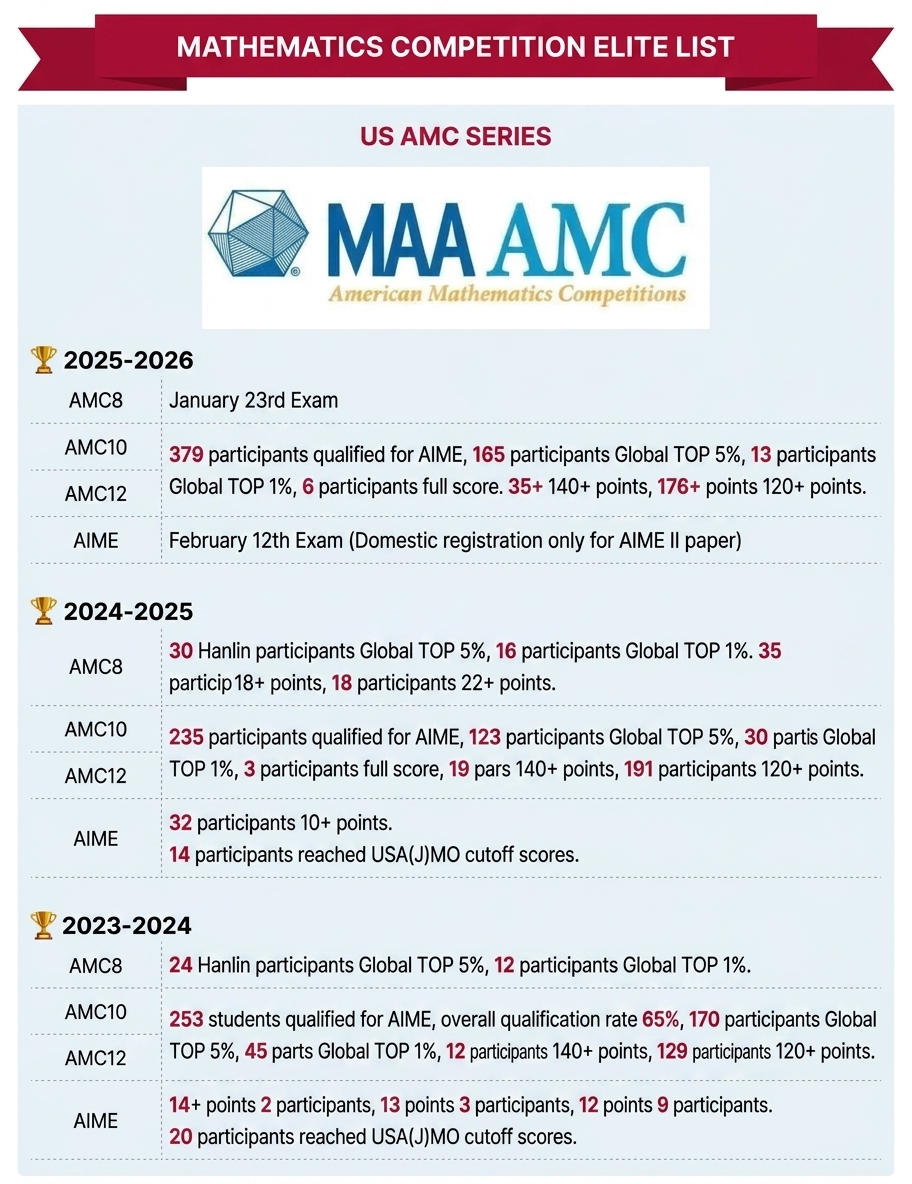
AMC8 (American Mathematics Competition 8), as one of the most influential youth mathematics competitions globally, features meticulously designed problems and highly regular patterns in its test point distribution. A deep understanding of these high-frequency test points is key to efficient preparation and winning awards. This article systematically reviews the test points across the four core modules of AMC8—Algebra, Geometry, Number Theory, and Combinatorics—and analyzes current question trends to help candidates pinpoint key scoring areas.
I. Overall Module Weighting and Question Trends
According to recent years’ analysis of past papers, the proportion of each module in AMC8 remains relatively stable, with slight annual adjustments. Recent exams place greater emphasis on cross-module integration of knowledge and practical application skills.
| Module | Proportion Range | Core Characteristics and Trends |
|---|---|---|
| Algebra & Probability | 40% – 45% | The largest proportion, forming the foundation for scoring. The trend is shifting from pure calculation to mathematical modeling and practical application, such as quadratic function modeling combined with real-life scenarios, data analysis, and statistical inference. |
| Geometry | 25% – 30% | Difficulty has been increasing year by year, making it a key differentiator. New question types include dynamic analysis of 3D nets, the Pythagorean theorem combined with practical engineering applications, emphasizing spatial imagination and graphical transformation skills. |
| Number Theory & Combinatorics | 20% – 25% | Fewer in number but high in difficulty; they are the core battleground for high scores (Top 5%, 1%). There is a greater focus on computational efficiency and algorithmic thinking, such as using short division to find GCD/LCM, constructive thinking, and more. |
II. Algebra Module: The Cornerstone of Scoring and Modeling Core
The algebra module runs throughout the exam and is crucial for securing foundational points. The focus goes beyond calculation to include the ability to translate practical problems into mathematical expressions.
| Test Point Category | Specific High-Frequency Test Points | Common Question Types & Preparation Suggestions |
|---|---|---|
| Basic Operations | Mixed operations with integers, fractions, decimals, percentages; proportion and percentage word problems. | Problems involving travel, work, concentration, growth rates. Practice fast and accurate calculations, and be adept at extracting equal relationships from text. |
| Equations & Inequalities | Solving linear equations/systems; simple linear inequalities. | Mostly word problems. The core is “set up unknowns – form equations – solve”. Pay attention to discussions of equations with parameters. |
| Sequences | Arithmetic sequences (general term, sum); simple geometric sequences and pattern-based sequences. | Observe number patterns and skillfully apply formulas. It is increasingly common to test geometric sequence sums combined with real-life scenarios. |
| Functions & Coordinates | Number line and absolute value; points, distance, slope on a coordinate plane; simple quadratic function graphs and properties. | Emerging trend: Quadratic function modeling (e.g., optimization problems). Master the basic characteristics of function graphs and coordinate geometry calculations. |
III. Geometry Module: An Imaginative Leap from Plane to Space
The geometry module is evolving from regular area and volume calculations to more complex spatial analysis and graphical transformations.
| Test Point Category | Specific High-Frequency Test Points | Common Question Types & Preparation Suggestions |
|---|---|---|
| Plane Geometry | Perimeter and area calculations for triangles, quadrilaterals, circles, sectors; Pythagorean theorem; similarity and congruence of figures. | Calculating the area of irregular figures (using methods like partitioning/complementary shapes, auxiliary lines) is a persistent focus. Memorize all formulas and understand their derivations. |
| Solid Geometry | Surface area and volume calculations for cubes, cuboids, cylinders, cones; nets and orthographic projections of solids. | Key focus: Dynamic analysis of 3D nets, requiring the ability to mentally convert between solid and planar figures. Recent exams have frequently included composite solids (e.g., with holes or seams) and their surface area changes. |
| Coordinate Geometry | Coordinates of points, symmetry, rotation; translation of figures; distance from a point to a line. | Often combined with algebra to test solving geometric problems with algebraic methods. Master basic coordinate transformation rules. |
IV. Number Theory Module: Clever Use of Integer Properties
Number theory problems are flexible and effectively test students’ logical reasoning and number sense.
| High-Frequency Test Points | Core Content & Problem-Solving Techniques | Preparation Tips |
|---|---|---|
| Divisibility Rules | Characteristics of numbers divisible by 2, 3, 5, 9, 11, etc.; properties of congruences. | Mastering quick divisibility judgment is the foundation for solving remainder and periodicity problems. |
| Prime & Composite Numbers | Prime number determination; prime factorization. | Proficiency in prime factorization is the first step in finding GCD, LCM, and solving many number theory problems. |
| Greatest Common Divisor & Least Common Multiple | Application of short division and the Euclidean algorithm (Euclid’s algorithm). | An ongoing trend is the emphasis on using short division for quick solutions, testing computational efficiency and understanding of integer properties. |
| Parity Analysis | Using parity for reasoning and eliminating options. | Often combined with number puzzles and operation problems; a common technique in solving number theory problems. |
V. Combinatorics Module: The Art of Logic and Counting
The combinatorics module focuses on logical thinking, with diverse problem contexts, distinguishing top-performing students.
| High-Frequency Test Points | Core Content & Problem-Solving Techniques | Preparation Tips |
|---|---|---|
| Counting Principles | Addition principle, multiplication principle (classification vs. step-by-step). | The foundation of all combinatorics problems. Must clearly understand “classification without overlap or omission, steps fully completed”. |
| Permutations & Combinations | Simple permutation (order matters) and combination (order doesn’t matter) problems. | Understand the application scenarios of C(n, k) and P(n, k) to avoid double counting. |
| Introduction to Probability | Classical probability (probability of equally likely events). | Master the formula Probability = Number of favorable outcomes / Total number of outcomes. New trend: Combined with real statistical data to test data analysis skills. |
| Logical Reasoning & Pigeonhole Principle | Reasoning using lists and diagrams; simple applications of the pigeonhole principle. | Train rigorous logical chains, learn to use tools like Venn diagrams and tables to organize complex conditions. |
VI. Question Difficulty Distribution and Corresponding Preparation Strategies
Understanding the difficulty gradient of the questions helps in formulating a reasonable time allocation strategy and scoring plan for the exam.
| Question Range | Difficulty Level | Main Tested Modules & Characteristics | Preparation & Exam Strategy |
|---|---|---|---|
| Questions 1-10 | Basic | 5th-6th grade school level, mainly pure algebraic operations, basic geometry concepts. | Must ensure all are correct. Average time per question should not exceed 1 minute to leave time for later challenging questions. |
| Questions 11-20 | Intermediate | Knowledge from various modules begins to merge, with cross-topic word problems. Longer question stems require quick information extraction. | Key scoring zone. Intensify practice with past papers, improve problem comprehension and integrated problem-solving ability. If stuck, skip temporarily and return after finishing the paper. |
| Questions 21-25 | Challenging / Final | Concentrates the most difficult number theory, combinatorics, and complex geometry problems. Usually involves deep integration of two or more knowledge points, requiring creative thinking. | High-score differentiator. Candidates aiming for the Top 5% need to make progress in this section. Practice high-frequency final question types regularly, allocate time wisely during the exam, and skillfully use techniques like substituting special values, estimation, and elimination. |
To conquer AMC8, you must ensure every point is secured in algebra and geometry while delving deep into the problem-solving techniques of number theory and combinatorics. Preparation should focus on past papers from the last 5–10 years, familiarize yourself with the exam rhythm through timed mock tests, and create an error log to systematically strengthen weak areas. Adhere to the principle of “fast and accurate on basics, steady and complete on intermediate, clever and breakthrough on challenging” to stand out in the 40-minute intense competition.
AMC8 Preparation Courses
Our instructors are graduates from top global universities. With precise curriculum planning and comprehensive learning tracking, we ensure your score improvement and award-winning success!
| Class Type | Hours | Class Size | Start Date |
|---|---|---|---|
| Winter Break Class | 30H | 3–8 students | Consult teacher for details |
| Systematic Course | 20H | 1v1 / 3–8 students | Consult teacher for details |
| Problem-Solving Class | 20H | 1v1 / 3–8 students | Consult teacher for details |