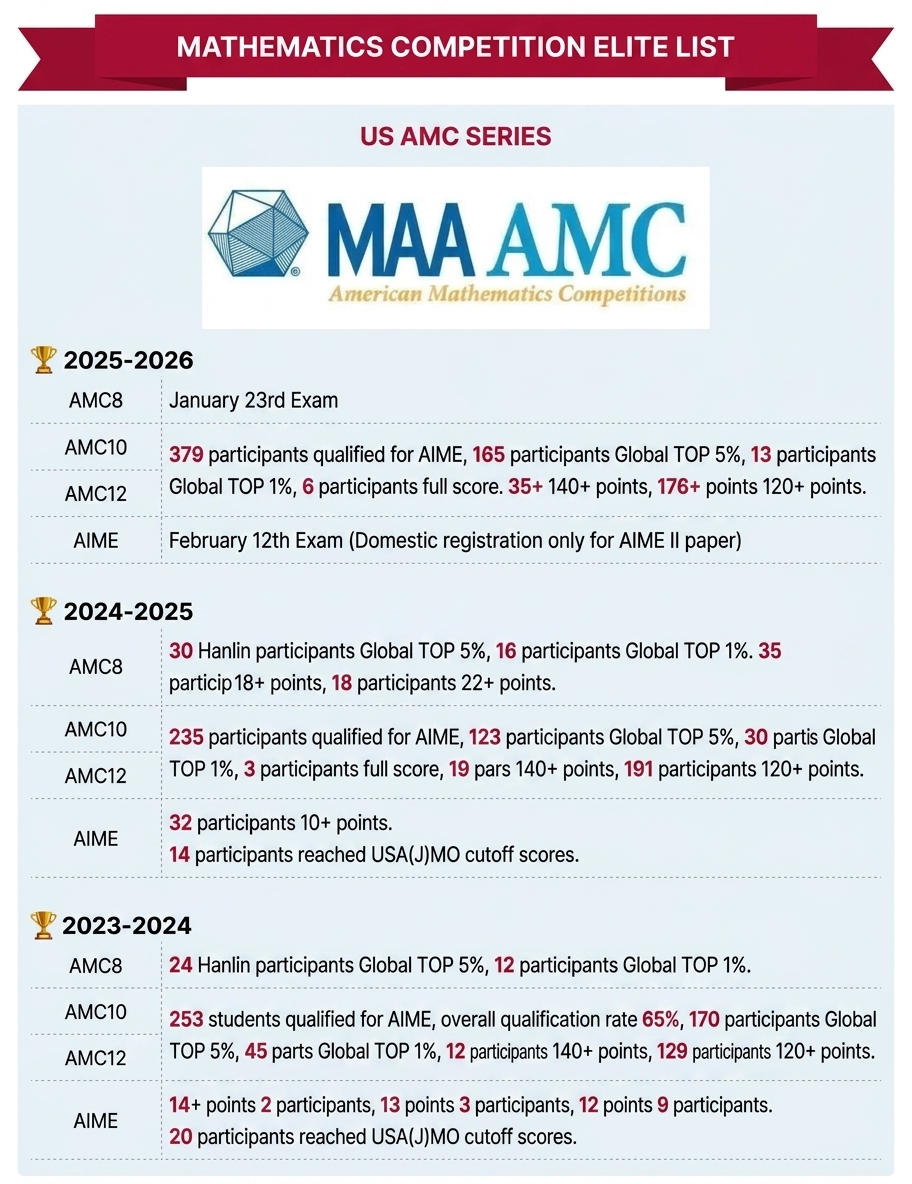
The AMC8 (American Mathematics Competition 8), organized by the Mathematical Association of America (MAA), is a world-renowned math contest for middle school students. This comprehensive guide covers the AMC8 eligibility rules, exam format, scoring system, award categories, recommended preparation timeline, and the key differences between AMC8 and AMC10/12.
I. AMC 8 Competition Schedule and Registration
The AMC 8 is held each January (the next sitting is the January 2027 season). A typical schedule is as follows:
| Item | Date |
|---|---|
| Registration Deadline | A few days before the contest |
| Official Exam Date | A single 40-minute window in January |
| Exam Duration | 40 minutes |
| Score Release | 2–4 weeks after the exam |
| Certificate Download | 6–8 weeks after the exam |
II. Eligibility Requirements
Grade Level: Students in grade 8 (8th grade / second year of junior high) or below[reference:0].
Age Restriction: Participants must be no older than 15.5 years of age on the day of the competition[reference:1][reference:2].
Nationality: No nationality restrictions; eligible students worldwide may participate[reference:3].
Increasing Participation: While official rules allow up to grade 8, actual participation has become younger, with many 3rd and 4th graders with strong math abilities taking on the challenge[reference:4].
III. Exam Format and Rules
Question Type: 25 multiple-choice questions, bilingual (Chinese-English) test papers[reference:5].
Scoring System: 1 point for each correct answer; no deduction for incorrect or unanswered questions. The total possible score is 25 points[reference:6].
Exam Format: The AMC 8 is offered in a hybrid format, with both home-based (online) and on-campus (offline) testing options[reference:7].
Pacing Requirement: With an average of only 1.6 minutes per question, the exam demands fast and accurate problem-solving[reference:8].
Difficulty Gradient:
Questions 1–10: Foundational, testing basic concepts[reference:9].
Questions 11–20: Intermediate, requiring flexible application of knowledge[reference:10].
Questions 21–25: High difficulty, often integrating multiple knowledge points[reference:11].
Allowed and prohibited materials during the exam are listed below[reference:12]:
| Category | Allowed Items | Prohibited Items |
|---|---|---|
| Stationery | Pens, pencils, eraser, ruler, blank scratch paper | Compass, protractor, graph paper |
| Electronic Devices | Computer with camera, mobile device (for online proctoring) | Calculator, smartwatch, phone (except proctoring device), any computing equipment |
IV. Registration Process
Individual direct registration is not accepted. Students must register through one of the following official channels[reference:13]:
School Group Registration: For students whose schools are official AMC partner test centers (typically international schools or select key secondary schools). Registration is organized centrally by the school’s math department or academic affairs office[reference:14].
Official Partner Platform Registration: Non-partner school students can register via ASDAN, the official AMC China partner. Two ways:
ASDAN official website: http://www.seedasdan.org/ – locate the AMC8 registration portal, fill in information, and pay the fee[reference:15].
WeChat Mini-Program: Search for “ASDAN International STEM Assessment”, register, and search for AMC8 to complete registration[reference:16].
Agency Proxy Registration: If the school is not a partner test center, students can register through officially authorized agencies. Note that agency registration deadlines are often earlier than the official cutoff, so advance contact is recommended[reference:17].
Registration Fee: 120 RMB. After successful registration, students receive an electronic admission ticket 1–2 weeks before the exam and must print it out[reference:18].
V. Core Topics and Syllabus
The AMC 8 syllabus covers four major content areas, with a strong emphasis on interdisciplinary applications and higher‑order logical reasoning[reference:19].
| Module | Percentage | Key Topics |
|---|---|---|
| Algebra & Probability | 40%–45% | Fraction, decimal, percentage operations; ratio and proportion; linear equations; quadratic function modeling (e.g., carbon emission optimization); probability integrated with real‑world business scenarios (e.g., supermarket promotion models)[reference:20]. |
| Geometry | 25%–30% | Properties of triangles, quadrilaterals, and circles; Pythagorean theorem; dynamic analysis of 3D nets; calculation of irregular shapes; problems combining geometry with engineering applications (e.g., building structural stability)[reference:21]. |
| Number Theory | 15%–20% | Prime numbers and prime factorization (including large numbers); divisibility rules; greatest common divisor (GCD) and least common multiple (LCM) using short division; parity analysis[reference:22]. |
| Combinatorics | 15%–20% | Counting principles; permutations and combinations; probability calculations; logical reasoning; sum of geometric sequences[reference:23]. |
Scoring: The AMC 8 is entirely multiple-choice. You earn 1 point for each correct answer and 0 points for a wrong or blank answer, for a maximum of 25. There is no penalty for wrong answers and no grading of written steps, so it is always worth attempting every question.
VI. Awards and Score Cutoffs
AMC8 awards are based on global percentiles. The table below shows the award categories and typical score requirements based on past competitions[reference:25].
| Award | Qualification Criteria | Typical Score Requirement |
|---|---|---|
| Perfect Score Award .=Perfect score of 25 | 25 points | |
| Distinguished Honor Roll (DHR) | Top 1% globally | 21–23 points |
| Honor Roll (HR) | Top 5% globally | 17–19 points |
| Achievement Roll (AR) | Grade 6 or below and score ≥ 15 | 15 points or above |
Recent years’ cutoffs show a steady upward trend, reflecting increasing competition[reference:26].
VII. Recommended Preparation Timeline
A scientific three-phase preparation plan is essential for achieving a high score on the AMC8[reference:27].
| Phase | Timeline | Core Tasks | Goals |
|---|---|---|---|
| Foundation Building | 2–3 months before the exam | Systematically review the four major modules: algebra, geometry, number theory, and combinatorics. Build a complete knowledge framework. Focus on algebraic equations and geometric theorem proofs. Complete 10–15 minutes of speed calculation practice daily[reference:28]. | Master 70% of core concepts; ensure zero mistakes on questions 1–10. |
| Skill Enhancement | 1–2 months before the exam .=Targeted practice on weak areas. Use past papers from 2015–2025, focusing on questions 11–20. Practice multiple solution methods for each problem. Maintain a mistake log, categorizing errors by type (e.g., “geometry nets,” “prime factorization traps”)[reference:29]. | Improve accuracy on questions 11–20; identify and correct recurring mistakes. | |
| Final Sprint | 2–3 weeks before the exam .=Conduct 2–3 full-length timed mock exams per week, strictly following the 40‑minute limit. Use the recommended time allocation: 8 minutes for questions 1–10, 15 minutes for questions 11–20, and 12 minutes for questions 21–25. Practice test‑taking strategies such as elimination, substitution, and educated guessing[reference:30]. | Build a stable answering rhythm; optimize time management; achieve a target mock score of 18+ points. |
VIII. Key Differences: AMC8 vs. AMC10/12
Understanding the differences between AMC8, AMC10, and AMC12 helps students plan a long‑term competition pathway. There is no direct promotion from AMC8 to AMC10/12; students may choose the appropriate level based on their age and math ability[reference:31].
| Comparison Dimension | AMC8 | AMC10 |
|---|---|---|
| Eligibility | Grade 8 or below, ≤ 15.5 years old | Grade 10 or below, ≤ 17.5 years old |
| Exam Duration | 40 minutes, 25 questions | 75 minutes, 25 questions |
| Scoring Rules | 1 point per correct answer, no deduction for incorrect/unanswered. Max: 25 points. | 6 points per correct answer, 1.5 points for unanswered questions, 0 points for incorrect. Max: 150 points. |
| Knowledge Scope | Elementary through 8th‑grade content: basic algebra, geometry, number theory, combinatorics. .=Extends to 9th‑ and 10th‑grade content; depth and breadth increase significantly. | |
| Advancement | No direct promotion pathway; awards for top 1% and 5%. | Top 2.5%–5% qualify for AIME (American Invitational Mathematics Examination). |
| Typical Cutoffs (Reference) | Top 1% (DHR): 21–23 points; Top 5% (HR): 17–19 points. | AIME qualifying: approx. 100–110 points; Top 1% (DHR): approx. 130–135 points. |
Starting from AMC8 and gradually progressing to AMC10/12 and AIME provides a systematic pathway for students to improve their mathematical thinking and problem‑solving skills[reference:32].
IX. Recommended Learning Pathways by Grade Level
Students at different grade levels should focus on different goals and content when preparing for AMC8[reference:33].
Grades 5–6Systematically learn the four core modules: algebra, geometry, number theory, and combinatorics. Complete the knowledge system through structured study.Achievement Roll (score ≥ 15) or Honor Roll (top 5%)This is the golden period for AMC8 preparation. Lay a solid foundation for future higher‑level competitions.
| Grade Level | Preparation Focus | Target Score / Award | Recommended Pathway |
|---|---|---|---|
| Grades 3–4 | Build interest in mathematics; engage in fun math games and basic problem‑solving activities; consolidate elementary school math fundamentals. | Beginner’s level; aim to get acquainted with competition format | Use the AMC8 as an introduction to international math competitions; focus on building a foundation rather than chasing high scores. |
| Grades 7–8 | Strengthen problem‑solving skills and speed; conduct mock exams and error analysis; target weak areas for intensive training. | Honor Roll (top 5%) or Distinguished Honor Roll (top 1%) | Aim for high scores to add value to secondary school applications and prepare for the transition to AMC10/12. |
AMC8 Preparation Courses
Our instructors are graduates from top global universities. With precise curriculum planning and comprehensive learning tracking, we ensure your score improvement and award-winning success!
| Class Type | Hours | Class Size | Start Date |
|---|---|---|---|
| Winter Break Class | 30H | 3–8 students | Consult teacher for details |
| Systematic Course | 20H | 1v1 / 3–8 students | Consult teacher for details |
| Problem-Solving Class | 20H | 1v1 / 3–8 students | Consult teacher for details |