As one of the most influential middle school math competitions globally, the AMC8 (American Mathematics Competition 8) is held once a year in January. This article provides a detailed breakdown of the syllabus, registration options, event schedule, and academic advancement value, helping students and parents thoroughly understand the competition and prepare effectively.
I. AMC8 Syllabus Overview
The AMC8 uses a 25 multiple-choice question format. Its question design and assessment focus can be summarized as follows:
1. Module Proportions and Exam Points
The table below shows the proportions and key points for each math module in the AMC8:
| Math Module | Proportion | Exam Points and Key Features |
|---|---|---|
| Algebra & Probability | 40%–45% | Quadratic function modeling for practical problems; probability problems combined with real-world scenarios (e.g., promotion and pricing situations); ratio, fraction, and equation word problems. |
| Geometry | 25%–30% | Analysis of 3D nets, applying the Pythagorean theorem to real-world contexts; calculating the area of irregular shapes, including multi‑layer overlapping shaded area problems. |
| Number Theory & Combinatorics | 20%–25% | Prime factorization, including quick factorization of larger integers; application of the sum formula for geometric sequences; combinatorial counting problems with multiple constraints. |
2. Scoring Rules
The AMC8 is entirely multiple-choice. You earn 1 point for each correct answer and 0 points for a wrong or blank answer, for a maximum of 25 points. There is no penalty for wrong answers and no partial or “process” credit: only the answer option you select is scored, with no deduction for working, theorem citations, units, or rounding. Because there is no penalty, you should answer every question, guessing if necessary.
3. Trends in Question Design
Problem statements often include unstructured information such as charts and data. Trap problems featuring unit confusion and logical qualifiers are common. For questions 21–25, the degree of problem‑solving freedom is higher, allowing for multiple solution methods.
II. Detailed Registration Methods
Registration for candidates in China is mainly through the following three channels:
| Registration Method | Eligibility | Specific Steps | Notes |
|---|---|---|---|
| School Group Registration | The student’s school is an official AMC8 partner test center | Submit registration information to the school’s academic affairs office or competition teacher | Only available for students at partner schools; must confirm whether the school is an official test center |
| ASDAN Mini‑Program Self‑Registration | The student’s school is a partner test center, but the school does not organize group registration | Search for the “ASDAN International STEM Assessment” mini‑program on WeChat, register, and complete the registration payment | Register before the annual deadline, which falls shortly before the contest |
| Agency Proxy Registration | Students from non‑partner schools | Submit materials (including ID number, grade certificate, etc.) through an officially authorized training institution | Proxy registration deadlines are typically earlier than the official cutoff date; contact the agency 1–2 weeks in advance |
It is worth noting that since 2021, the China region has eliminated the individual registration channel. Candidates must complete registration through one of the three methods above.
(No bundled courses or hidden fees – choose online or offline test seats as needed.)
We are an official authorized test center. Scan the QR code to receive the registration form and free proxy registration.
(Students from non‑ASDAN partner schools in China, self‑registered candidates, and students from overseas regions can all scan the QR code to receive the registration form.)
*Offline test centers: limited seats, available on a first‑come, first‑served basis.
III. Event Details
The key milestones and exam arrangements for the AMC8 each year are as follows:
| Item | Date/Time | Specific Notes |
|---|---|---|
| Registration Deadline | Shortly before the contest each year | Late registration will not be accepted; agency proxy registration deadlines are earlier. |
| Exam Date | Once a year in January (next: January 2027 season) | A single 40-minute window; your test center will confirm the exact start time. |
| Score Release | 2–4 weeks after the exam | Candidates who registered through ASDAN can check their scores relatively quickly. |
| Electronic Certificate Download | 6–8 weeks after the exam | Official certificates require patience. |
Exam Format: The China region offers both online (home-based) and offline (on-campus) test modes. Candidates can flexibly choose based on their actual situation. The exam lasts 40 minutes, consists of 25 multiple‑choice questions, and has a maximum score of 25 points (1 point for each correct answer, no deduction for incorrect or unanswered questions).
Eligibility: Students in grade 8 or below who are not older than 15.5 years old on the day of the exam may participate. Based on domestic registration trends, participants are mainly concentrated in grades 4–7, with grades 5 and 6 considered the “golden window” for taking the AMC8.
IV. Academic Advancement Value
The value of AMC8 scores in academic advancement both domestically and internationally is increasingly prominent, and it has become an important benchmark for measuring students’ mathematical abilities.
1. Domestic Academic Advancement
In educational hubs such as Beijing, Shanghai, Guangzhou, and Shenzhen, AMC8 scores have become an important reference for selective secondary schools. The specific value is reflected in:
Shanghai’s “San Gong” schools (Shanghai Foreign Language School Affiliated to SISU, Shanghai Experimental School, and Pujiang Foreign Language School) place great importance on AMC8 scores during their selection process, with global top 1% award winners having a strong competitive advantage.
The international divisions of Beijing’s “Liu Xiao Qiang” schools use AMC8 as one of the assessment criteria for mathematical ability.
International school entrance exams often use original AMC8 problems or adapted versions, and an excellent AMC8 score can increase the chance of being admitted to an international school.
2. International Applications
The AMC8 is an important plus point for applications to top private secondary schools in the United States, the United Kingdom, Singapore, and other countries. It is also the first step toward the AMC10/12 competition system, which holds significant value for future applications to prestigious overseas universities.
3. Recent Score Cutoffs and Award Distribution
The table below shows recent AMC8 award score cutoffs (cutoffs vary slightly from year to year):
| Award Level | Award Criteria | 2023 Cutoff | 2024 Cutoff | 2025 Cutoff | Typical Recent |
|---|---|---|---|---|---|
| Perfect Score Award | Perfect score of 25 | 25 | 25 | 25 | 25 |
| Distinguished Honor Roll (DHR) | Top 1% globally | 21 | 22 | 23 | 23 or so |
| Honor Roll (HR) | Top 5% globally | 17 | 18 | 19 | 19 |
| Achievement Roll (AR) | Grade 6 or below with score ≥ 15 | 15 | 15 | 15 | 15 |
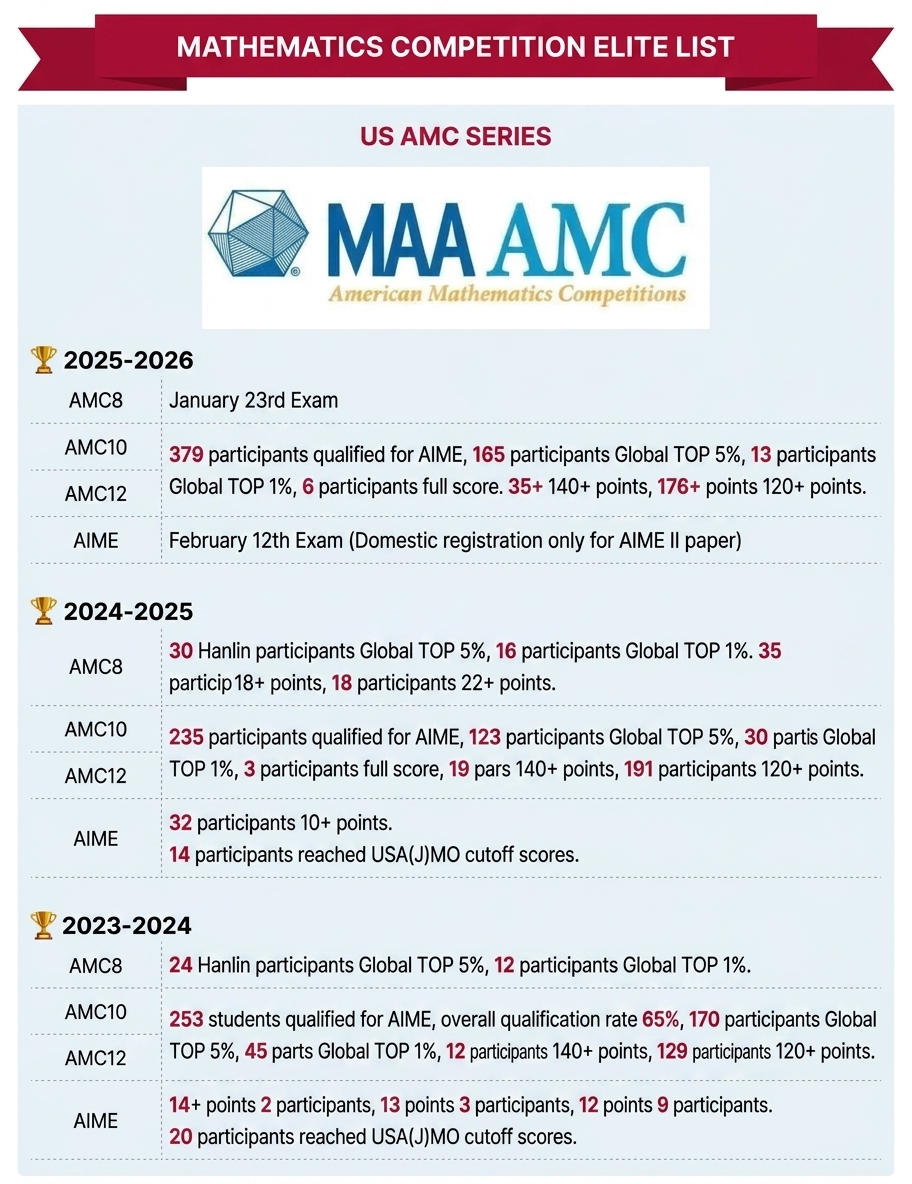
As can be seen from the table, the award score cutoffs have been steadily rising. In particular, the cutoff for the global top 1% increased from 21 points in 2023 to 23 points in 2025, reflecting the overall improvement in participants’ abilities and the increasing intensity of competition.
V. Preparation Strategy Recommendations
To prepare well for the AMC8, candidates need to develop a scientific preparation strategy.
1. Three‑Stage Preparation Path
Foundation Reconstruction Phase (3–6 months before the exam): Focus on integer operations, geometric properties, and basic probability. Complete 15 core module problems daily.
Specialized Breakthrough Phase (1–3 months before the exam): Practice with past exam papers from 2018–2025 by module. Maintain an error log to classify mistake types (conceptual gaps / reading errors / calculation errors).
Full‑Simulation Sprint Phase (1 month before the exam): Complete 2–3 timed mock exams per week, strictly simulating the test environment, and train the ability to solve basic problems in ≤10 seconds per question.
2. Golden Rules for Time Allocation
Questions 1–10: Limit to 8–10 minutes. Use the substitution of special values for ratio problems.
Questions 11–20: Allocate 15–20 minutes. Use case analysis and graphical aids.
Questions 21–25: Reserve 10–12 minutes. Prioritize problem types you can break through (e.g., using symmetry to simplify geometry optimization problems).
3. Targeted Breakthrough for High‑Difficulty Exam Points
For the dynamic analysis of 3D nets, use geometry software to develop spatial visualization skills.
For quadratic function modeling problems, master the basic characteristics of function graphs and their practical application scenarios.
For complex combinatorial counting problems, proficiently use case‑based thinking and enumeration techniques that avoid duplication and omission.
The AMC8 rewards strong real-world modeling ability alongside solid problem-solving skills. Early systematic training (recommended preparation period of ≥6 months) and precise strategies (such as good time allocation) are decisive factors in helping candidates break through their academic ceilings. We hope all participants will show their best form and achieve excellent results!
Students preparing for the competition can download the 2000–2025 AMC8 bilingual past papers + answer keys + formula collection + vocabulary list + preparation books + handouts for free.
AMC8 Preparation Courses
Our instructors are graduates from top global universities. With precise curriculum planning and comprehensive learning tracking, we ensure your score improvement and award-winning success!
| Class Type | Hours | Class Size | Start Date |
|---|---|---|---|
| Winter Break Class | 30H | 3–8 students | Consult teacher for details |
| Systematic Course | 20H | 1v1 / 3–8 students | Consult teacher for details |
| Problem-Solving Class | 20H | 1v1 / 3–8 students | Consult teacher for details |
Next steps
- AMC 8 past papers — the syllabus is easiest to absorb through real papers
- Registration channel — how to secure a seat for the coming sitting
- Sitting the AMC 8 in China — authorised centres and local logistics