I. Key Dates
| Item | Date |
|---|---|
| Registration Deadline | About 10 days before the exam each January |
| Admission Ticket Inquiry | In the week before the exam |
| Official Exam Date | A single 40-minute window in January (the next sitting is in January 2027) |
| Score Release | 2–4 weeks after the exam[reference:6] |
| Electronic Certificate Download | 6–8 weeks after the exam[reference:7] |
II. Exam Format & Eligibility
Target Participants: Students in grade 8 or below, not exceeding 15.5 years old on the day of the exam[reference:8]. The competition is open to students globally, with the China region including Hong Kong, Macau, and Taiwan[reference:9].
Exam Structure: 25 multiple-choice questions, 40 minutes, total score 25 points (1 point for each correct answer, no deduction for incorrect or unanswered questions)[reference:10][reference:11]. The test is bilingual (Chinese-English)[reference:12].
Test Format: In the China region the AMC8 is offered both online (home-based) and in-person (on-campus); candidates may choose either[reference:13][reference:14].
III. Registration Methods & Process
As of 2021, the China region no longer accepts individual registrations. Students must register through one of the following channels[reference:15]:
| Registration Channel | Eligibility | Key Steps & Notes |
|---|---|---|
| School Group Registration | Students whose school is an official AMC8 or ASDAN partner test center[reference:16] | Submit information to the school’s academic affairs office or competition teacher. The school handles the registration centrally[reference:17]. |
| ASDAN Mini-Program Self-Registration | Students whose school is a partner test center[reference:18][reference:19] | ① Search for “阿思丹国际理科测评” (ASDAN International STEM Assessment) on WeChat ② Register an account and complete mobile verification ③ Search for “美国数学测评(AMC8)” (American Mathematics Assessment AMC8) ④ Fill in student and family information ⑤ Upload a recent 1-inch ID photo ⑥ Pay the registration fee of 120 RMB[reference:20][reference:21] |
| Authorized Agency Registration | Students whose school is not a partner test center[reference:22][reference:23] | Submit materials (ID card or passport scan, grade certificate, photo) to an officially authorized agency. Deadlines are typically 1–2 weeks earlier than the official cutoff[reference:24]. Students should contact the agency in advance. |
IV. Syllabus Focus
The AMC8 syllabus emphasizes interdisciplinary application and logical reasoning[reference:26]. The four modules and their estimated percentages are as follows:
| Module | Proportion | Newly Added Topics & Changes |
|---|---|---|
| Algebra & Probability | 40%–45%[reference:27] | Newly added: Quadratic function modeling for real-world problems (e.g., carbon emission optimization); probability problems integrated with business scenarios[reference:28]. |
| Geometry | 25%–30%[reference:29] | Newly added: Dynamic analysis of 3D nets; integration of the Pythagorean theorem with building structure stability; increased complexity in calculating irregular shapes[reference:30]. |
| Number Theory & Combinatorics | 20%–25%[reference:31] | Newly added: Increased difficulty in prime factorization (quickly factoring four-digit numbers); application of geometric sequence summation formulas; combinatorial counting with multiple constraints[reference:32]. |
Scoring: The AMC8 is multiple-choice only. You earn 1 point for each correct answer and 0 for a wrong or blank answer, for a maximum of 25 points. There is no penalty for wrong answers, and solution steps are not graded.
V. Awards & Reference Score Cutoffs
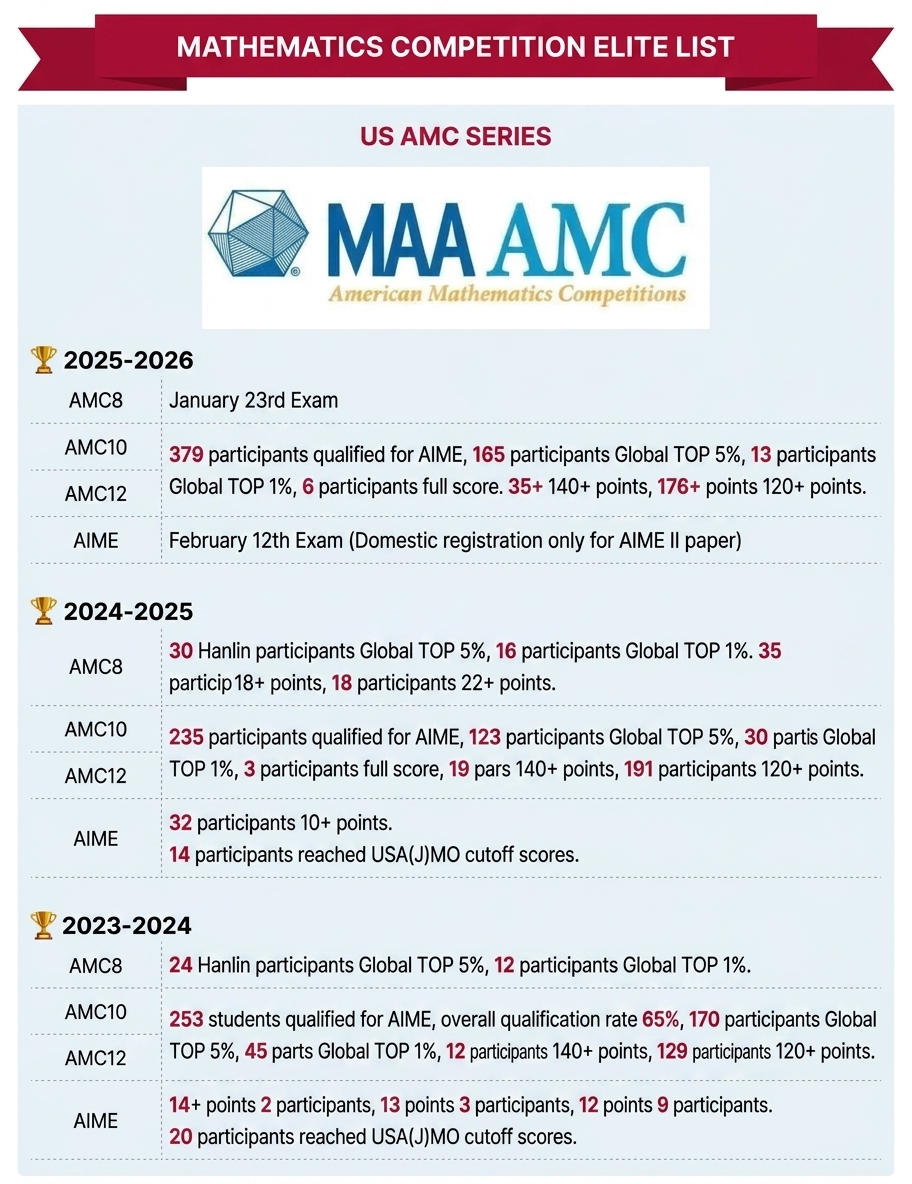
AMC8 features a multi-level awards system to recognize students at different levels[reference:34]:
| Award | Qualification Criteria | 2025 Reference Score |
|---|---|---|
| Perfect Score Award | Perfect score of 25 | 25 points[reference:35] |
| Distinguished Honor Roll (DHR) | Top 1% globally | 23 points[reference:36] |
| Honor Roll (HR) | Top 5% globally | 19 points[reference:37] |
| Achievement Roll (AR) | Grade 6 or below and score ≥ 15 | 15 points[reference:38] |
VI. Preparation Strategies & Timeline
1. Phased Preparation Plan
| Stage | Timeline | Core Tasks |
|---|---|---|
| Foundation Consolidation | 1–2 months before the exam | Systematically review the four modules, build a complete knowledge framework. Practice arithmetic daily (15–20 minutes) to strengthen calculation accuracy. Focus on past questions 1–15[reference:40][reference:41]. |
| Skill Enhancement | 1 month before the exam | Target weak areas; focus on high-frequency topics such as similar triangles, remainder problems, permutations and combinations. Practice one problem with multiple methods for questions 11–20. Maintain an error log categorized by “conceptual gap/reading error/calculation error”[reference:42][reference:43]. |
| Final Sprint | 2–3 weeks before the exam | Conduct 2–3 full-length mock exams per week, strictly simulating the real test environment. Master the golden rule of time allocation: 8 minutes for questions 1–10, 15 minutes for 11–20, 12 minutes for 21–25, and 5 minutes for review[reference:44][reference:45]. |
2. Recommended Time Allocation During the Exam
| Question Range | Difficulty Level | Recommended Time | Strategy |
|---|---|---|---|
| 1–10 | Basic | ≤ 8 minutes | High accuracy; avoid careless mistakes[reference:46] |
| 11–20 | Intermediate | 15 minutes | Use substitution with special values and elimination method[reference:47] |
| 21–25 | Difficult | ≥ 12 minutes | Prioritize combinatorics or geometry transformation problems; if stuck, guess rather than leave blank[reference:48] |
3. Common Mistakes to Avoid
Misreading the problem: Confusing “growth rate” with “growth amount,” or ignoring key qualifiers. Circle keywords while reading[reference:49].
Calculation errors: Skipping steps leading to sign errors or forgetting coefficients. Write intermediate steps separately[reference:50].
Fixed thinking patterns: Overlooking multiple possible configurations in geometry. Test with special values or dynamic visualization[reference:51].
AMC8 Preparation Courses
Our instructors are graduates from top global universities. With precise curriculum planning and comprehensive learning tracking, we ensure your score improvement and award-winning success!
| Class Type | Hours | Class Size | Start Date |
|---|---|---|---|
| Winter Break Class | 30H | 3–8 students | Consult teacher for details |
| Systematic Course | 20H | 1v1 / 3–8 students | Consult teacher for details |
| Problem-Solving Class | 20H | 1v1 / 3–8 students | Consult teacher for details |
Next steps
- Registration channel — how to actually secure a seat once you have the dates
- AMC 8 past papers — the free pack — papers, answer keys and solutions for many years
- Sitting the AMC 8 in China — authorised centres and what the process looks like locally