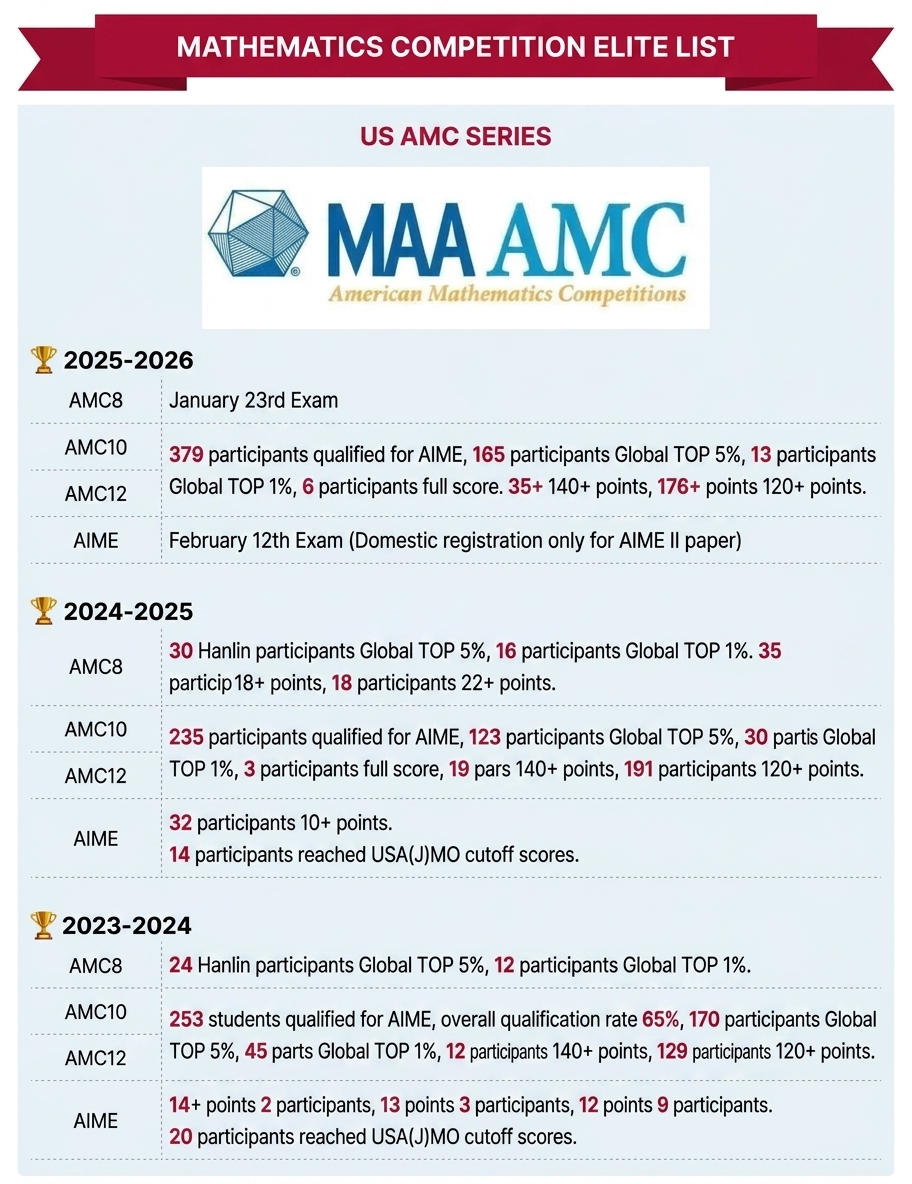
As one of the most influential secondary school math competitions globally, the AMC8 is not only a crucial benchmark for assessing students’ mathematical abilities but also the starting point of a top-tier academic pathway. In recent years the AMC8 has seen its question style evolve, with the syllabus trending toward integration and real-world application. This article provides a comprehensive analysis of the latest competition system and offers practical preparation strategies.
I. Key Dates
The AMC8 is held once a year in January, in a single 40-minute window; the next sitting takes place in January 2027. Registration closes a few weeks before the exam. Scores are typically released a few weeks after the exam, with certificates issued some weeks later. Confirm the exact dates and start time against the official schedule for the current season. Due to limited seating, it is recommended to complete registration as early as possible to avoid congestion near the deadline.
II. Registration Methods
Individual direct registration is not supported for the AMC8. Registration is mainly conducted through the following channels: school group registration (if your school is an official test center), registration through the ASDAN official platform, or proxy registration through officially authorized agencies. The registration fee is 120 RMB. Both an on-campus (offline) and a home-based (online) sitting are offered in the China region, and candidates may choose either.
III. Exam Format
The China region will simultaneously offer both online and offline testing formats, allowing candidates to choose flexibly based on their actual situation. This adjustment provides greater convenience for international school students, helping them coordinate their exam schedules. The exam duration remains 40 minutes, consisting of 25 multiple-choice questions. Scoring: 1 point for each correct answer, no deduction for incorrect answers, for a total score of 25 points. The exam uses bilingual (Chinese-English) test papers, making it suitable for students from different language backgrounds. It is important to note that electronic devices such as calculators and smartwatches are prohibited during the online exam; only basic stationery such as writing utensils and scratch paper are allowed.
IV. Exam Content and Key Difficulty Analysis
The AMC8 exam content has trended toward integration and innovation, placing greater emphasis on logical reasoning and practical problem-solving skills. The exam covers four core modules: Algebra, Geometry, Number Theory, and Combinatorics. The changes in each module are as follows:
Algebra remains the heaviest focus, with an increased emphasis on applied problems, such as dynamic probability calculations combined with supermarket promotion models and quadratic function modeling for carbon emission optimization. The geometry module is no longer limited to traditional plane geometry, introducing dynamic analysis of 3D nets and problems integrating the Pythagorean theorem with building structures, requiring stronger spatial visualization skills. Although Number Theory and Combinatorics account for a relatively smaller proportion, their difficulty has increased significantly, with deeper exploration of prime factorization and integer properties. Mastery of short division to quickly find the least common multiple (LCM) and greatest common divisor (GCD) is required. Additionally, new topics such as the sum of geometric sequences have been added, demanding stronger logical reasoning skills.
V. Scoring Rules
The AMC8 is multiple-choice only, so scoring is based solely on the answer chosen. You earn 1 point for each correct answer and 0 points for a wrong or blank answer, for a maximum of 25 points. There is no penalty for wrong answers, and solution steps are not graded. Because blank answers score the same as wrong ones, you should never leave a question blank — always make your best guess.
VI. Sample Problem Analysis
The following is a typical AMC8 problem from recent years, helping you understand the style and difficulty of the exam:
Problem: The octagram shown in the diagram below is a popular quilting pattern. What percentage of the entire 4×4 grid is covered by this star?
A) 40% B) 50% C) 60% D) 75% E) 80%
Analysis: This problem tests geometric intuition and the concept of percentages. The octagram is composed of four overlapping squares, each with a diagonal length half the side length of the grid. Calculation shows that the octagram covers 50% of the entire grid area, so the correct answer is B.
Another notable problem involves Ancient Egyptian hieroglyphs representing numbers:
Problem: The table below shows Ancient Egyptian hieroglyphs used to represent different numbers. For example, the number 32 is represented by three ten-character symbols and two unit symbols. What number does a specific combination of hieroglyphs represent?
Analysis: This problem combines mathematics with history and culture, testing students’ understanding of place value and logical reasoning. It requires understanding the value represented by different symbols and adding them together to obtain the final number. Such problems reflect the trend toward interdisciplinary integration in the AMC8.
VII. Preparation Strategy Guide
To prepare effectively for the AMC8, your study needs to be targeted. Here is a suggested three-phase preparation plan:
Foundation Building Phase (1-2 months before the exam): Systematically review the syllabus, build a complete knowledge framework, and focus on the four core modules: Algebra, Geometry, Number Theory, and Combinatorics. Engage in 15-20 minutes of daily speed calculation practice to strengthen calculation accuracy.
Skill Enhancement Phase (1 month before the exam): Target weak areas by module, focusing on high-frequency topics such as similar triangles, remainder problems, and permutations and combinations. Practice solving questions 11-20 using multiple methods to develop flexible thinking. Maintain an error log, record the causes of mistakes, and review them by category to avoid repeating errors.
Sprint Phase (2-3 weeks before the exam): Conduct 2-3 full-length mock exams per week, strictly controlling time. A reasonable time allocation strategy is: 8 minutes for the first 10 questions, 15 minutes for questions 11-20, and 12 minutes for questions 21-25. Flexibly use problem-solving techniques such as elimination, substitution, and special value methods to maximize your score.
VIII. Awards and Competitiveness Analysis
AMC8 awards are divided into four levels: The Perfect Score Award is given to students who achieve a perfect score of 25 points; the Distinguished Honor Roll (DHR) is awarded to the top 1% of participants globally; the Honor Roll (HR) is awarded to the top 5%; and the Achievement Roll (AR) is awarded to students in grade 6 or below who score 15 points or more. In recent years, the competition has become increasingly fierce. In 2025, the cutoff for the top 1% was 23 points, and for the top 5%, 19 points. For students in grades 3-5, a first-time target can be set at 15 points, and achieving the Global Honor Roll is a good result. For students in grades 6-8, the target can be set at the top 5% or top 1%, which generally requires a score of 17 points or above.
IX. Common Mistakes and Coping Strategies
In the AMC8 exam, students often lose points due to the following issues: inaccurate understanding of problem statements, especially for word problems with lengthy descriptions; careless calculations, particularly errors in intermediate steps of multi-step operations; and unreasonable time allocation, spending too much time on earlier questions, leading to rushed completion of later ones. To address these common mistakes, it is necessary to cultivate the habit of careful reading, circling keywords during problem analysis. Keep your scratch paper neat during calculations to facilitate checking. Develop your own time management strategy through mock exams; when encountering a difficult problem, mark it and move on, returning to it after completing all the questions.
The AMC8 is ultimately a systematic test of students’ comprehensive mathematical thinking and logical reasoning abilities. Only scientific planning and systematic preparation can help you stand out. We hope this analysis helps all test-takers fully understand the competition, develop effective preparation strategies, and achieve ideal results in the AMC8!
Students preparing for the competition can download free resources, including 2000-2025 AMC8 bilingual past papers, answer analyses, formula collections, vocabulary lists, preparation books, and handouts.
AMC8 Preparation Courses
Our instructors are graduates from top global universities. With precise curriculum planning and comprehensive learning tracking, we ensure your score improvement and award-winning success!
| Class Type | Hours | Class Size | Start Date |
|---|---|---|---|
| Winter Break Class | 30H | 3–8 students | Consult teacher for details |
| Systematic Course | 20H | 1v1 / 3–8 students | Consult teacher for details |
| Problem-Solving Class | 20H | 1v1 / 3–8 students | Consult teacher for details |