No calculator is allowed on the AMC 8 — basic writing materials such as pencils, blank scratch paper, and erasers (per maa.org). That makes calculator-free technique a scoring skill in its own right: mental-math fluency, estimation to eliminate, and plugging the answer choices back into the problem. This survival kit covers the concrete arithmetic craft that turns a no-calculator rule from a liability into a weapon — separate from learning the maths topics themselves.
Why calculator-free technique is a separate skill
Students often prepare for the AMC 8 by studying topics — number theory, geometry, counting — and assume the arithmetic will take care of itself. On a calculator-permitted test, it mostly would. On the AMC 8 it does not: the exam is 25 questions in 40 minutes with no calculator, so every multiplication, fraction, and percentage is done by hand or in your head. A student who knows exactly how to solve a problem can still lose the point to a slow or slipped hand-calculation, or run out of time because arithmetic ate the clock.
The good news is that the AMC 8 is designed to be calculator-free. Its problems are built so that clean numbers, cancellation, and clever reasoning — not brute-force computation — carry the solution. That means the calculator ban is not an obstacle bolted onto the maths; it is part of the maths. Training the technique below is therefore not a workaround. It is preparing for the exam as intended. Reconfirm the current materials policy, question count, and timing on maa.org, since the MAA sets and occasionally updates them.
| Permitted on the AMC 8 | Prohibited |
|---|---|
| Writing utensils (pens/pencils) | Calculators |
| Blank scratch paper | Smartwatches and phones |
| Rulers | Computing devices |
| Erasers | Compasses, protractors, graph paper |
The mental-math core: fluency that saves seconds
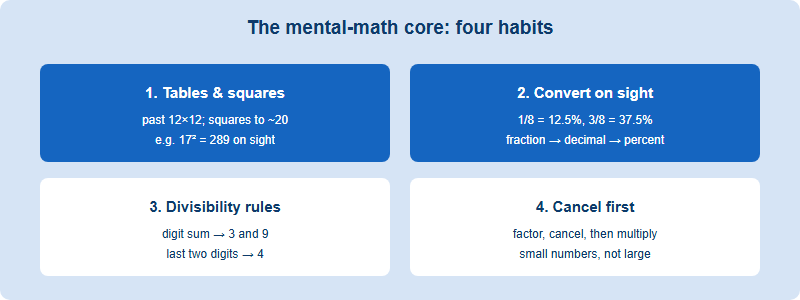
A handful of number facts and habits, made automatic, save seconds on nearly every question — and seconds compound across 25 problems. None of this is advanced; it is fluency, the arithmetic equivalent of touch-typing.
- Times tables past 12, and squares to ~20. Recognising 13×14, or knowing 17² = 289 instantly, removes a whole hand-calculation step. Squares show up constantly in area, distance, and counting problems.
- Fraction–decimal–percent conversions on sight. Know that 1/8 = 0.125 = 12.5%, 3/8 = 37.5%, 1/6 ≈ 16.7%, 2/3 ≈ 66.7%. Percentage and ratio questions collapse when you convert without scratch work.
- Divisibility rules. A number is divisible by 3 if its digit sum is; by 9 likewise; by 4 if its last two digits are; by 6 if it passes both 2 and 3. These turn number-theory and counting questions into quick mental checks.
- Cancel before you multiply. In any fraction expression, cancel common factors first so you multiply small numbers, not large ones. On a no-calculator test this is the single biggest time-saver — AMC 8 problems are engineered so things cancel neatly.
A worked flavour, without reproducing any exam question: to compute something like (24 × 35) / 42 by hand, do not multiply 24×35 = 840 and then divide. Cancel first — 42 = 6×7, and 35 = 5×7, so the 7s cancel; 24/6 = 4; you are left with 4×5 = 20. Two mental steps instead of a long-division. That habit — look for cancellation before computing — is the heartbeat of calculator-free AMC 8 arithmetic.
Estimation: eliminate before you compute
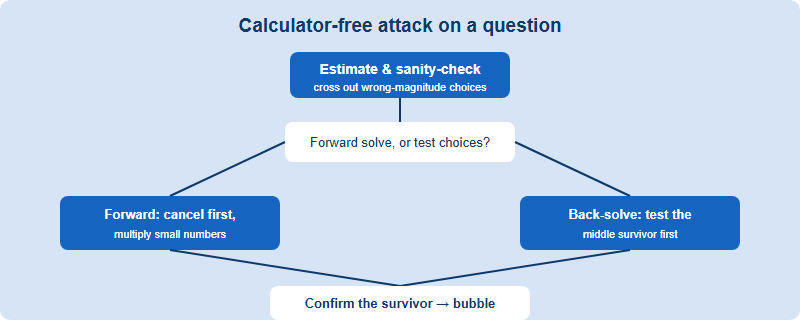
Because the AMC 8 is multiple choice with five options, you often do not need the exact value — you need the right choice. Estimation exploits that gap. By computing a rough answer, you can frequently rule out choices that are the wrong order of magnitude, off by a sign, or absurd for the situation, then confirm the survivor cheaply.
- Round to friendly numbers. Replace 197 with 200, 48 with 50, 6.9 with 7, get an approximate answer, and discard any option that is nowhere near it. On many questions this alone leaves one or two survivors.
- Sanity-check magnitude. If a question asks for a probability, the answer must sit between 0 and 1; if it asks for an average of numbers, the answer must lie between the smallest and largest. Choices violating these can be crossed out without any computation.
- Use estimation to raise guess odds. Even when you cannot finish, a rough estimate often eliminates two or three choices. Combined with the exam’s no-penalty scoring, that turns a blind 1-in-5 guess into a far better bet.
Estimation is not sloppiness; it is a deliberate first pass that narrows the field so your exact work — when you do it — is faster and more targeted. On a calculator-free test, spending ten seconds to eliminate three choices is often a better use of time than grinding a full exact computation you might slip on.
Plug in the answers: let the choices do the work
One of the most powerful calculator-free tactics is to work backward from the answer choices. If a question asks “which value satisfies this condition,” you can test the choices instead of solving forward — and testing is usually faster arithmetic than solving. Because the answers are given, the AMC 8’s format quietly hands you a shortcut on many problems.
- Back-solving. When choices are numbers and the question describes a condition, substitute a choice and check whether it works. Start with a middle value; the result tells you whether to try higher or lower, so you rarely test all five.
- Plugging in for variables. When a problem is stated abstractly (“for any number n…”) and the choices contain variables, pick a small, convenient value for the variable, compute the target, then see which choice matches. Choose numbers that avoid coincidences (not 0 or 1, which can make several choices agree).
- Eliminate impossible choices first. Before back-solving, cross out any option ruled out by parity, sign, or magnitude. Then you back-solve only the survivors.
These tactics matter more on a no-calculator test than they would with a calculator, because forward algebra can involve messy intermediate arithmetic, whereas checking a specific number is often clean. Knowing when to abandon the forward solution and test the choices instead is a mark of an exam-savvy AMC 8 student.
Training the technique (not just the topics)
Calculator-free skill is built by deliberate practice that specifically targets arithmetic and answer-choice tactics, separate from topic study. A first-party routine we use with China-based international-school students:
- Daily mental-math reps. A few minutes a day of times-table, square, and conversion drills, plus one page of by-hand fraction/percent computation. Fluency is a muscle; it responds to frequency more than intensity.
- Practice papers strictly calculator-free. If you rehearse with a calculator, you train a skill you cannot use on test day. Always time yourself and use only permitted materials — scratch paper, ruler, eraser.
- Review for the faster method, not just the right answer. After each problem, ask: could I have estimated to eliminate, or back-solved from the choices, or cancelled earlier? The point of review is upgrading your arithmetic route, since the exam rewards the efficient path.
- Keep an “arithmetic slip” log. Track where by-hand computation went wrong — a carried digit, a sign, a mis-cancelled factor. Patterns reveal the one or two habits worth drilling to stop leaking points you had otherwise earned.
To be clear about scope: this toolkit sharpens how you compute, not what maths you know. It sits alongside topic mastery — number theory, geometry, algebra, counting — not in place of it. But on a 40-minute, no-calculator paper, the difference between a student who cancels, estimates, and back-solves fluently and one who grinds every computation by hand is real, measurable points. Reconfirm the AMC 8’s current materials policy and format on maa.org before you sit, since the MAA is the authority on the rules.
Frequently asked questions
Is a calculator ever allowed on the AMC 8?
No. Per maa.org, basic writing materials such as pencils, blank scratch paper, and erasers are permitted; calculators, phones, smartwatches, compasses, protractors, and graph paper are prohibited. Confirm the current list before your sitting.
Do I really need mental-math drills if I know the topics?
Yes. On a no-calculator, 40-minute paper, slow or slipped by-hand arithmetic costs points and time even when your method is correct. Fluency and technique are a separate, trainable scoring skill.
What is “back-solving” on the AMC 8?
Testing the given answer choices in the problem instead of solving forward. Because the answers are provided, checking a number is often faster and cleaner by hand than forward algebra — start with a middle value.
How does estimation help if it is not exact?
The AMC 8 is multiple choice, so a rough estimate can eliminate choices of the wrong magnitude or sign, leaving one or two survivors to confirm — and it raises your odds when you must guess.
For the scoring logic behind “always guess the survivors” and a difficulty-ramp target map, see our companion guides on the AMC 8 resource hub, and confirm the current materials policy on the official AMC pages at maa.org.
This is an independent guide operated by Hanlin Education for China-based international-school students. It is not affiliated with, endorsed by, or sponsored by the Mathematical Association of America (MAA). The AMC 8’s materials policy, format, and rules are determined by the MAA — always confirm current details on maa.org and your registration page. Any error will be corrected within 7 working days.