You beat it by realizing the barrier is small and specific: roughly a few dozen technical terms and a handful of phrasing traps, not English fluency in general. Students who read novels in Chinese and chat in English at school still misread “at least,” “distinct,” or “consecutive” under a 40-minute clock — and pick the distractor answer built for exactly that misreading. This guide isolates the vocabulary that actually costs points and gives you a reading protocol that fits the AMC 8’s time budget.
Why language costs points even for fluent students
The AMC 8, run by the Mathematical Association of America (MAA), is 25 multiple-choice questions in 40 minutes, taken in person with no calculator (current rules and dates on maa.org). That works out to about 96 seconds per question — and on a wordy problem, half of that can disappear into reading. With in-person January sittings, expect the paper in English with no translation aids at your desk and no pausing the clock — confirm the language and permitted-materials policy with your test centre and on maa.org. In the room it is you, the English text, and a pencil. If your family is still sorting out where and how to sit the exam, start with our guide to the in-person AMC 8 and China registration.
Here is the key insight from working with bilingual students: their errors cluster. They rarely misunderstand the story (“Maria has some stickers…”). They misread quantifiers and qualifiers — the short, boring words that carry the precise mathematical condition. In Chinese math classes, 至少 (at least) and 恰好 (exactly) are visually distinct and drilled from primary school; in English, “at least,” “at most,” “more than,” and “no more than” look similar at reading speed, and each one changes the answer. Multiple-choice answer sets are typically written so that the misreading produces one of the wrong options. That is why the language barrier converts directly into lost points instead of just lost time.
The vocabulary core: the words that actually appear
You do not need a 500-word academic glossary. The high-frequency technical vocabulary of middle-school competition math is compact. Learn the terms below to reflex level — meaning you translate them into a mathematical condition without consciously thinking — and the reading barrier mostly disappears.
| English term | Precise meaning | Common misreading by bilingual students |
|---|---|---|
| at least / at most | ≥ / ≤ (boundary value included) | Treating the boundary as excluded, or swapping the two |
| more than / fewer than | > / < (boundary excluded) | Confusing with at least / at most |
| consecutive | Following in order without gaps (7, 8, 9) | Reading it as merely “several” |
| distinct | All different from each other | Skipping it entirely, allowing repeats |
| integer / digit | Whole number / single symbol 0–9 | Treating “digit” as “number,” breaking digit problems |
| remainder / quotient | Leftover after division / result of division | Swapping the two roles |
| factor / multiple | Divides into it / is divided by it | Reversing direction (a classic 因数/倍数 mix-up) |
| sum / difference / product | Result of + / − / × | Reading “product” as a physical object in the story |
| mean / median / mode | Average / middle value / most frequent | Defaulting everything to “average” |
| respectively | In the same order as listed | Pairing values with the wrong people or objects |
| in terms of | Expressed using that variable | Hunting for a numeric answer that doesn’t exist |
Two habits make this table stick. First, keep a one-page glossary in your error log: every time phrasing (not math) causes a wrong answer, write the sentence, the term, and the correct reading. Most students discover they recycle the same four or five misreadings. Second, when you review a practice problem, say the condition aloud in Chinese and English — “distinct positive integers, 互不相同的正整数” — so the reflex forms in both directions.
Anatomy of an AMC 8 word problem
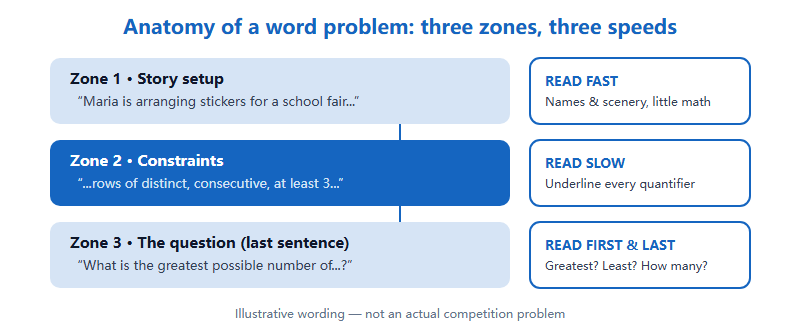
Nearly every word problem has the same three-part skeleton, and knowing it changes how you read. The story setup carries almost no mathematical weight. The constraints — usually mid-paragraph — carry all of it. And the actual question is almost always the final sentence. Weak readers give every sentence equal attention; strong readers skim the setup, slow down hard on constraints, and anchor on the last sentence first.
The three-pass protocol: reading that fits 96 seconds
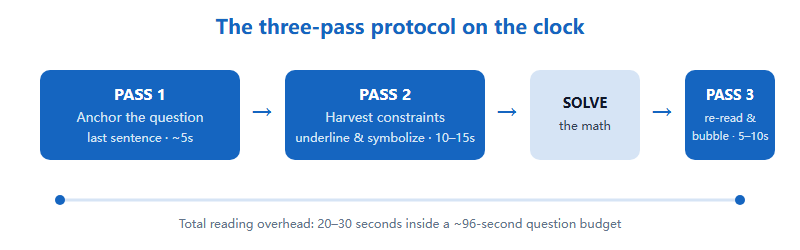
Under time pressure, “read carefully” is useless advice — you need a procedure. This three-pass protocol takes 20–30 seconds on a typical problem and prevents the two most expensive errors: answering the wrong question, and dropping a constraint.
- Pass 1 — Anchor the question (5 seconds). Jump to the last sentence first. Circle the question type: greatest? least? how many? which cannot? This tells you what every other sentence is for.
- Pass 2 — Harvest constraints (10–15 seconds). Read from the top, underlining every quantifier and technical term: each “distinct,” “consecutive,” “at least,” “整数-type” condition. Convert them to symbols in the margin as you go: “≥ 3,” “all different,” “7, 8, 9-style run.”
- Pass 3 — Sanity re-read (5–10 seconds, after solving). Before bubbling, re-read only the last sentence and your underlines. Did they ask for the number of students or the number of groups? Units and objects switch in the final sentence more often than students expect.
Pass 3 feels skippable and is not. In our experience reviewing bilingual students’ practice papers, a meaningful share of wrong answers come from problems the student solved correctly — then answered a slightly different question. Thirty seconds of re-reading across the whole paper routinely buys back several points, which on a 25-point scale is a large move.
Training the reflex without adding study hours
Language reflexes build through repetition inside math practice, not through separate English lessons. Three low-cost adjustments:
- Do all practice in English from day one. Students who prep from Chinese-language materials and switch to English papers in December pay the translation tax at the worst possible moment. Past AMC 8 problems are the natural training text — every practice session is also vocabulary exposure.
- Read constraints aloud during review. Speaking “at LEAST three” with stress on the quantifier builds auditory memory that survives exam stress better than silent reading.
- Build a personal trap list. After each timed set, sort your errors: math error, speed error, or reading error. Most bilingual students find reading errors are 20–30% of their misses at first — and the single fastest category to eliminate.
One more exam-day note: because the AMC 8 is now sat in person at authorized centers during a January window, dictionaries, phones, and any translation aid are out of the picture; only materials the rules permit go to your desk (check current policy on maa.org). The reading skill has to live in your head before you walk in — logistics for getting a seat are covered in our China-based registration walkthrough.
FAQ
My child is fluent in English. Can we skip this?
Check the data first: sort three practice papers of errors into math vs reading causes. Fluent conversational English often coexists with slow or imprecise technical reading under time pressure.
Should we prep with Chinese-language materials first?
Concepts can be learned in any language, but do problem practice in English from the start. Switching languages late means paying the translation tax during the exam itself.
How long does it take to close the language gap?
For most students, a few weeks of English-only practice plus a personal trap list eliminates the bulk of reading errors — it is usually the fastest-improving error category.
Are dictionaries allowed in the exam room?
Assume no translation aids of any kind and prepare accordingly; the exam is administered in person under MAA rules. Confirm the current permitted-materials policy on maa.org before exam day.
This article is an independent guide operated by Hanlin Education for China-based international-school students. We are not affiliated with, endorsed by, or sponsored by the Mathematical Association of America (MAA). Competition dates, rules, and registration details change; always confirm current information on maa.org. If you spot an error, we will correct it within 7 working days.