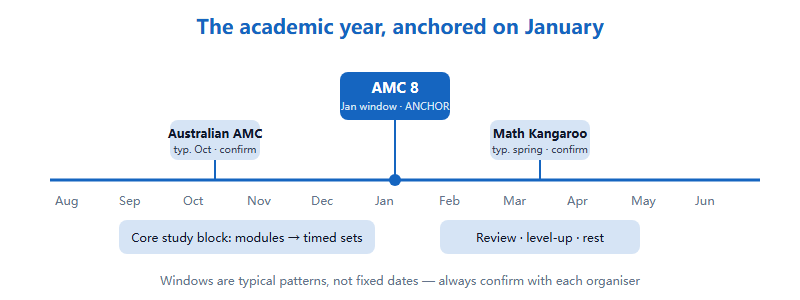
Anchor the year on the AMC 8’s January in-person window, then place at most one or two supporting contests around it — one in autumn for match practice, optionally one in spring for momentum — and leave the rest of the calendar for actual learning. That is the whole strategy. Most planning mistakes we see from China-based families are not choosing the wrong contest; they are stacking too many, so every month becomes exam month and no month is study month.
Why the AMC 8 is the natural anchor
For a student in grade 8 or below at an international school in China, the AMC 8 — run by the Mathematical Association of America (MAA) — is usually the most consequential contest of the year: it is the entry tier of the AMC ladder that later leads to AMC 10/12, it is widely recognized by schools, and its 25-question, 40-minute, no-calculator format is a meaningful but achievable stretch. It is also now an in-person exam sat during a January window at authorized centers, which means seats and registration deadlines are real constraints — our 2026–27 guide to finding a center and registering from China covers that process, and the authoritative calendar is always maa.org.
An anchor contest does three jobs: it sets the deadline your study plan counts back from, it defines the syllabus your weekly practice serves, and it is the result you actually care about. Everything else on the calendar must justify itself relative to the anchor — either it rehearses skills the AMC 8 needs, or it belongs to a different goal and a different year.
The contest year at a glance
Here is how the major options available to China-based international-school students spread across an academic year. Dates shift from cycle to cycle and differ by region, so treat the windows below as typical patterns and confirm every date with the organiser before planning around it. Note also that three similarly named competitions are entirely different events run by different organisations: the American AMC 8 (MAA, USA), the Australian AMC (AMT, Australia — offered in China through ASDAN), and the AMO (SIMCC, Singapore). Same letters, different exams.
| Contest | Organiser | Typical window for China-based students | Role in an AMC 8 year |
|---|---|---|---|
| Australian AMC | AMT (Australia), via ASDAN in China | Autumn — recent China sittings have been in October; confirm with ASDAN | Autumn match practice; friendly multiple-choice format, broad grade bands |
| AMC 10 (for students beyond grade 8) | MAA (USA) | November; confirm on maa.org | Not for AMC 8-age students — relevant only after moving up the ladder |
| AMC 8 (anchor) | MAA (USA) | January in-person window; confirm on maa.org | The main event — everything counts back from here |
| Math Kangaroo | AKSF and national partners | Typically spring; confirm with the local organiser | Optional post-AMC 8 momentum keeper, lighter and puzzle-flavoured |
| Math League rounds | Math League (USA) | Multiple rounds across the year; confirm with the organiser | Optional low-stakes practice; pick rounds that don’t crowd December–January |
The stacking rules: how many contests is too many
Contests are assessments, not training. Every contest week costs you the week before (tapering, logistics) and often the week after (recovery, review). Stack four or five contests into a school year and you have quietly converted two months of potential study time into exam administration. Our working rules:
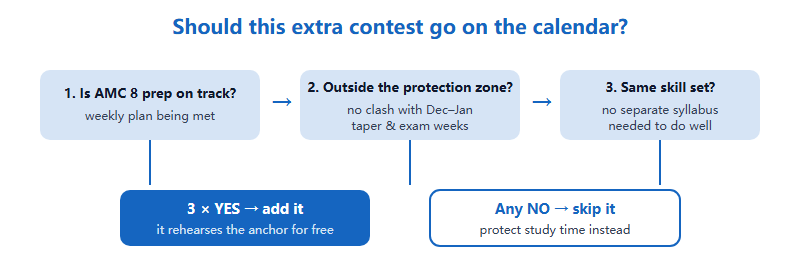
- Rule 1 — One anchor per year. For grade 8-and-below students on the American ladder, that is the AMC 8. Its January window gets absolute calendar priority: register early, protect the two weeks before it, and schedule nothing else within a month of it.
- Rule 2 — At most one autumn rehearsal. An October-window contest such as the Australian AMC gives genuine exam-room practice — bubbling under time, sitting with strangers, managing nerves — about three months before the anchor. One rehearsal captures nearly all of that benefit; two captures almost nothing more.
- Rule 3 — Spring is optional and mood-based. After January results, a lighter spring contest can keep momentum for students who are hungry for more. For students who are tired, skipping it and starting next year’s material is the better investment. Neither choice needs justifying.
- Rule 4 — Never let a side contest reshape the syllabus. If preparing for a supporting contest means studying topics the AMC 8 doesn’t reward, during AMC 8 season, the supporting contest is costing more than it gives. Enter it on AMC 8 training, or don’t enter it.
Two sample years: grade 6 vs grade 8
A grade 6 student (first serious year). August–September: build fundamentals, no contests. October: optionally sit the Australian AMC window purely for exam-room experience — the score matters far less than the rehearsal. November–December: weekly timed AMC 8 sets, register and confirm the January seat early. January: AMC 8. February onward: review errors, then either Math Kangaroo in spring for fun or straight into next-level material. A grade 6 student can sit the AMC 8 again in grades 7 and 8, so this year is about building the machine, not maximizing the number.
A grade 8 student (final eligible year). The calculus changes: this is the last AMC 8, and the AMC 10 becomes relevant the following November. Autumn: skip or minimize side contests — every week from September serves the January anchor. January: AMC 8, final attempt. February–June: begin bridging toward AMC 10 content at a sustainable pace. The transition itself is a topic for another day, but the calendar principle holds: finish one anchor before adopting the next.
Either way, the single most time-sensitive item on the whole calendar is not a study task — it is securing the January seat. Centers confirm capacity on their own schedules, and the registration window closes before exam week. If you haven’t started, our in-person AMC 8 registration walkthrough for China-based families is the place to begin.
What not to do
Three patterns we consistently see backfire. Contest hopping: entering every competition a school circulates, so the student is permanently tapering or recovering and never deeply studying. Trophy arithmetic: choosing contests by how impressive the certificate sounds rather than by what the preparation builds — admissions readers care about sustained mathematical growth, and no single certificate guarantees anything. Name confusion: assuming the Australian AMC or the Singapore-run AMO is “the same AMC” and that awards transfer between ladders — they are separate competitions run by separate organisations, and each should be entered on its own merits, deliberately rather than accidentally.
FAQ
How many math contests per year is reasonable?
For most grade 4–8 students: one anchor (AMC 8) plus at most one autumn rehearsal, with a spring contest optional. Two to three sittings a year; the rest is study time.
Does the Australian AMC help AMC 8 preparation?
As exam-room rehearsal, yes — timed multiple-choice practice three months before the anchor. It is a different competition by a different organiser (AMT), so treat it as practice, not a substitute.
When should we book the AMC 8 seat?
As early as your chosen authorized center allows. It is an in-person January exam and center capacity is finite; confirm the current cycle’s deadlines on maa.org and with your center.
Should a grade 8 student also plan for AMC 10 in the same year?
Plan the transition, but sequentially: the January AMC 8 first, then bridge toward AMC 10 content from spring. Preparing both simultaneously in autumn splits focus at the worst time.
This article is an independent guide operated by Hanlin Education for China-based international-school students. We are not affiliated with, endorsed by, or sponsored by the Mathematical Association of America (MAA). Competition dates, rules, and registration details change; always confirm current information on maa.org. If you spot an error, we will correct it within 7 working days.