Most AMC 8 entry problems are not about which route you use. They are about five pieces of data — legal name, date of birth, grade, school status and results contact — being wrong or inconsistent at the moment they are submitted. This page is the sheet to fill in before you start, the deadline stack to work backwards from, and the audit to run on your confirmation while there is still time to fix it.
Why a data error is a different class of problem from a wrong answer
A misread question costs one point out of 25. A date of birth typed with the month and day transposed, or a name recorded in an order that does not match the identity document a student brings to the door, is not a point — it is a query that has to be resolved by somebody, sometimes on the morning of the exam, sometimes not at all. The awkward part is timing: registration data is supplied months before anyone looks at it closely, and the moment you most want to change it is usually after the window to change it has shut.
So the sequence that works is: assemble the data first, register second, audit the confirmation third, and do the audit early enough that a correction is still administratively possible. That last clause is the whole point of this page.
The data sheet: five fields, and what each one must match
Fill this in on paper before you open any registration form. Every field has an external source of truth, and the job is to copy from that source rather than from memory.
| Field | What it must match | What goes wrong | Why it matters later |
|---|---|---|---|
| Legal name | The identity document the student will carry on the day, character for character, in the same order | Given name and family name swapped; an English name used at school that does not appear on the passport; inconsistent romanisation | Certificates and results print from this record, and door checks compare it against the document |
| Date of birth | The identity document, digit for digit | Day and month transposed between DD/MM and MM/DD conventions — in our own handling the most common silent error | The AMC 8 eligibility test has an age condition attached to it, so this field is not cosmetic |
| Current grade | The grade the student is actually enrolled in during this school year | Guessing an equivalence between a local year group and a US grade; entering next year’s grade | The AMC 8 is for grade 8 and below, and some recognition is reported by grade band |
| School or independent status | Whether the school itself registers students, and if not, which arrangement applies to you | Assuming the school will handle it and discovering in January that it does not | It determines which deadline you are actually working to — and they are not the same date |
| Results contact | An email address and phone number someone will genuinely monitor after the exam | A student’s school address that expires, or a parent address nobody checks | Score reports and any query about your entry arrive here, weeks after everyone has stopped thinking about it |
Two notes on the eligibility-linked fields. The grade condition is straightforward: the AMC 8 is designed for students in grade 8 and below. There is also an age condition attached to competition day, and the exact wording of that condition is the kind of detail that is revised between cycles — check the current text on maa.org and with your centre rather than relying on a figure you read anywhere, including here. What matters for this page is narrower and safer: whatever the rule says, it is evaluated against the date of birth in your registration record, so that field has to be right.
The deadline stack: work backwards from the sitting day
The MAA publishes a competition window in January and each authorised centre selects its own day inside that window, which is why there is no single national date to plan against. Confirm the window on maa.org; then get your specific day and cut-off from the centre you are actually entering through.
For the 2027 cycle, the following is China test-centre information supplied to us in an operator briefing, not an MAA announcement, and it applies to that centre rather than to the competition globally: the China sitting is 22 January 2027, the centre’s registration closes on 12 January 2027, the entry fee is RMB 120 per entry, and papers are provided bilingually in Chinese and English. Reconfirm all four with the centre before you rely on them.
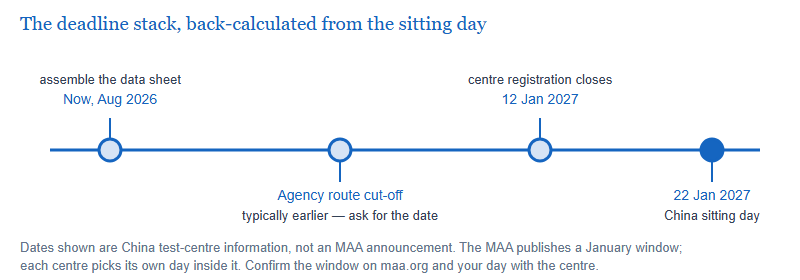
The structural point worth absorbing is that the entry route you use determines which of these dates binds you. Where a partner school registers its students centrally, the school’s internal collection date is your real deadline. Where entry runs through the ASDAN mini-programme and your school is an ASDAN partner, the programme’s process sets it. Where an agency registers an independent candidate, the agency’s cut-off is typically earlier than the centre’s official close, because the agency has to batch and submit before that close. In all three cases the date you should write on your calendar is the earliest one in your chain, not 12 January. The mechanics of finding and choosing a centre in the first place are covered in our guide to the in-person January AMC 8 for China-based families.
The seven-point confirmation audit
Run this within 48 hours of registering, while the person who submitted it still remembers what they typed, and run it a second time in the first week of January. Both passes need to land before your chain’s cut-off, because a correction requested afterwards may simply be too late to process.
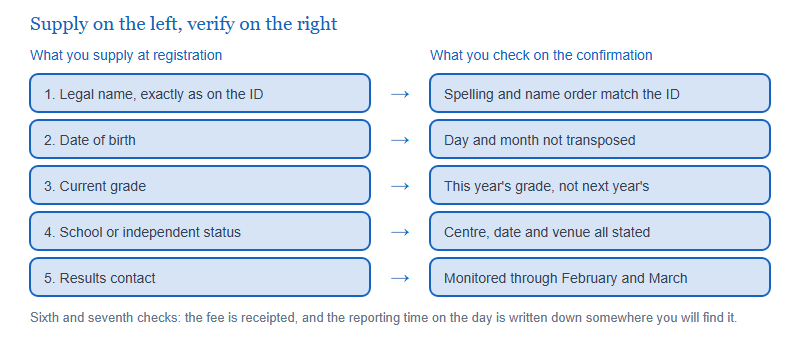
- Name. Read it against the identity document, not against your own expectation of how it is spelled.
- Date of birth. Read the digits aloud. Transposition errors are invisible when you skim.
- Grade. The grade the student is in now, for this school year.
- Centre, date and venue. Confirm the specific day — the competition runs to a window, so “January” is not an answer.
- Fee receipted. Keep proof of payment with the confirmation, in one place.
- Reporting time. Not the start time — the time you are expected to arrive, which is earlier.
- Results contact. Send a test email to the address on the record and confirm it arrives.
The three fields that go wrong most often in our own handling
From our own registration handling for China-based families — our observation, not published data, and other registration channels will see a different mix — three fields account for most of the corrections we end up making.
- Name order. Bilingual families routinely hold documents that present the family name first and school records that present it last. Whichever the identity document says is the one that goes in the form.
- Date of birth format. A student born on 3 August can appear as 03/08 or 08/03 depending on who typed it. This is the error most likely to survive all the way to the door, because nobody re-reads a number that looks plausible.
- Grade, entered aspirationally. Families sometimes enter the grade the student is moving into, especially when registering late in a calendar year. Enter the grade of enrolment at the time of the competition.
There is a second reason the grade field deserves care. Recognition on the AMC 8 is reported partly by grade band, so a mis-declared grade can put a student in the wrong comparison group. Our operator briefing describes the recognition structure as a perfect-score award, a global Distinguished Honor Roll at roughly the top 1% of scorers, an Honor Roll at roughly the top 5%, and a separate achievement award for students in grade 6 and below who reach a set score. The briefing also attaches typical correct-answer figures to those bands — in practice around 21 correct for the Distinguished Honor Roll, around 17 for the Honor Roll, and 15 or more for the grade 6 and below award. Treat those as typical observed figures rather than fixed thresholds: the tiers are percentile-based and move with the field each year, and the MAA is the authority on the current criteria. Confirm them on maa.org.
What you control, what the centre controls, what the MAA controls
Knowing which layer owns a decision saves a great deal of pointless emailing in January.
| Owned by | Decisions | What to do about it |
|---|---|---|
| You | Accuracy of all five data fields; which route you enter through; how early you register; whether you run the audit | This is the whole of your leverage — use it early, because it expires at your chain’s cut-off |
| Your centre | The sitting day inside the window; the registration close; the fee; venue and reporting time; whether corrections can still be processed | Ask directly and in writing. Do not infer a centre’s date from another centre’s date |
| The MAA | The competition window; eligibility rules; the paper; scoring; recognition criteria | Confirm on maa.org. Nothing at this layer is negotiable through a centre |
Two things sit at the MAA layer and are worth stating plainly because families sometimes plan as though they were adjustable. The format is fixed: 25 questions, 40 minutes, no calculator, one mark per question for a total out of 25. And the competition is sat in person on a day inside the published January window — a centre can tell you which day it has chosen, but it cannot move you outside that window. Our guide to the in-person January sitting sets out what that constraint means in practice for families weighing up one centre against another.
Frequently asked questions
Which deadline actually applies to me?
The earliest one in your chain. If a school or agency submits for you, their internal cut-off binds you, not the published close.
Can I correct my name or date of birth after registering?
Ask your centre immediately. Corrections are generally easier before registration closes and may not be possible afterwards.
Does the grade I enter affect my recognition?
It can. Some recognition is reported by grade band, so enter the grade of enrolment at the time of the competition. Confirm criteria on maa.org.
Is the paper in English only?
Our China test-centre information says papers are provided bilingually in Chinese and English. Confirm this with your own centre before the day.
This is an independent guide operated by Hanlin Education for China-based international-school students. We are not affiliated with, endorsed by, or sponsored by the Mathematical Association of America (MAA). Dates, fees and entry arrangements described above are China test-centre information rather than MAA announcements, and eligibility, recognition criteria and competition rules change between cycles — confirm all current details on maa.org and with your test centre before acting. Any error brought to our attention is corrected within 7 working days.