Per China test-centre information, the January sitting uses a bilingual Chinese–English paper. Two languages help — but only if you decide in advance which column you read first. This page gives the two-column reading protocol, a fourteen-row table of the classroom conventions that quietly flip between your two languages, and a pre-flight check to run in the week before the exam.
What a bilingual paper changes — and what it does not
A bilingual paper removes one problem and introduces another. It removes the situation where a student loses a question purely because a word like consecutive or remainder did not resolve fast enough. It introduces the situation where a student reads a question in one language, solves it using habits learned in the other, and answers a slightly different question from the one printed.
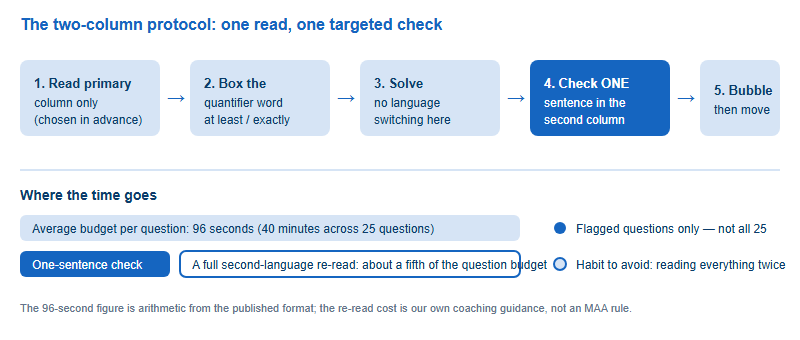
Nothing about the mathematics changes. The exam is still 25 questions in 40 minutes, one mark per correct answer, no calculator, sat in person. That works out at an average of 96 seconds per question, and a full re-read of the second column is not free inside that budget. So the protocol below is not “read both”. It is “read one, and check one sentence in the other”.
On dates, keep two facts separate rather than letting one correct the other. The MAA publishes the competition window on maa.org; individual centres schedule their own sitting inside that window. Per China test-centre information for the coming season, the sitting is 22 January 2027, with centre registration closing on 12 January 2027 at RMB 120 per entry, and papers supplied in Chinese and English. Confirm the window on maa.org, and the day, price and paper format with your own centre — our guide to the in-person January AMC 8 for China-based families sets out how the entry routes differ.
The protocol: one primary column, one verification sentence
Five rules. Decide them now, not on the morning of the exam.
- Rule 1 — pick a primary column and do not switch mid-paper. Choose the language you do mathematics in, which is not always the language you speak most. A student who has done three years of IB MYP or IGCSE mathematics in English usually thinks in English notation even at home; a student who moved into the international system last year usually does not.
- Rule 2 — answer choices are read in symbols first. Numbers, fractions and expressions are language-neutral. Read them as printed. Only the words inside a choice — a unit, or an option such as “none of these” — need a language decision.
- Rule 3 — the second column is for the constraint sentence only. Almost every AMC 8 word problem has one sentence carrying the constraint: at least, exactly, distinct, positive, different, consecutive. That single sentence is worth a cross-check. The story sentences are not.
- Rule 4 — budget the check. A targeted one-sentence cross-check costs a few seconds. A full second-language re-read is closer to fifteen or twenty, which is a fifth of your average question. Spend it on questions you have flagged, not on all 25.
- Rule 5 — if the two columns read differently to you, stop adjudicating. Work from your primary column, mark the question, and return to it at the end if time allows. The exam does not award marks for deciding which rendering you prefer, and the clock does not pause while you decide.
Which column should be primary for which question? Use this as the default and override it only with a reason.
| Question type | Primary column | Cross-check trigger | Why |
|---|---|---|---|
| Pure computation (no story) | Either — read the symbols | None | Almost nothing is language-carried; a check wastes seconds |
| Word problem with a story | Your chosen primary | Only if your answer is also the answer to a plausible misreading | The story is padding; the constraint is one sentence |
| Geometry with a figure | The figure first, then primary column | Any stated property you cannot see in the figure | The figure is language-neutral; the given properties are not |
| Counting with distinct / at least | Your chosen primary | Always — the highest-value check on the paper | One quantifier changes the entire count |
| Data display (chart, table) | Read the axis and the key first | The key line or the unit line | Units and scale factors are where the marks move |
| Probability | Your chosen primary | Whether replacement or order is specified | Two words decide which of two counts you run |
The fourteen convention flips
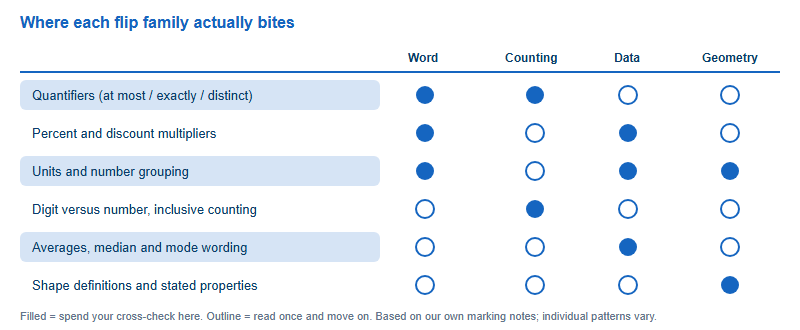
These are not translation errors. They are places where the habit you learned in a Chinese-medium classroom and the habit you learned in an English-medium one point in different directions — so the same sentence lands differently depending on which set of reflexes is switched on. The right-hand column is the physical action: something you write on the paper so that the flip cannot survive as far as your answer.
| # | Where it flips | The two habits | Write this down |
|---|---|---|---|
| 1 | Natural numbers | Mainland classrooms treat 0 as a natural number; several other systems do not | Convert the phrase to a symbol the moment you read it: ≥ 1 or ≥ 0, taken from what the question states. Never import your default |
| 2 | Discounts | “打八折” names what you pay (80%); “20% off” names what you save. Same result, opposite number spoken | Write the multiplier: × 0.8 |
| 3 | Successive percentage change | Both systems teach it; students in both still add the percentages | Chain multipliers: ×1.2 ×0.8, never +20% − 20% |
| 4 | Number grouping | 万 is 10 000 and 亿 is 100 000 000; English groups digits in threes, and “billion” is 1 000 000 000 | Rewrite the number in plain digits before any arithmetic |
| 5 | Digit versus number | “A two-digit number” has two digits and one value. Under time pressure students substitute one for the other | Underline the word digit every time it appears |
| 6 | Median with an even count | Learned as “the middle one” in either language; the even case needs the average of the two middle values | Write the ordered list before you point at anything |
| 7 | Mode | A data set can have no mode, one mode, or several | Count frequencies; do not assume a single winner |
| 8 | Average speed | Total distance over total time — not the mean of two speeds, in any language | Recover total distance and total time first |
| 9 | Quantifiers | at most, at least, exactly, distinct, different, consecutive | Draw a box round the word before solving |
| 10 | Inclusive counting | “From 3 to 17 inclusive” is 15 numbers, not 14 | Use end − start + 1, written out |
| 11 | Customary units | An American contest may use inches, feet, yards, miles, pounds or ounces alongside metric names | Learn the small set (12 inches = 1 foot, 3 feet = 1 yard) and convert to one unit before computing |
| 12 | Clock time | a.m./p.m. and phrases such as “quarter past” against a 24-hour habit | Convert to minutes after midnight |
| 13 | Probability format | One habit answers in fractions, the other reaches for percentages | Keep fractions in lowest terms and match the form of the answer choices |
| 14 | Shape definitions | Textbook definitions of quadrilateral families differ between curricula, and between English-language textbooks | Mark the properties the question actually states on the figure, and reason only from those |
The pre-flight: twelve things to settle before exam week
Work down this list once, in one sitting, and then again in the final week. It is a checklist, not reading.
- □ I have chosen my primary column and written it at the top of my last three practice papers.
- □ I have done at least one full timed paper reading only my primary column.
- □ I have done at least one full timed paper reading only the other column, so I know what it costs me.
- □ I box quantifier words automatically, without being reminded.
- □ I write a multiplier (× 0.8) rather than a percentage phrase, every time.
- □ I can convert 12 inches, 3 feet and one yard without stopping to think.
- □ I rewrite 万 and 亿 quantities in plain digits before computing.
- □ I write the ordered list before finding any median.
- □ I check whether a counting question says distinct.
- □ I know my cross-check is one sentence, not one problem.
- □ I have a flag mark for “come back to this” that I can see at a glance.
- □ I have confirmed the paper format and the exam day with my centre, and the window on maa.org.
If you are still choosing a centre or an entry route, settle that before fine-tuning reading habits — the in-person January guide covers the routes and what each one asks of the family.
Fifteen minutes a week, without adding any mathematics
This is language training, so it does not compete with topic work. Three drills, five minutes each.
- The stem sprint. Take five question stems from any past paper. Rewrite each in the other language, in one line, keeping only the constraint. Then check: did the constraint survive? In our own marking, students lose exactly and distinct far more often than they lose the numbers.
- The multiplier card. Write ten discount and increase phrases — half in each language — and convert each to a single multiplier. No arithmetic beyond that. The aim is that “pay 80%” and “20% off” produce the same pen stroke.
- The quantifier hunt. On any set of ten problems, do not solve. Box the quantifier in each and write, in three words, what it forbids. This is the cheapest habit on this page.
One honest observation from our own marking, offered as a pattern rather than a statistic: among the errors that survive a student’s own checking all the way to a final answer, quantifier and unit errors are more common than arithmetic errors. Arithmetic slips get caught by the student, because the numbers stop agreeing. Misread constraints do not, because the working is internally consistent — it is simply the working for a different question. Individual results vary, and the fix is procedural rather than mathematical, which is why it belongs in a fifteen-minute weekly slot rather than in your topic revision.
Frequently asked questions
Should I read both languages for every question?
No. Read one column, then cross-check only the sentence carrying the constraint. Reading everything twice does not fit inside 40 minutes.
Which column suits a student who moved into an English-medium school last year?
Usually Chinese for the story and English for symbols and answer choices. Test it on one timed paper before deciding.
Is the bilingual format confirmed for my sitting?
It is per China test-centre information. Confirm the paper format and exam day with your own centre, and the window on maa.org.
Does a bilingual paper make the exam easier?
It removes vocabulary as an obstacle. It does not change the mathematics, the 40-minute limit or the no-calculator rule.
This is an independent guide operated by Hanlin Education for China-based international-school students. We are not affiliated with, endorsed by, or sponsored by the Mathematical Association of America (MAA). Competition dates, eligibility, formats and awards are set by the MAA — confirm current details on maa.org, and confirm sitting arrangements with your test centre. Errors reported to us are corrected within 7 working days.