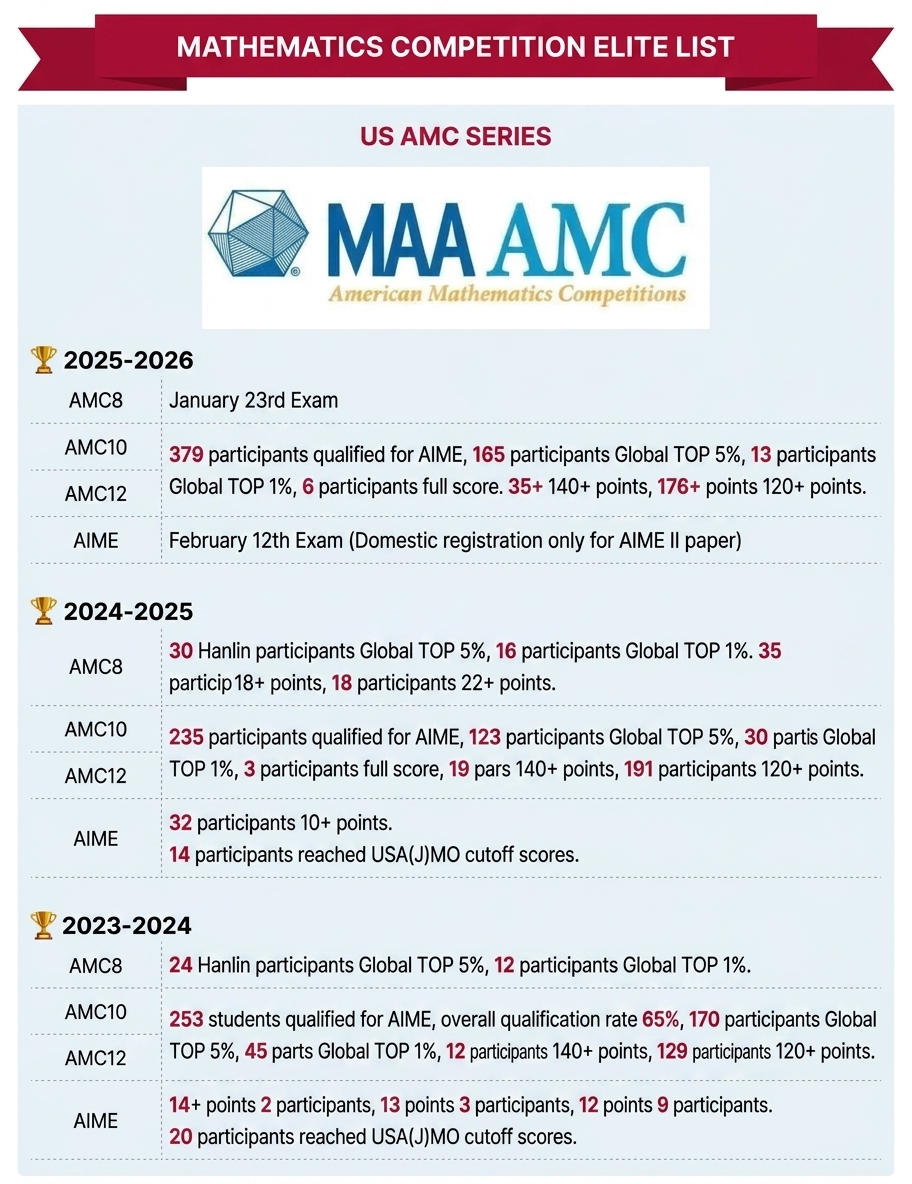
In recent years, the value of AMC8 math competition scores in China’s middle school admissions process has become increasingly prominent. A high AMC8 score report has become an important reference for many prestigious middle schools when screening students. This math competition from the United States has attracted widespread attention in China’s education circles, especially in first-tier cities like Beijing, Shanghai, Guangzhou, and Shenzhen.
Whether it’s the highly sought-after “San Gong” (Three Public Schools) in Shanghai or the well-known “Liu Xiao Qiang” (Six Strong Schools) in Beijing, a high AMC8 score has become a crucial measure for screening students. Many quality middle schools use AMC8 scores as an important benchmark for evaluating students’ mathematical abilities.
I. Shanghai Region: AMC8 as a “Key” to the “San Gong” Schools
In Shanghai, AMC8 competition scores are particularly helpful for applications to three prestigious public schools: Shanghai Experimental School, Shanghai Foreign Language School Affiliated to SISU (SFLS), and Pujiang Foreign Language School (collectively referred to as the “San Gong” schools). The Shanghai Municipal Education Commission even explicitly stipulates that students ranking in the global top 1% on the AMC8 can receive a 5-point bonus in the entrance examination, while those in the top 5% can receive a 2-point bonus.
Actual admissions data shows that students successfully admitted to the “San Gong” schools often have excellent AMC8 scores. Based on past admissions data, an AMC8 score of 20 points or above is a strong competitive condition for applying to the “San Gong” schools.
These schools not only value AMC8 scores during the admissions process but also consider students’ English proficiency, forming a screening model known as “TOEFL Junior + AMC8.”
II. Beijing Region: A Bonus for the “Six Strong Schools”
The situation in Beijing is equally noteworthy. Recognition of AMC8 scores by quality middle schools such as the Haidian “Liu Xiao Qiang” (Six Strong Schools) has been increasing year by year. Data shows that among the students admitted to the Early Admission Program of the High School Affiliated to Renmin University of China in 2023, 35% had AMC8 scores of 18 points or above.
Beijing National Day School explicitly states in its recruitment requirements for technology specialty students that “those with AMC8 scores of 17 points or above will be given priority for interviews.” The average AMC8 score of students admitted to the Mathematics and Science Experimental Class of Tsinghua University High School in recent years has reached 20 points (global top 1%).
Many prestigious middle schools in Beijing, such as the High School Affiliated to Renmin University of China, Tsinghua University High School, and Peking University High School, have a large number of students participating in the AMC8 competition and achieving excellent results.
III. Successful Cases: How Ordinary Students Stand Out with the AMC8
Xie Weiye, a student with a strong interest in mathematics, had a systematic test preparation strategy. Another student, Xin Yi, demonstrated a different preparation path. Xin Yi typically did only two things after school: playing soccer and reading. He wasn’t particularly enthusiastic about mathematics, but on his teacher’s advice, he solved just one math problem a day, spending at most 10 minutes thinking about it. If he couldn’t solve it, he would look at the answer and try to understand the approach. This low-intensity, consistent practice ultimately earned him a spot in the global top 5%.
Looking at actual admissions cases, students successfully admitted to Shanghai’s “San Gong” schools typically had the following profiles:
Student A: AMC8 score of 20 points (Top 5%), no English certificates like TOEFL Junior, but possessed diverse talents such as Piano Level 10 and Calligraphy Level 8. Received an interview invitation from Shanghai Experimental School and was successfully admitted.
Student C: AMC8 score of 17 points, TOEFL Junior score of 850, served as a class squad leader. Received interview invitations from all three “San Gong” schools and was ultimately admitted to SFLS.
IV. Recognition by International Schools
AMC8 scores also hold significant value in applications to international schools. Many renowned international schools in Shanghai, such as YK Pao School, World Foreign Language School, Weiyu, Star River, and Xiehe, consider AMC8 scores during their admissions process. Some schools even use original or adapted AMC8 problems in their entrance exams.
For students planning to pursue an international educational path, AMC8 scores serve as an international proof of mathematical ability, laying the foundation for subsequent applications to U.S. high schools and colleges. High AMC8 scores can help students stand out when applying to international schools.
V. How to Plan Your AMC8 Preparation Reasonably?
Test preparation strategies for the AMC8 should vary depending on the student’s age group. It is not recommended for students in third grade or below to start preparing for the AMC8 too early, as their mathematical foundation is not yet solid. They should focus more on learning basic mathematical concepts.
Fourth and fifth grade is an appropriate time to begin preparing for the AMC8. Students can start systematically learning the knowledge points covered by the AMC8 and engage in targeted practice.
Sixth-grade students have already mastered most of the knowledge points tested on the AMC8. Their focus should be on improving problem-solving skills and test-taking abilities.
During the preparation process, consistently solving one math problem per day is more effective than cramming at the last minute. The AMC8 uses bilingual (Chinese-English) questions, which is friendly to Chinese students and also helps improve their English mathematical terminology.
From the perspective of academic advancement, the AMC8 is not just a competition; it is a valuable learning process that enhances logical thinking and problem-solving abilities.
AMC8 Preparation Courses
Our instructors are graduates from top global universities. With precise curriculum planning and comprehensive learning tracking, we ensure your score improvement and award-winning success!
| Class Type | Hours | Class Size | Start Date |
|---|---|---|---|
| Winter Break Class | 30H | 3–8 students | Consult teacher for details |
| Systematic Course | 20H | 1v1 / 3–8 students | Consult teacher for details |
| Problem-Solving Class | 20H | 1v1 / 3–8 students | Consult teacher for details |